II
In our last study we learned some things about the home of the planet Mercury,—that he wings his rapid flight so near our sun that it is with difficulty that we get more than a dim glimpse of him; we also learned where and when to look for his next appearance to us. As we wish all to become familiar with these worlds, we will spend another hour trying to fix in mind more clearly just where this planet may at all times be thought of.
When we remember that Mercury never gets more than twenty-nine degrees away from the sun, we realize that wherever the sun is, this planet is not far away. Could the light of the sun be shut off from our earth at any time during the day, we should see Mercury shining out not far from the sun. You can readily see that the only exceptions to this would be that when Mercury lay to the east of the sun, the planet would still be below the horizon, should we shut off the sun’s rays just as it was rising in the early morning; also, should the sun’s rays be shut off just at sunset at such a time as Mercury happened to be to the west of the sun, he would then have set before the sun, and so be out of the range of our vision. Let all fix in mind the fact that Mercury is always to be found in that part of the heavens where the sun is.
In these science studies with the INSTRUCTOR family, we propose to leave out such terms as will not be familiar to many of our circle, and to speak of the many wonders of nature, in language so simple, and make the subjects so plain, that every one may, by a little thought, become intelligent upon them, and be able to point out and describe to others the many interesting phenomena that are continually taking place in the heavens.
In our last study we told you that we should soon see Mercury twinkling in the gray light of the western sunset; and true to his promise, he was there. Last evening, also the evening before, we could not but admire his efforts to send his struggling rays through the still, bright light of early sunset, to say “good night” to us before he disappeared. Last night a heavy storm settled over our Wisconsin horizon, and hid him from view; and to-night I fear we shall also be denied the pleasure of seeing his face. By the time this article reaches you, Mercury will have swung in between us and the sun; and we shall not see him again until in April, when he will have reached a point so far to the west of the sun that he will rise earlier than the sun, and will therefore appear as a morning star.
If the reader will hold the accompanying diagram squarely before him, facing the sun, at noon, he will get a good idea of the different relative positions of Mercury and the sun. The circle in the center of the diagram, marked “S” represents the position of the sun, while the different disks represent the positions and phases of Mercury in his journey about the sun, as they would appear to us through a telescope if we could see this planet at all times. Beginning with the large black disk, which, in the diagram, illustrates the dark side of Mercury,—the side that must be turned toward us, as he passes between our earth and the sun,—let us follow the planet westward, or to our right, for a period of eleven days; and we shall then find him as represented by the crescent old moon in the first figure to our right; going on for another period of eleven days, we find him to the extreme west of his circuit, and presenting to us his half-moon shape, as represented in the disk marked “W” in the diagram. It will be readily seen that when in this part of his circuit, he must, as he, in connection with the sun, apparently sinks in the west, pass below the horizon before the sun; and being ahead of the sun in their apparent journey, he must rise in our eastern sky before the sun reaches that horizon; thus the planet is then a morning star.
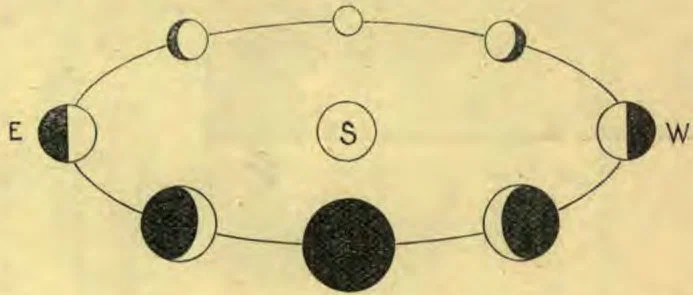
By noticing the diagram it will be seen that when Mercury reaches the point exactly opposite the sun from us, he shows us his full face, although his size at this time has apparently greatly diminished, owing to the fact that he is now nearly seventy-two millions of miles farther away from us than when we saw only his dark side, as shown by the large disk in the diagram.
In twenty-two days from the time when we see his full face, as just described, he will have passed to the most eastern portion of his circuit, and will appear as represented by the half-moon disk in the diagram, marked “E.” It was at about that point that I caught him last evening and the evening before. Twenty-two days later he will have returned to his starting-point, between us and the sun, having passed through all the phases illustrated above, enjoying the different seasons of spring, summer, autumn, and winter, and accomplishing the whole journey of some one hundred and seven million, eight hundred and seventy-five thousand miles in exactly eighty-seven days, twenty-three hours, and twenty-five minutes. Thus you see that he has traveled at the rate of about one hundred and nine thousand miles each hour.
In some future study we will learn more of the wonders of this world, whose home seems to be in the very chariot of the sun itself.
Dr. O. C. GODSMARK.