Light and Shade
A careful study of the varying aspects of water at different times of the day, and under different conditions, should be made, in order to become familiar with the reflections, and their appearance and disappearance with the slightest breeze. Notice how, in a strong wind, every wave on a river or lake seems made up of innumerable little waves, crossing and recrossing the larger one. These require the most accurate drawing to represent them fairly. Those who live near the seashore have an opportunity for many interesting studies.
Shading in drawing is a finishing touch. It gives solidity and color to the objects in the drawing.
Shades and shadows, being simply the partial absence of light, have no substance; but in drawing they are treated as solid forms. It is not necessary, however, to make the light and shade in a drawing of the same brightness and depth that it is with the real object. This is usually impossible. It is only necessary to keep the relative proportion of light and shade correct. The sun is many times brighter than the whitest paper, and the deepest shades in nature are much darker than the blackest pencil; so we must let the highest light be represented by the whiteness of the paper on which our drawing is to be made, and the lowest, or deepest, shade be represented by the blackest mark we can make with our pencil. These are the two extremes beyond which it is impossible to go; yet both of these extremes may be used to represent our subject truthfully, by keeping the relative proportion of light and shade correct. Between these two extremes all the different shades must be included. Some of the prettiest drawings are made by keeping all the shades and shadows lighter than the extreme black, and all the other shades in proportion.
Always look first for the broad masses of light and shade (these are best seen through the half-closed eyelids, as explained in a previous article); then the shades of the parts will be comparatively easy to manage.
Care must be taken not to mistake color for shade. The two are quite independent of each other, and should not be confounded. Close observation is sufficient to detect both.
There will be a tendency at first to make the shading too light. This fault may be overcome by marking in a part of the deepest shading at first, so that the two extremes of light and shade will be before the eyes, to assist in judging the values of the remaining shades. A shadow is darkest nearest the object that cast it. Care must be taken not to go to the extreme of putting shades in impossible places, or shadows where they do not belong. Nature does not do this, and she is the best guide.
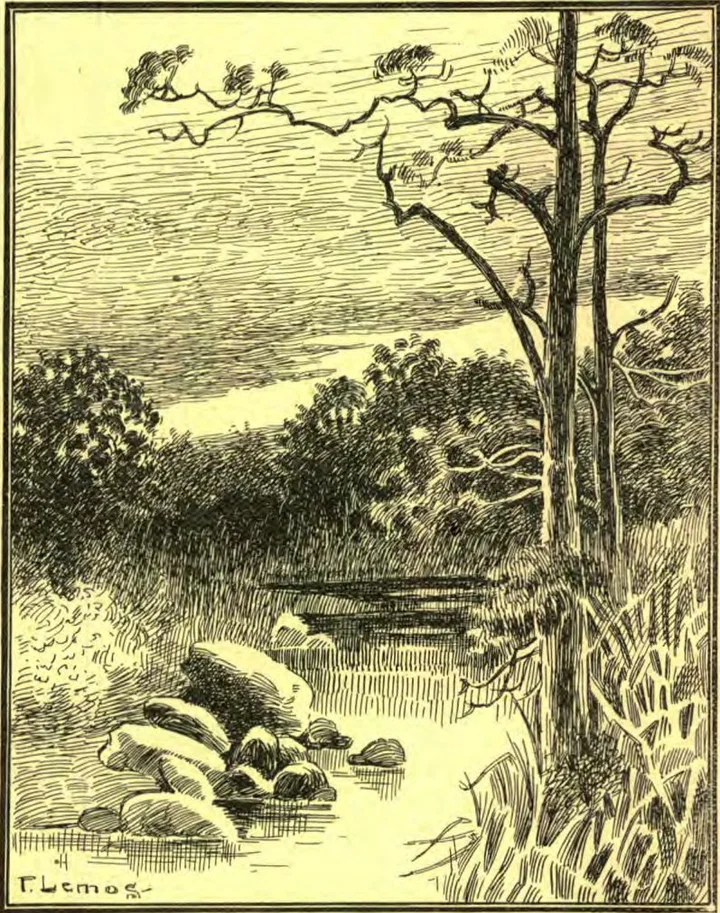
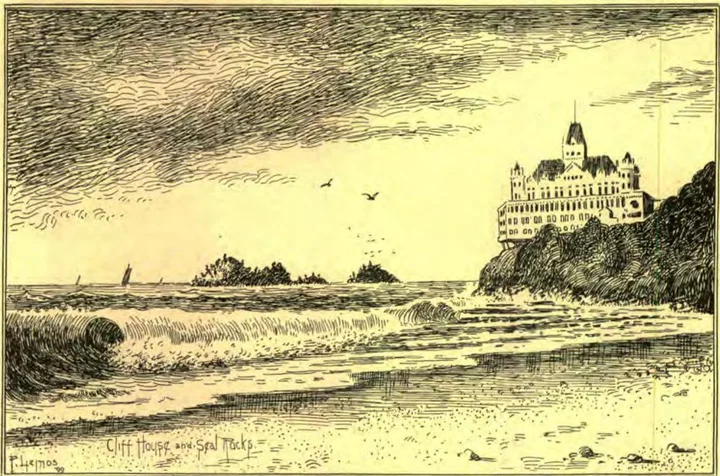
Strictly speaking, there is no outline in nature. That which we commonly call an outline is the dividing line between two shades,—the ending of one shade and the beginning of another. Notice how the fields, hills, woods, etc., are merely patches of shade and color, that end more or less abruptly.
There are three general grades of light in shading,—bright light, half-light, and diffused light.
Bright light is direct from the sun. In bright light the shades are comparatively light, and the shadows dark.
When the sun is partly obscured by haze or light clouds, the light is called “half-light.” In half-lights the shadows and shades are about equal in depth.
Diffused light is the light of an ordinary room, or of a cloudy day. In diffused light the shadows and shades are not defined; they are indefinite, and blend together. A diffused light is usually preferred by artists, for the reason that it does not contain strongly defined lines and edges, or strong contrasts of light and shade; but it is best for the beginner to draw objects in the bright and half-lights, as the shadows and shades then possess a definite form, and can be easily seen.
PEDRO LEMOS.