PLANT LIFE IN WINTER

6%

Review and Herald Publishing Company · Battle Creek, Mich. · Mar 15, 1900

FromThe Youth’s Instructor, Vol. 48, No. 11.

Read the full edition

PLANT LIFE IN WINTER

In the last article we spoke of the cells of plants and their protoplasmic contents. We have learned that all plant activity and growth are due to the multiplication and action of protoplasm. There is, further, a remarkable action of the protoplasm in the interior of the cell itself. Just as the blood in your body is forever flowing through the heart, the arteries, and the veins, back into the heart again, thus making round after round, so in these cells there is, under a favorable temperature, a constant streaming of the protoplasm.
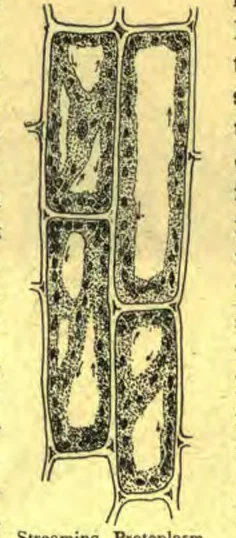
Often protoplasm is studded with minute, dark granules called microsomata. These granules are seen “driven backward and forward with the stream, like particles of mud in turbid water,” and their motion reveals the motion of the protoplasm in which they lie. There is often more than one current in the same cell. “Granular currents flow hither and thither, now uniting, now again dividing. They often run in opposite directions, even when only a trifling distance apart.” In the drawing (see following page) the direction of these currents is indicated by arrows.
I have mentioned this streaming of protoplasm in plants, in order that we may study what happens when a plant freezes, and see how hard it tries to keep from freezing. Professor Kerner, of Germany, has given us some observations made with the Nitella Syncarpa, a plant growing in the clear water of lakes and pools in Central Europe. When this plant is exposed to a temperature where water freezes, its vital activity is not disturbed. The streaming of the protoplasm in the cells is still very active; and even if, by further cooling of the surrounding water two degrees centigrade, needles of ice are formed, the streaming of the protoplasm may still be recognized. The cells are somewhat crowded and compressed by the ice-needles, but even at three degrees below zero centigrade, the protoplasm is never killed.
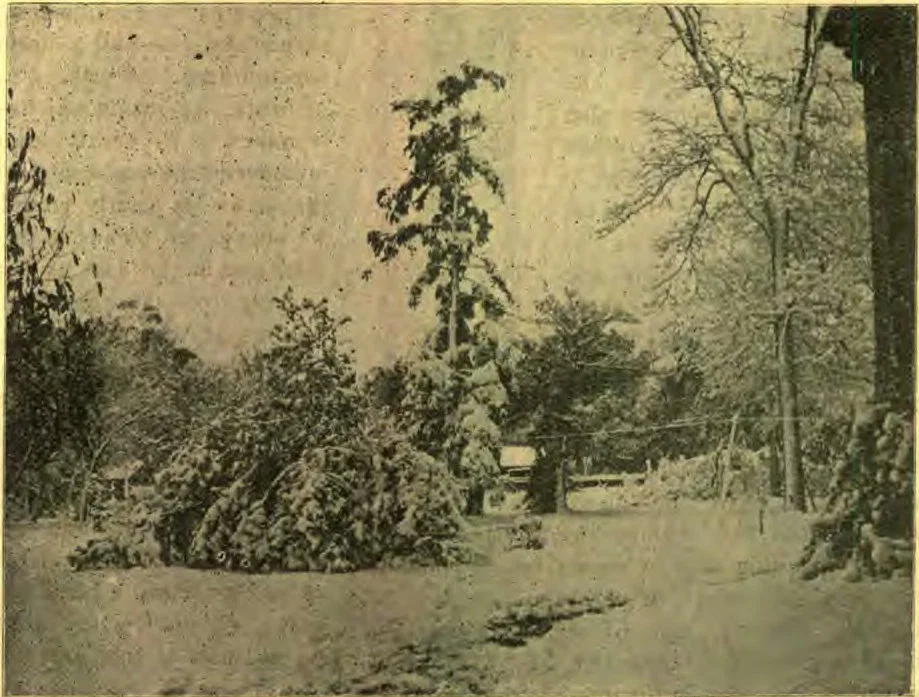
“LOW THE TREES BEND THEIR HOAR HEADS.”
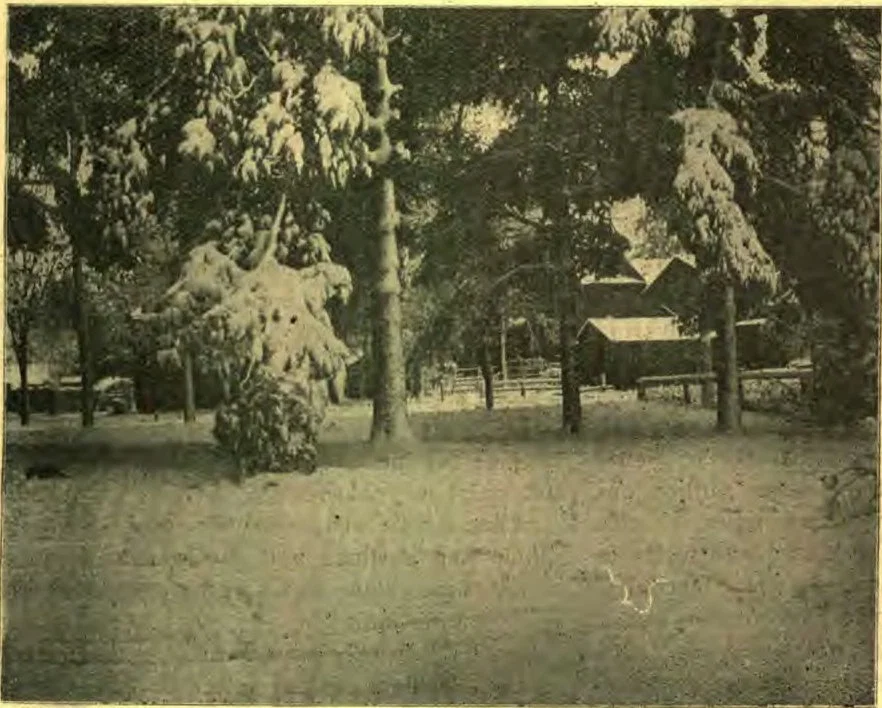
“THEIR WINTER ROBES OF PUREST WHITE.”
The water in ponds or lakes, if it remains fluid, never gets colder than this, and near the bottom it may even be warmer; so we see that this little plant is safe from freezing if it does not get too near the surface, where the water turns to ice. But if this plant is exposed to a temperature of −4°, its cells first begin to shrivel up, give up a portion of their water, shrink away from the cell-wall, and make a folded contracted sac in the center of the cell; while the water around it— between it and the cell-wall—stiffens into ice. The protoplasm is dead. When exposed to a warmer temperature, the ice melts, and the protoplasm expands, and lies close to the cell-wall; but it is incapable of again producing the streaming movement; it has ceased to live.
What I wish you especially to notice is the fact that the protoplasm never freezes without first squeezing out some of the water in itself. This water flows out into a space between itself and the cell-wall, so that we have, looking from the outside of the cell, a sphere, or ball, of fairly hard material called the “cell-wall;” inside of this lies a second shell, so to speak, of water; and in the center of this is the little sac of protoplasm.
If the temperature does not become so cold that the water from the protoplasm is frozen solid, the protoplasm will come to life, if slowly brought back to a warmer temperature. Why is this water squeezed out of the protoplasm when the cell gets cold?—Because the water is what turns to ice; and should the water, while still in the protoplasm, be turned to ice, the protoplasm would at once be killed. In order to adapt itself to a cooler temperature, and still not die, the protoplasm squeezes out this water; then the water may have many crystals of ice all through it, and still do no special harm to the protoplasm. But if the weather grows colder, the water freezes solid, and the protoplasm dies of cold.
You know that salt placed on ice in winter will often cause it to melt when clear water is quickly frozen solid. In the same way, brine, or salt water, will not freeze until the temperature has passed far below the freezing-point; if at last it does freeze, the water separates from the salt before it becomes solid. So with the protoplasm. Like salt water, it will not freeze when ordinary water is turned to solid ice; but when the weather gets colder and colder, the water separates from the protoplasm; and when this water freezes, the plant dies.
You know that some plants can stand much more cold than others. For instance, water freezes at the freezing-point; with a little salt added, it freezes at a somewhat lower temperature. The more salt in the water, the lower its freezing-point. The water of the Greenland Ocean freezes at a temperature three and one-half degrees below that necessary to congeal clear water. “When concentrated till its specific gravity reaches 1.1045, sea-water requires for its congelation a temperature eighteen degrees lower than the ordinary freezing-point.”—Tyndall. In a similar manner all protoplasm does not freeze with the same amount of cold. House plants will not live where apple and cherry trees are uninjured. Peaches will freeze where evergreen trees flourish luxuriantly.
The stone pine and the shore pine can not bear the frost of winter, while the arolla pine and the Bhotan pine flourish in regions where the trunks and acicular leaves of all the trees are cooled down for weeks to four degrees below zero Fahrenheit, or thirty-six degrees below the freezing-point of water.
Streaming Protoplasm
On the summit of a fairly high sand-hill, over which the icy north and northeast wind swept almost uninterruptedly, a plant of scurvy-grass was observed by travelers on the northern coast of Siberia. “This plant had begun to bloom in the summer of 1878, and had also partly developed fruit.” When the winter began, however, it still possessed ripe fruits, flowers, and flower-buds, as well as succulent green foliage leaves. It was to be expected that during the long winter, under the influence of continuous cold, the delicate succulent tissue would be completely destroyed. In the summer of 1879 the plant, whose tissue had without doubt been cooled down for a long time to twenty-two degrees below zero Fahrenheit, or eighty-six degrees below the freezing point of water, began once more to grow, and continued the growth from where it had been interrupted at the beginning of winter. The leaves resumed their functions as in the previous summer, the flower-buds opened, and new inflorescence sprang from the axils of the leaves, proving that the protoplasm of this plant had not been killed, even by a temperature of fifty-one degrees below zero, or one hundred and thirteen degrees below the freezing-point of water!
Myrtle and orange trees freeze dead in a temperature from four to seven degrees below the freezing-point; cypresses and fig trees at from twelve to sixteen degrees; vines at thirty-eight degrees; oaks and beeches at forty-five degrees; apple and pear trees at fifty-nine degrees; and plum and cherry trees at fifty-six degrees.
L. A. REED.