SOME OF OUR TOOLS

9%

Review and Herald Publishing Company · Battle Creek, Mich. · Jun 8, 1899

FromThe Youth’s Instructor, Vol. 47, No. 23.

Read the full edition

SOME OF OUR TOOLS.

In our last lesson we named the articles that we are to use in sewing; we will now tell something about how each is made. First let us examine the needle. The sewing-needle is made from steel wire, which is cut from coils into pieces about twice the length of a needle. After being straightened, the pieces are ground to a point at each end, and flattened in the middle; on this flattened portion two small dents are made to mark the places for the eyes, which are drilled by machinery. They are then cut in two, hardened by being heated and dipped in oil, and tempered by again heating and cooling. After being scoured, rounded, and polished, they are sorted, folded in papers, and labeled ready for sale. Simple as the needle is, it passes through the hands of a hundred workmen before it is finished.
Thread is “a slender cord composed of two or more yarns or filaments, as of flax, silk, cotton, or wool, twisted together.” That made from the flax-plant is called linen thread, and is very strong. This plant grows to a height of two or three feet, and has a delicate blue flower. The stalk of the plant is hollow, and consists of a woody portion, called the boon, and a fibrous portion, from which the thread is made. If a fine fiber is desired, the stalks are pulled up by the roots as soon the leaves begin to fall off, and the bottom of the stalk becomes yellow. By waiting until the seeds are ripe, seeds for oil and a coarse fiber are obtained. After being dried in the sun, the seeds are removed, and the stalks soaked in water to loosen the fiber from the boon. The fibers are dried and run through rollers, to break the boon. Then they are combed out, and the wood is removed by machinery. The flax is then ready for the mill, where it goes through many processes before the finished product is spooled.
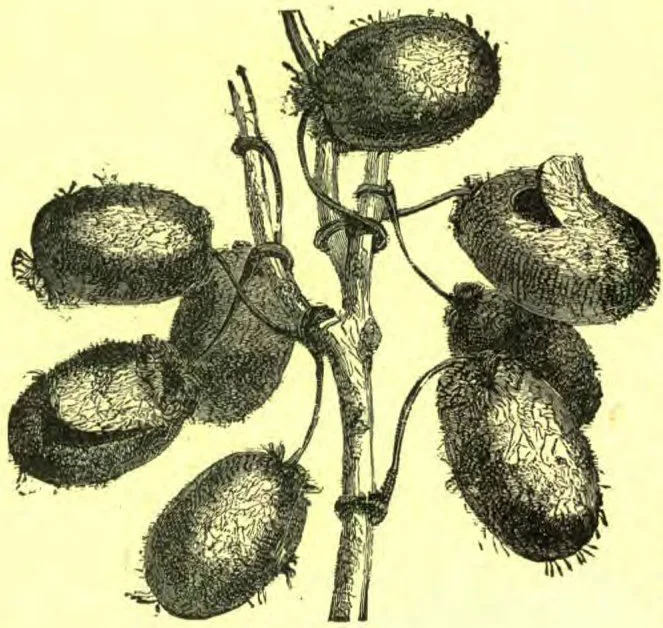
Silk thread is made from the cocoons of the silkworm. Each cocoon contains one fourth of a mile of thread, which is so fine and delicate that it is necessary to reel the threads from four or more cocoons together. In order to keep the threads of the moth’s silken house unbroken, the cocoons are subjected to heat sufficient to kill the little builders inside. It is said that to furnish material for forty yards of silk, over one hundred thousand of these tiny creatures perish. Silk is the strongest of all fibers used for weaving.
COCOONS.
COCOONS.
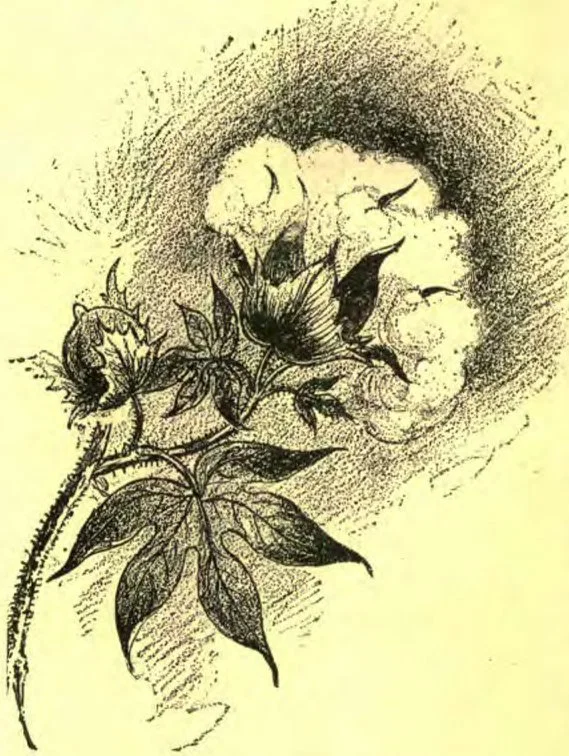
Cotton thread is made from the cotton-plant, which grows on plantations in warm countries. The seed is sown in March and April, and early in June the plant begins to bloom. The blossom resembles that of the hollyhock, and changes its color, being a pale straw-color in the morning, pure white at noon, pale pink at night, and a bright pink the next morning. At the close of the second day it is a light purplish red. After the flowers fall, the pods, or bolls, grow rapidly. When they are ripe, they burst open, showing the fleecy cotton ready for picking. When thread is to be made, the yarn is doubled and twisted more than for weaving into cloth, as greater strength is required. It is then reeled off into loose skeins for washing, bleaching, and dyeing, after which comes the reeling onto the bobbins and the spooling. After an attendant has set the spool on the spindle, and attached the end of the thread from the bobbin, the machine runs the thread on evenly, without overlapping or leaving a hair’s-breadth between, and even adjusts its work with the same precision to the widening of the spool with every layer of thread. It runs on exactly two hundred yards, and at the right time and place cuts a slit in the edge of the spool, draws the end of the thread tightly into the slit, and cuts it off, dropping the finished spools into a tray, where they are labeled, and packed into boxes containing a dozen each.
COTTON BLOOM.
COTTON BLOOM.
Pins such as those now in use were not known in ancient times; but thorns, and bone, wooden, gold, or silver skewers were used to fasten the clothing. In the sixteenth century, when pins were first manufactured, they were so expensive that only the rich could afford to buy them. When first made in the United States, a paper of pins cost one dollar; but pins in many sizes are now made by machinery, and can be bought for less than five cents a paper.
Scissors are made in many sizes and styles. Every pair over six inches long should be called shears. Those made of steel are made almost entirely in Germany. In this country iron, with steel for the inside edges, is used. Nearly all the work in making scissors is done by hand, the process depending somewhat upon the size. Each pair passes through the hands of fifty or sixty workmen before it is finished.
In last week’s paper you read something about thimbles. They are made of celluloid, aluminum, silver, and gold, with open or closed tops. The little dents on the surface are made to hold the head of the needle firmly.
Do not be satisfied with this brief description of the articles we shall use oftenest in our work. If you can, read further on each subject, especially about thread-making and the working of the little silkworm. NELLIE V. DICE.