WHY LEAVES FALL

6%

Review and Herald Publishing Company · Battle Creek, Mich. · Nov 30, 1899

FromThe Youth’s Instructor, Vol. 47, No. 47.

Read the full edition

WHY LEAVES FALL

I DO not know that I can explain to you much about this mystery of the fall of the leaf, for mystery in a large degree it is; but I will try.
You will know, if you stop to think, that a tree or plant obtains its moisture from the soil through its roots. This water, drunk up out of the soil by all the tiny rootlets, passes into the roots, and up the stem or trunk to all places where it is needed; and in time much of it passes out of the leaves in their breathing process. When the weather is right, this inflow and outflow of water is perfectly balanced, and the plant keeps moist inside, and fresh and green to the eye.
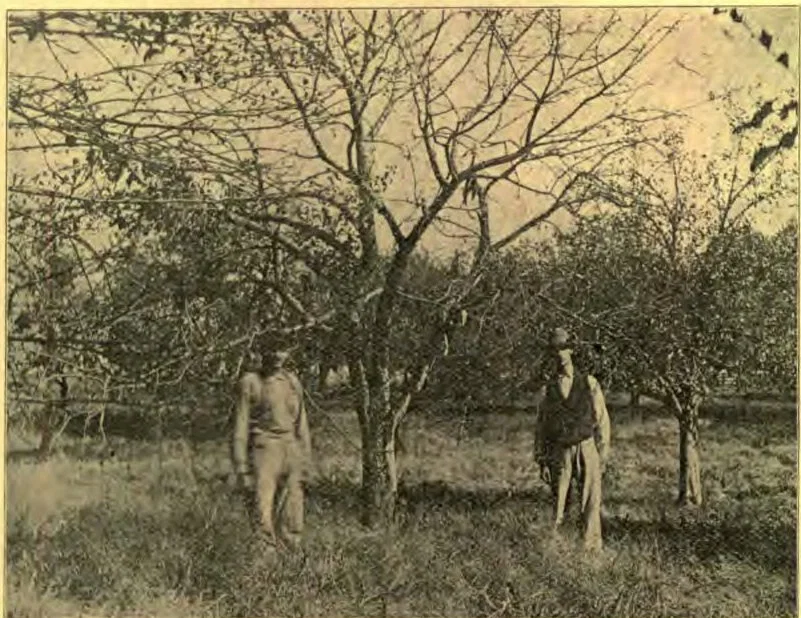
APPLE-TREES IN AUTUMN.
But when the weather grows colder, the roots become apparently chilled, and do not drink up water fast enough. But the water in the tree passes out through the leaves just as fast as ever. You can see that the tree would soon dry up at this rate, if something did not happen: but something does happen.
The leaves can not pull themselves off the tree; but as they are losing more water than the tree is able to get, they must be got rid of. As if the tree knew this was all going to happen, sometime beforehand a little something begins to grow at the place where the leaf is fastened to the tree. It grows right across the stalk and separates it, or cuts it quite in two. I can not make you realize how strong this little layer of cells is, that it can grow this way, and cut the petiole, or leaf-stem, in two.
But now that the petiole is cut in two, it hangs ever so lightly. If the wind blows, or the tree is shaken, down comes the leaf; but if no wind blows, the leaf will fall, after a while, of its own weight.
The place where this separation takes place looks as if the stalk had been cut through with a knife. In some trees it takes but a few days for this operation to take place; in others it may take a number of weeks.
It is also worth mentioning that in some trees the leaf-fall begins at the top of the tree, and gradually proceeds downward; in others, it is quite the contrary. In ashes, beeches, hazels, and some others, the apexes of the branches are leafless when the lower parts are still covered with foliage; in willows, poplars, and pear-trees, on the other hand, the lower portions of the branches lose their leaves early in the autumn, the loss of the leaves extending gradually toward the top.
Thus the tree gets rid of its leaves; and now, since but little water is lost, the roots, though in the cold they are not able to work as actively as in the summer weather, are able to keep the tree supplied with what little water it may need. In fact, the tree needs but little at this time.
It is true that some plants, like corn and wheat, die when they have lived a year; but not so with the oak and the maple and many other plants and trees. These do not die when winter comes, but they do go to sleep. Like bears and some other animals, they sleep through the cold months.
If you look at a tree at such a time, it appears dead. Its branches are all bare; it seems to have no life. But there is life there, and next spring will prove that the tree was not dead, but only asleep. During the winter the sap no longer flows in the stem. The little rootlets do not gather water for the sap now; they are quiet; they, too, have gone to sleep. There are buds all over the tree, but they are closely wrapped in warm blankets, and are all fast asleep. The winds rock them back and forth in their winter cradles, but they never wake till the warm spring sunshine calls them from their winter beds.
“How much life there is asleep in that tree! The buds are all there, which are to make all that you will see on it next summer. They are covered up snugly from the cold in their winter coats. The little things are very still, but they are alive. They only want a warm sun to make them show it. As soon in the spring as they feel the warmth through their coats, they begin to swell, and soon open their coats, and go to work to make leaves, and flowers, and fruits. A great work they do after their long winter sleep. Look up into a tree in summer, and see how these leaf-buds have filled every branch with leaves. You can hardly believe that it is the same tree that you saw so bare in the winter.”—Hooker, pages 132–133.
If we would know how much life there is covered up in the earth in winter, we have only to watch the opening spring days. The things that come then in so short a time,—the plants that spring out of the earth and flower so speedily, the leaves that cover the trees so thick and green,—all this life was not dead, it was only asleep, and needed but the touch of the sun, warm and tender, to call it all forth.
L. A. REED.