To the Hollander there is no place in the whole world so dear as Holland. It is the land for which he has fought and must ever fight; for right there before him, winter and summer, year in and year out, making constant warfare, is his great enemy, the sea.
But the Dutch are good fighters, and this enemy is met with those tremendous bulwarks, the dikes. These dikes, built with piles made from trunks of immense trees driven deep in the earth, and surrounded by solid masonry of granite and cement, form, as it were, great walls behind which the people live. Outside, these slanting walls are covered with flat stones in such a way that the harder old ocean beats and lashes against them, so much firmer they become.
Inside there are steps leading to the top, where the space is ample for buildings, carriage-roads, etc. Of course there are windmills here too; for Holland wouldn’t be Holland without them, and they are seen not only on the dikes, but everywhere else. They are used for draining the land, the lakes, the rivers, for making oil, grinding rock, cleaning grain, sawing wood, making starch, rope, paper, mustard, flour, meals, paste, etc. Sometimes they are grouped together, and sometimes they stand alone. Even a man’s wealth is often estimated by the number of windmills he has. A lady stopping once to watch them in a town containing four hundred, said it seemed, when their great arms went round and round and round, almost as if the whole landscape were in motion.
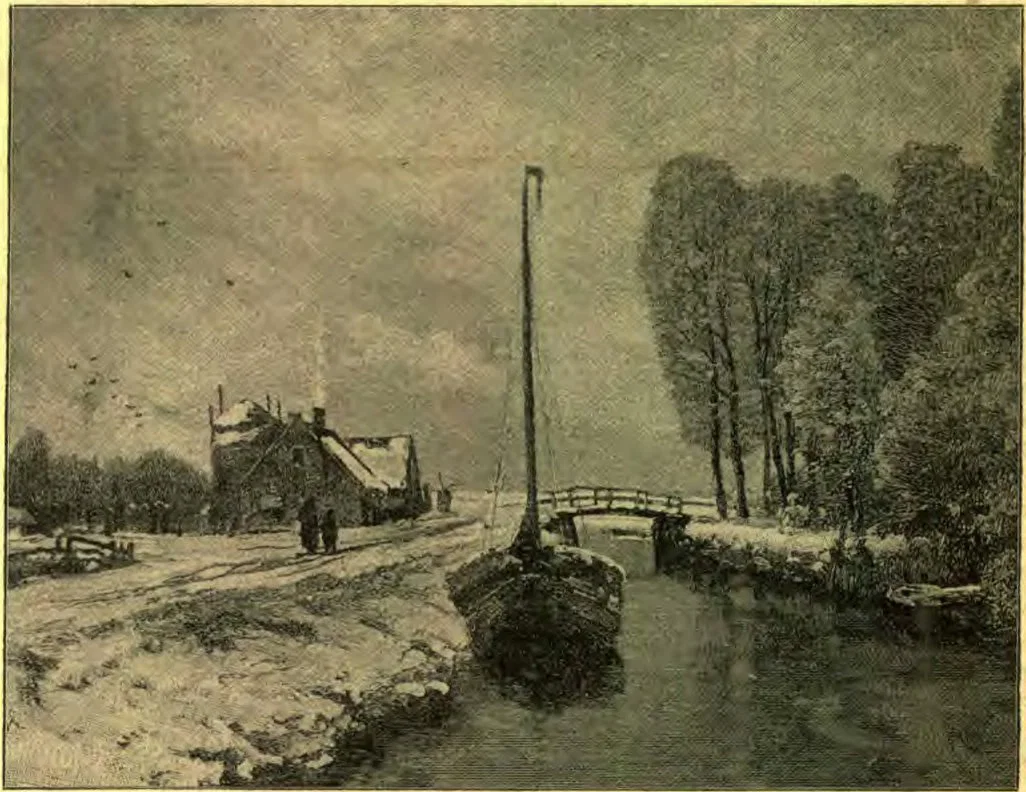
WINTER IN HOLLAND.
There is perhaps nothing the Hollanders enjoy more than their canals, which penetrate, in every direction, not only the country, but all the cities and villages, making veritable watery roadways. They are picturesque, too,—bordered with lovely trees and quaint tile-roofed houses, and crossed by numerous bridges. Many kinds of boats sail these waters, from the pleasure-boat of “Mynheer,” which he fastens near his house as an American does his horse and carriage, to the water omnibus, carrying passengers, and freight-boats, carrying anything one needs to buy for the home. But however much enjoyment is found in the boats, it is tame compared with the fun when the canals are frozen. Here the click of wooden shoes is forgotten, for everybody skates: old men and old women, youths and maidens, boys and girls; the men to business, the women to market, the doctor to visit his patients, the schoolmaster and the children to school, and everybody to church on Sunday.
Turn to your histories, and read how the Dutch soldiers conquered the Spanish because the latter, though knowing much about fighting, did not know how to wage war on skates. Then when you turn to your art books, and study of Rembrandt and Steen and Paul Potter, do not forget that Holland gave them to us.
Holland has well been called a queer country, but a more interesting one cannot be found. The Hollander loves his pipe, his ale, his cheese; but on a kinder-hearted people the sun never shone. Even the birds seem to understand that not only are the children taught from infancy not to disturb them, but that the law protects them as well.
Nowhere can the storks find more peaceful homes than in Holland. From this people, who are often called slow, but who, to protect their homes, have fought the waves with a perseverance and endurance elsewhere unknown, we can all learn lessons of patience and pluck. — Miss M. L. Butler, in the Wellspring.