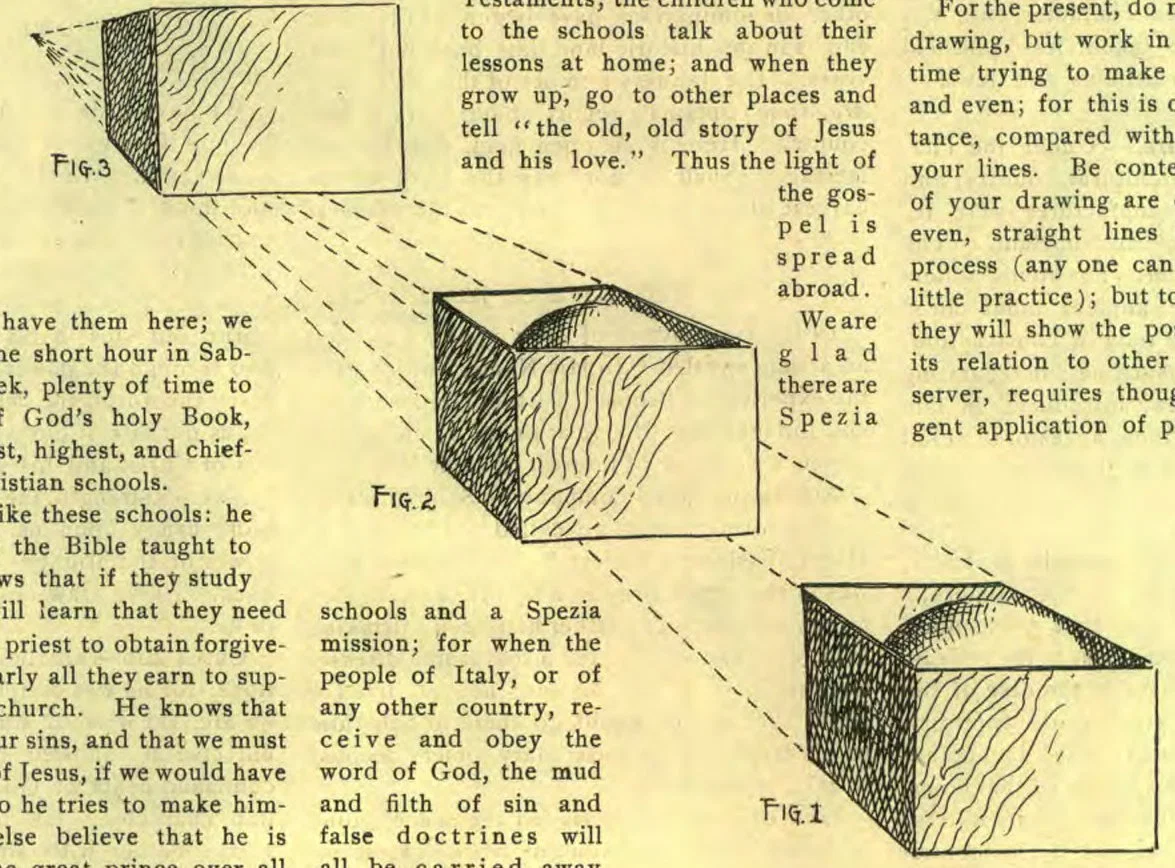
Now that we have studied the principles of perspective, we will study the relative perspective of different objects; for the perspective of curves and that of straight lines are separate studies.
Suppose you take paper and pencil, and study the perspective of certain objects around you. Paper that has a rough surface, and a soft pencil, are best to use in drawing. Do not sit too near the object to be drawn, but if possible, three or four times its height away. To sit farther away will do no harm; but to sit nearer will bring you so close to the object as to put your drawing in what is called “violent perspective.”
For the present, do not attempt to shade your drawing, but work in outline. Do not spend time trying to make your lines very straight and even; for this is of only secondary importance, compared with the proper direction of your lines. Be content if the principal lines of your drawing are correct. The making of even, straight lines is merely a mechanical process (any one can make such lines, with a little practice); but to place your lines so that they will show the position of the object, and its relation to other objects and to the observer, requires thought as well as an intelligent application of principles.
Place objects in every position you can think of, and draw them; for you must get used to representing objects seen in difficult positions. In drawing a certain object, we might turn it so we could get a good view of it; but in drawing a roomful of objects, we must take them as they are. For instance, while we might move the objects on a shelf, we could not move the shelf itself. This is why we must practice drawing objects in all positions. We must study to see correctly; and in order to do this, we must study with thought. Try to draw correctly what you see, and do not be discouraged by criticism.
Many lack a knowledge of perspective; and this is one reason you will not always be able to make a perspective drawing that every one will recognize. When objects are above the eye, on the level with the eye, or below the eye, we get different views of them. For example, here is a box with a ball in it. When the box is below the eye, as in Fig. 1, it is easy to see the ball; but if placed a little higher, as in Fig. 2, we can see less of the ball; and when raised to the level of the eye, as in Fig. 3, or above the eye, it is impossible to see the ball in the box.
Suppose you see the box as in Fig. 3; and while you are sitting down drawing, some one enters the room, walks up to the shelf, sees the ball inside the box, and asks you where the ball is in your drawing. You have to say, “I am making a picture of the box as I see it; I can not see the ball, so I can not draw it.” To learn to look at a picture properly, we must be familiar with this fact of perspective,—that, looking from one position, we can not see all the parts of an object seen from other positions.