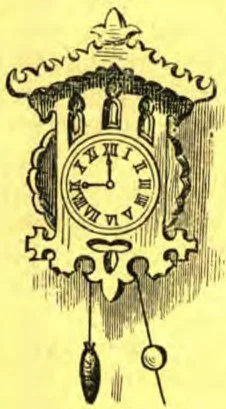
A “FIXED-UP” CLOCK

3%

S. D. A. Publishing Association · Battle Creek, Mich. · Sep 5, 1895

FromThe Youth’s Instructor, Vol. 43, No. 36.

Read the full edition

A “FIXED-UP” CLOCK.

“What’s the matter with this old clock, Uncle Lee?”
The question came in muffled tones from the attic, where George was “rummaging.” “What?” said Uncle Lee—uncle by courtesy, only, to George as well as to half the other boys in town. Then Uncle Lee said “what” again. It was a way he had of hearing with one ear only till he got ready to hear with the other. Now he came to himself.
“O!” His voice changed when he saw what George had. “That stopped the night my mother died, and I never could get it to go since.”
“You don’t know how to fix clocks, I guess,” said George. “Let me fix it; I always fix my grandma’s.” George was sixteen, and he spoke with the assurance of a master-workman in a clock factory.
Uncle Lee hesitated a moment, and looked the lad over. Then he thought: “May be he can fix a clock,” and added aloud: “Try it if you like; but don’t break anything, boy.”
So George lifted the clock out of its box, and took it down stairs. He “fixed” it all the rest of the day, and then went home. The clock refused to go.
A few weeks later Herbert Blackman came in from the country, and saw the wheels lying around where George Stuttle had left them.
“Hello! What have you been doing to your clock?”
“I have not been doing anything with it. George wanted to fix it when he was here, and that’s the consequence,” said Uncle Lee.
“George Stuttle—fix a clock! You must be crazy to let that great big moose touch clock-wheels”—Herbert was small! “Let me fix it, and I’ll show you how a clock ticks.”
“Very well, Herbert; fix it,” answered Uncle Lee quietly.
So Herbert “fixed” the clock industriously till his father drove down in the evening to take him home, at which time there were almost as many wheels in his head as there were on the table.
Then the poor old clock lay undisturbed till one day Herb White dropped in to see Uncle Lee.
“Did your clock go off like the ‘one-hoss shay’?” inquired Herb.
“No; it only wouldn’t go, and so George Stuttle and Herbert Blackman each tried to fix it. Poor boys!” laughed Uncle Lee. “They did their best, but you’ll have to take my word for it that it’s a clock.”
“Is it possible, Uncle Lee, that you let either of those boys meddle with a clock?” exclaimed Herb, with unspeakable scorn. “I just wish you’d let me try. I know how to fix clocks.”
“Go ahead, by all means.” This time Uncle Lee’s eyes twinkled.
“May be you think I can’t fix it,” said Herb indignantly; “but I’ll show you, in a jiffy.”
Uncle Lee had business in the town that day, which kept him away most of the afternoon. When he came back, Herb, with flushed, nervous face, was still at the clock.
“Pretty long jiffy,” remarked Uncle.
“Blame the thing!” snarled Herb; “the witches are in it, I know. It just won’t go together,” and he shoved away from the table, giving a most ungentle creak to his chair. So the clock wasn’t “fixed” any more that day.
But a few days afterward Herb’s older brother, Manley, walked in, and Uncle Lee told him about the clock. Manley gave the wheels and cogs a comprehensive and comprehending glance,—he was nineteen, or thereabout,—and made a few wise remarks on the absurdity of letting boys fuss with such delicate things as clock machinery; but he ended with, “I’d like to try it, though, if you’ll let me.”
So Manley “fixed” the clock for several hours. He succeeded in fitting the pieces together quite ingeniously—so much so that the clock almost recognized its identity, and one part—it was an old-fashioned clock with weights—ran for three or four minutes. Then it stopped, stubbornly refusing another tick.
This time Uncle Lee stood the old clock on the mantel, where it stayed till another White boy, Fred, came one very cold day to stay all night. After awhile he said,—
“I never saw that clock before. Where have you kept it? and why doesn’t it go?”
“Go?” laughed Uncle Lee; “I should think it ought to run like chain lightning, it has had so much attention lately. First George Stuttle tried it; then Herbert Blackman knew he could fix it—you ought to have seen the pieces when he got through with it! Next your brother Herb mixed up the wheels some more, and finally Manley got it partially together. So there it stands—a victim of too much fixing.”
“If you’ve let all those fellows dive into that clock, you’ve got to let me! Manley and Herb think they’re awful smart—fix a clock, indeed! Manley couldn’t fix a door-knob, let alone a clock; much less could Herb. And as for George and Herbert, I am surprised that you should let them try.”
“Go ahead, do,” said Uncle Lee, as well as he could for laughing. “I think the clock can stand one more overhauling.”
So at it Fred went, merrily enough. “Won’t I crow over all those bungling fellows!” thought he to himself. He worked steadily all the afternoon, and till late in the evening. Still the clock refused to go. Finally he got up angrily, put on his hat and coat, and started off.
“May I inquire where you are going?” asked Uncle Lee politely. “Pray do not stop fixing the clock!”
“I’m going home.”
“What! four miles through this cold and snow, at this time of night!” exclaimed Uncle Lee, thoroughly sobered now, as he saw how seriously the boy was taking his defeat.
“Yes; I can’t stay. Good-by,” and away he hurried.
That was the last of the clock-repairing at Uncle Lee’s (though perhaps if there are any more boys who would like to “fix” the clock, they might be furnished with its address). The once-faithful timekeeper still refuses to give a tick; but as it stands on the mantel, those boys sometimes actually turn red in the face, it seems so audibly to shake its fat sides, and chuckle: “Don’t you think it’s better to know how to do a thing and not say much about it, than to say so much about it and not know how to do it?”
So perhaps the clock’s mission is a better one than just to tell what time it is.
MYRTA B. CASTLE.