BUILDING A COTTAGE

14%

Review and Herald Publishing Company · Battle Creek, Mich. · Jul 27, 1899

FromThe Youth’s Instructor, Vol. 47, No. 30.

Read the full edition

BUILDING A COTTAGE.

The Window-Frame.

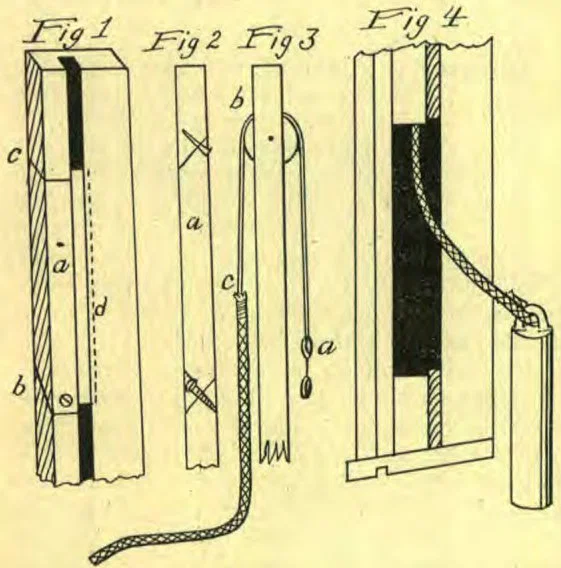
This week I will give some instruction about putting the pocket and weights into a window-frame. We will take the pocket first. Fig. 1 represents a portion of a window-jamb. You will see the jamb cut at b and c, and at the dotted line d, leaving a piece, a, which can be taken out. In Fig. 2 you will see the edge of the same jamb with the piece a in place. Run your saw into the jamb at b and c (Fig. 1), saw down to the check-stop groove at d, then split the piece out. From the piece thus split out, cut off about one fourth of an inch on the back, at the upper end; then drive the head ends of two sixpenny nails into the jamb for the piece to lie against. Afterward bore a hole, and insert a No. 10 seven-eighths-inch screw. See Fig. 2. When you are ready to put in the windows, take out the check-stop and screw, when the piece a can be removed. This piece should be out next to the blind-stop. In nailing on the blind-stop, be careful not to nail into the pocket, and thus prevent the removal of the piece a.
In Fig. 3 you will see the upper end of a section of a jamb, with a pulley inserted. This shows how to put in the cord, and attach it to the weights. The best cord for the weights is braided silver-lake cotton cord. It is very smooth and hard. To put this cord in place you will need a piece of fine linen cord about the size of a fish-line. To the ends of this attach two small lead weights, as shown in Fig. 3, at a. This apparatus is called a “mouse.” Attach the mouse to the weight-cord at c. Now put the mouse through the pulley at b (the weight of the leads will draw the cord down); then put your hand into the pocket, catch the mouse, draw the cord through the pulley, and tie it to the weight, as shown in Fig. 4. Next put the weight into the pocket. Bore a seven-eighths-inch hole about half an inch deep in the edge of the sash, one foot from the top. From this hole to the top of the sash plow a three-eighths-inch groove three eighths of an inch deep. In the end of the cord that goes into the sash, tie a single knot. Place the knot in the hole, the cord in the groove, and a No. 10 inch screw through the knot into the window-sash. Insert the piece a, put in the sash and check-stop, always letting the outer sash down to the window-sill; then you will have no trouble in putting the stop in place.
While we are on this subject, we will also consider the pitch, or slant, of the window-sill. It should be one eighth of an inch to the inch, which you will find by placing your bevel at one-half inch on the blade and four inches on the tongue. I trust I have made this so plain that you all understand it.
W. K. LOUGHBOROUGH.