Adam, when placed in the Garden of Eden, was given the care of all the beautiful things of creation. This Edenic perfection was only a sample of what God intended the whole earth should be eventually.
God placed in Adam such a love for the fair fruits and flowers that it was his chief delight to train the thornless roses and cultivate the luscious fruits. While sin has thwarted the original plan, and to some extent crowded that love for the more beautiful things of nature from his heart, man has not lost all that love; for we see it manifested all about us in flower gardens, shady groves, and green lawns, surrounding his dwelling-place. The flowers in nature’s garden possess just as much real beauty as those found in any cultivated garden, and we admire and appreciate them; yet how natural for us to covet a small portion of ground where we can train, nourish, and arrange to our taste these tokens of love.
My descriptions thus far have been of flowers that bloom in the winter and very early in the spring; for it is in the winter season that Mother Nature robes her gay daughters with the most lovely costumes. In this sunny clime we prefer to roam the hills and meadows for our wild flowers in the winter and spring; for when summer comes, with its long, hot, sultry days, we have not the ambition nor inclination to climb the hills and search the dales for flowers, but are content with those found in our dooryards.
California is noted for her exquisite roses; and what you read of them, even in a California journal, does not tell of half their beauty. From March till December the gardens are bedecked with all sizes and shades of them. Allow me to present to you our little friend Madame Cecil Brunner, who might be forgotten, were it not for her name and fragrance. This delicate little tea-rose is of a pink color, very double, and no larger than a common daisy. Her sister, Madame Falcot, is also one of our familiar friends. She is somewhat larger than the former, and of a different color, being robed in a vesture of purest gold.
The Rainbow is one of our largest and most fanciful roses. No words can describe it more perfectly than its name. The darkest color which is at the base of the petals is a rich amber, and changes to the lighter shades as it nears their outer edges. The Sunset resembles the one just described; it is a rich shade of gold, tinted with dark ruddy crimson. The Sofrano and la France are some of our most common roses, and are light yellow or buff and red respectively. We might continue with almost an endless list of roses, but must hasten to mention other of our friends of the flower family which are just as dear to us.
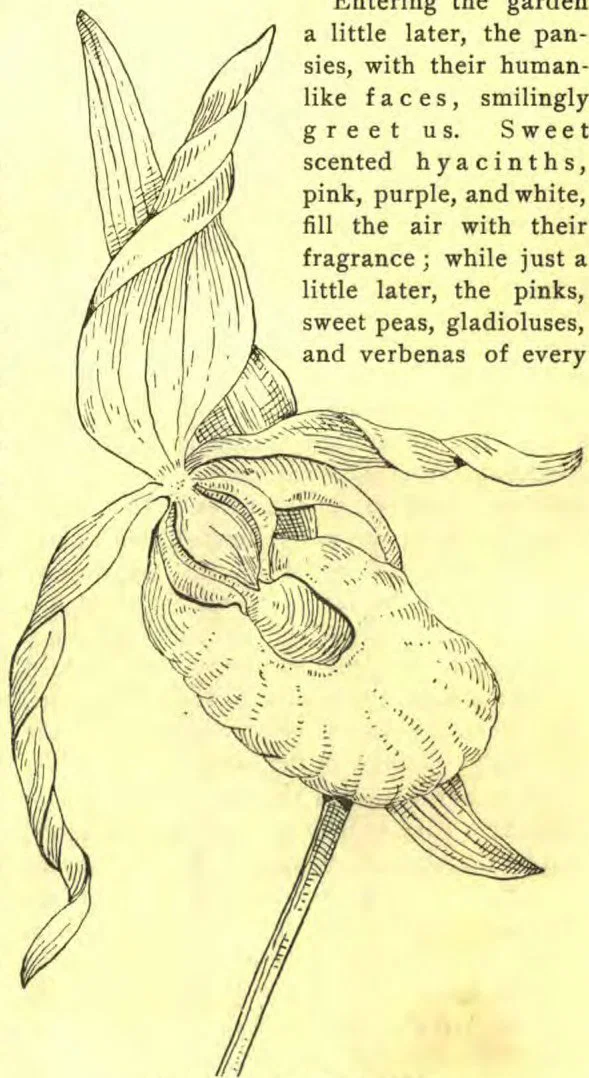
One of the oddest and fairest of our flowers is the lady’s-slipper, of which there are two kinds, the yellow and the stemless pink. While it is a rarity in our gardens, it may be met with frequently on rich wooded hillsides. To the imaginative there is something unearthly and fairy-like about this flower. The lip is a perfect pattern for the tiny foot of some elfin woman. When seen growing in the woodland, one might fancy the fairies of the mountain holding their summer revels there. Mayhap some fairy Cinderella has lost her slipper, unnoticed by the prince.
YELLOW LADY'S SLIPPER.
The violets, which are white, yellow, and blue, begin to bloom in January, and linger with us until they are gradually wilted by the hot rays of the mid-summer sun.
Entering the garden a little later, the pansies, with their human-like faces, smilingly greet us. Sweet scented hyacinths, pink, purple, and white, fill the air with their fragrance; while just a little later, the pinks, sweet peas, gladioluses, and verbenas of every234shade and tint, bloom in profusion. We must not omit mentioning the Fuchsia, as it grows a solid bank of floral loveliness upon the wall or in the open garden as a shrub; nor our geraniums, which beggar description for their luxuriant growth and endless varieties.
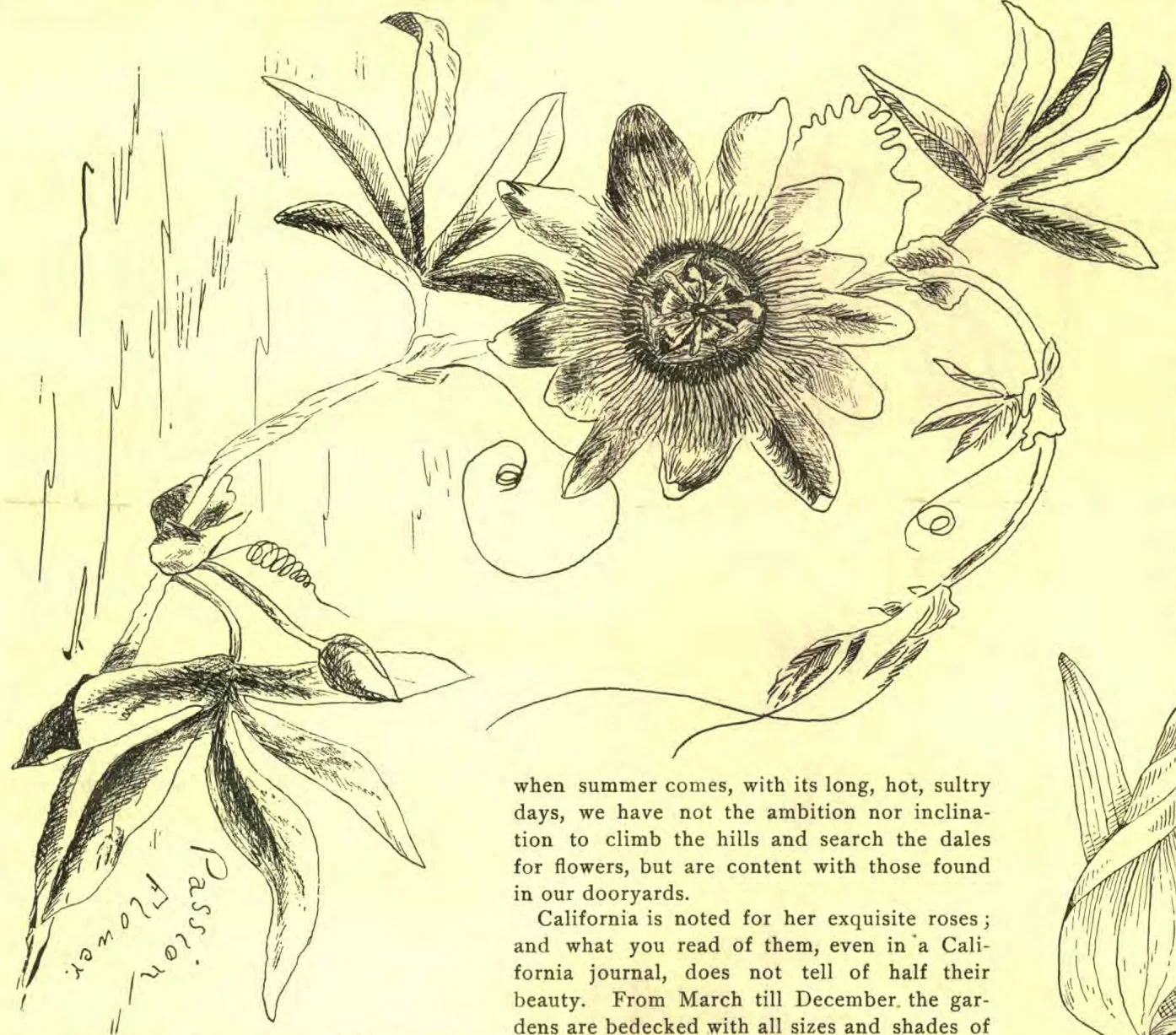
While the passion-flower is not attractive because of its beauty, its odd appearance makes it a favorite as well as a novelty. Its rapid growth is one of its striking characteristics. I have known the front of a large porch to be quite thickly covered in one season with the vines springing from a single cutting. The calyx of twelve light green sepals is surmounted by the corolla, a fringe of white, tinted beautifully with purple, in which the artist who named the flower saw the crown of thorns which surrounded our Saviour’s brow. Above rise the five stamens, supporting the anthers, heavily laden with their golden pollen. Fancy called these the hammers, while the three styles of the pistil correspond to the nails of the cross.
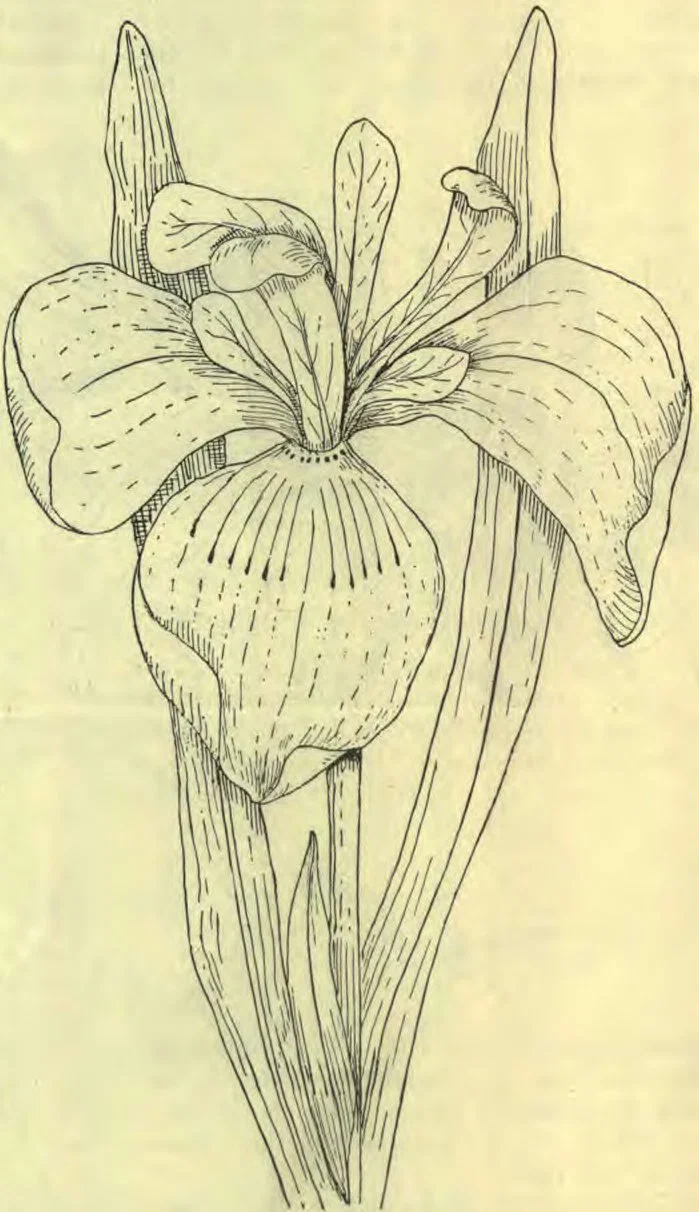
YELLOW FLAG.
Another of our early flowers is the Easter, or wax, lily, which grows upon a long stem from three to five feet high. The flowers bloom in a cluster at the summit of the stem, and are found from three to fifteen flowered. As we look upon them in their pure white robes, we can certainly say, “Solomon in all his glory was not arrayed like one of these.”
If there is one flower which blooms in California that seems to be favored above others, it is the china lily, which is found all over the State. It is either pure white or golden. Some are single and others very double. They begin to bloom in January; but if the bulbs are taken from the ground in November, and placed in water, they will blossom and continue to put forth their beautiful foliage throughout the winter months.
We lastly picture the common flag. Some may wonder why that homely flower is presented; for it has been referred to as “that old bog plant.” Should we examine it closely, we would find it a possessor of much beauty, which it does not hide in some dark corner of the earth, but seemingly self-conscious, parades not only in the broad light of every garden, but also in the open fields. While we number it among our tame flowers, it has doubtless spread as an assisted immigrant from our gardens to neighboring marshes, meadows, and ditches. This entire flower is a pale chrome yellow, shaded lightly with orange, and veined with a shading of gray. The name of the family to which it belongs was taken from Iris, the attendant of Juno, who personified the rainbow; and indeed little imagination is needed to see in its beautifully blended coloring what one has called the “veritable rainbow of the earth.”
What power lies in the subtle influence of flowers! They change a house into a home, and by their presence lighten the pain of the suffering. If under the weight of a curse of six thousand years is manifest such beauty, symmetry, and delicate loveliness, how can we even conceive of the glory of flowers in their pristine beauty and infinity of perfection! But stop—sometime ere long we shall behold them in all their former loveliness,—the everlasting flowers of which the angel said: “They shall never wither or fade.”