The Hawaiian, or Sandwich, Islands are situated near the middle of the North Pacific Ocean, about two thousand miles southwest of San Francisco, and three thousand five hundred miles from the coast of Asia. They have a delightful climate, the cool sea-breezes modifying the heat of the tropical sun, which otherwise might be too great for comfort. Casper Whitney, in Harper’s Weekly of June 17, says: “In point of fact, the climate of Hawaii is perhaps not excelled anywhere else on earth. Large enough, as the islands are, to have a character of their own, and still in no way to neutralize the peculiarly desirable quality of oceanic environment, the Hawaiian climate is midway between temperate and tropical; tender, yet not enervating; breezy, though not boisterous; with sunshine from which you need no protection, and a rainfall that does not become monotonous. A veritable land of sunshine and breezes, whose temperature you may vary as you choose, from sea-level up to Mauna Kea (13,805 feet) or Mauna Loa (13,600 feet). You may leave one side of an island in a rainstorm, and find sunshine on the other; but though there is considerable variety in this respect, the temperature is about uniform, and at sea-level is seventy-four degrees Fahrenheit. Taken by the year, this average does not vary over a degree one way or the other; taken by the month, the average of the coldest month is sixty-nine degrees, and of the warmest, seventy-eight degrees. The extreme lowest temperature is fifty degrees; the highest, ninety degrees: and either of these figures has been reached only once in the last dozen years. The average daily range at Honolulu is eleven degrees, and its usual temperature is several degrees cooler than the average of a number of other cities in the same latitude,—notably Havana. The northeast trade winds are the saving feature of the Hawaiian Islands, imparting uniform temperature, healthfulness, and tonicity. What particularly impressed me in the Hawaiian climate,—and I cite my experience because I do not, as a rule, care for these too balmy climes,—was the absence of an enervating quality. Some say that such an influence does attend upon long residence on the islands; but my investigations suggest that only white women who never take any exercise are so affected.”
Several days before reaching the islands, one notices the change in the climate, and realizes that he is approaching the tropics. White dresses and white linen or duck suits are much in evidence.
The first view of these “dots in the Pacific” is anything but reassuring. They stand like sentinels, brown, barren, and rocky, giving one no idea of the beauty hidden within. But soon the vessel rounds Diamond Head, and lo! what a transformation! Mountains of living green from base to summit, with valleys of surpassing beauty, pass in succession before the gaze of the admiring tourist, while the waves of the “Peaceful” Ocean rise and fall softly and slowly, washing the white sands, and seeming loath to leave the beautiful shores that they so lovingly caress.
Now our vessel glides through the narrow opening in the reef into the placid waters of the harbor. Suddenly all around us we see, bobbing up and down in the water, little black, curly balls, and in a moment we see that they are heads,—heads of little brown Kanakas (natives). These little men appear just as much at home in the water as upon terra firma. We look upon them with wonder as they emerge from the watery depths, holding up, with grins of triumph, the nickels thrown overboard by the passengers.
Along the wharf stands a motley assembly of persons of all shades and colors,—whites, Chinese, Japanese, and last but not least, Kanakas,—all mingled in promiscuous confusion, and all looking happy and contented.
An American notices, with a faint feeling of satisfaction, the absence of that hurry and rush so common in all large cities of his own country; and if he sometimes tires of the slow74means of public transit,—the mule-cars,—he must still acknowledge that they are quite in harmony with the narrow streets, the climate, and the customs of the people.
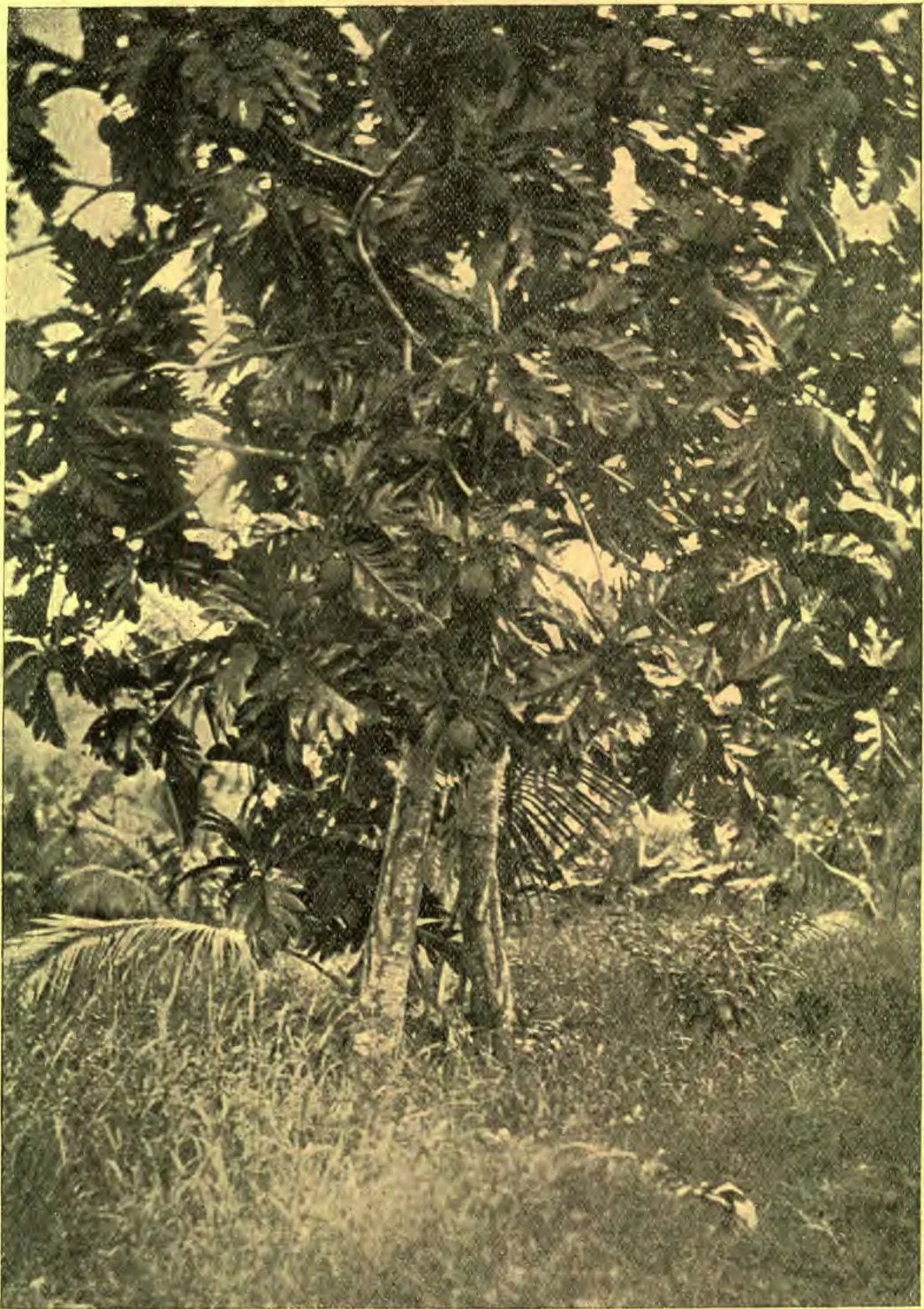
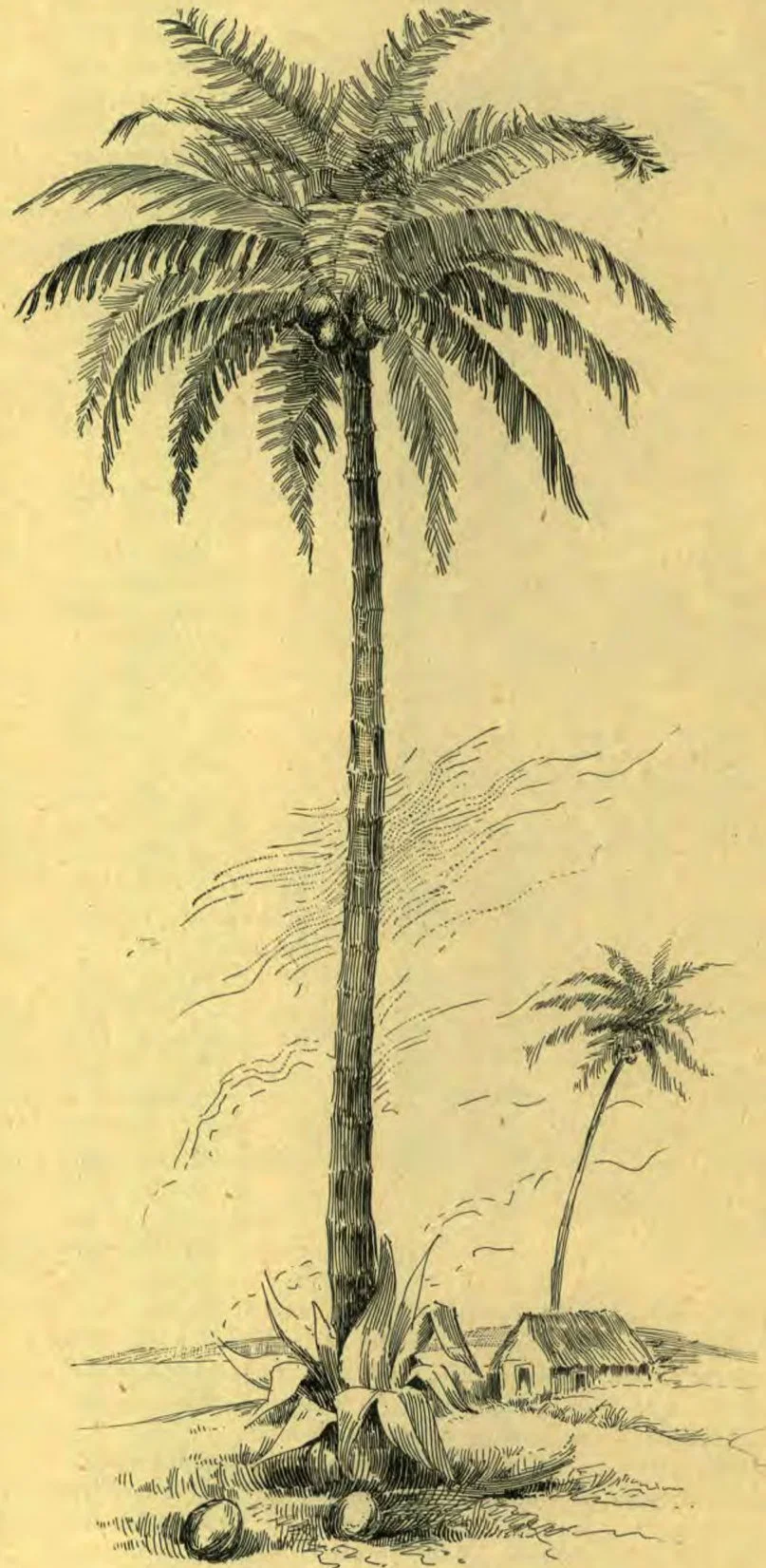
Algeroba, mango, alligator pear, and orange trees, with their wide-spreading branches and luxuriant foliage, are all strangers to the inhabitant of the regions where King Frost reigns nearly half the year. Banana and papaja trees, though smaller, are not less important. Among other trees are the breadfruit, cocoanut and date palm, fig, guava, pepper, kou, koa, eucalyptus, and Ponciana Regia. For several months in the year, the latter is aglow with a mass of bright scarlet or yellow flowers.
Among the shrubs should be named the single and double hibiscus. This is used mostly for hedges, and is in bloom the year round. It has large, scarlet, bell-shaped flowers.
The bugainvilloea is a large vine, growing something like the wild grapevine of the Central States, and often covering the side and half the roof of a house with a cataract of magenta blossoms.
There are also shrubs called “color-leaves.” These, as the name implies, have beautiful leaves of various colors, some being mottled red and green, yellow and green, or red, yellow, and green, while others are striped.
COCOANUT PALM.
Then there is the lanialii, bearing large, yellow, trumpet-shaped flowers; the gardenia, beautiful with wax-like white blossoms; the promelia, melia, and various other useful as well as ornamental shrubs and vines.
There is also the ti (pronounced “tea”) plant, seen in almost every native yard. Ti leaves are used in great numbers in preparing the native feasts, or luaus, a description of which will be given in the future.