THE CHLOROPHYL CELL

7%

Review and Herald Publishing Company · Chicago, Battle Creek, Michigan, Atlanta · Apr 13, 1899

FromThe Youth’s Instructor, Vol. 47, No. 15.

Read the full edition

THE CHLOROPHYL CELL.

I.

If I should ask the reader why we eat, the answer, naturally, would be, “To live;” but if I should carry the query a little further, and ask what was meant by “to live,” it would perhaps puzzle you to reply.
Let us take the answer, “We eat to live,” and study from this point of view. If food keeps the body alive, then to understand fully the reasons we use it for that purpose is to understand, as far as human knowledge can, how it is possible for food to keep an animal alive. This being so, let us begin at the beginning, and learn all we can as to what food is, and where it comes from. We shall then be better able to understand how a living creature can appropriate food, and so sustain life.
Fig. 1.
Fig. 1.
These two subjects—the creation of food and its consumption by a living organism—are so intimately connected that neither can be studied singly; for food is not only consumed by living creatures, but is also produced by living creatures. This necessitates the study of life as related to these creatures, before the study of the origin of food can be entered upon.
This brings us to the question, What living creature is it that creates food?—Life is a gift from God, and is by his power sustained through the work of a single form of life, and that one of the most minute, and apparently insignificant that exists, but in the creation of which God has made life possible for all other living organisms.
I want you to try to grasp this thought fully, so that you may better realize the wisdom of God. You can readily see that if the creation of food had been left to a highly organized creature, one with high will power, large brain, and broad reasoning faculty, the creature might rise above the Creator, and attempt to perform his work differently from God’s design, or do it carelessly, so affecting the character and quantity of the food produced, to the detriment and possible destruction of all life. God, therefore, gave but one creature, and that one among the lowest forms of life, the power to create food. All other lives are consumers of food, never producers. But this life, infinitesimal in size, with no desire to do anything but to fulfil the purpose of its creation, manufactures the material which is the food basis of life for all the world.
Of course you want to know what the wonderful little creature is, and where it can be found. To find this low form of life, this atom, we must descend the scale, below any form that is visible to the eye; we must go down the scale until we pass beyond all forms of life that, even under the microscope, show organization; that is, have organs, such as a stomach or mouth.
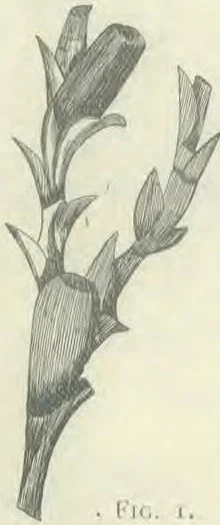
Apparently we shall not be able to find on the earth any form of life low enough in origin to answer to the description of the one we seek. Where else can we go?—Why, the sea is left us. In it we find some exceedingly small yet beautiful creatures; as, for instance, this hydroid, or “water animal.” See Fig. 1.
FIG. 2.
FIG. 2.
“Why!” you say, “that is a plant! It has no feet, no mouth, no eyes; how can it be an animal?” It is an animal, nevertheless. Among the lower orders of life it is often difficult to distinguish between animal and vegetable life; but in many instances, some of which will be illustrated, the vegetable lives have power to move about, while the animal has not.
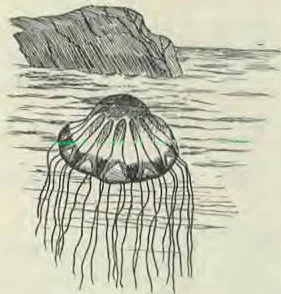
This little hydroid, which is greatly magnified in the illustration, dropping to the bottom of the sea, attaches itself to any projecting surface, such as a rock, barnacle, or mussel; and sending up its beautiful green stems, builds at last, in the junction near the top, a lovely conical-shaped home for its little unborn babe. Here the little one is deposited, nourished, and cared for, by means of an open tube that reaches the entire length of the stems; until the day when the tiny creature, fully matured, climbs to the rim of its beautiful home, shakes out its eight little tentacles, or arms, rises rapidly to the surface of the water, and floats away on the broad surface, a gay little jelly-fish. See Fig. 2. W. S. CHAPMAN.
(To be continued.)