THE GOSPEL IN JAPAN

7%

S. D. A. Publishing Association · Battle Creek, Mich. · Oct 10, 1895

FromThe Youth’s Instructor, Vol. 43, No. 41.

Read the full edition

THE GOSPEL IN JAPAN.

PROBABLY the first missionary to Japan was Francis Xavier, a Roman Catholic priest who went there in the sixteenth century, and began teaching the doctrines of his church. Some of the rulers and leading men of the empire embraced his creed, as did also a large number of the common people. When the sect became powerful, the usual means employed at that time for gaining adherents to the Catholic Church were resorted to, and under the persuasive influences of drawn swords, torture, flames, and the like, converts to the new faith were made by the wholesale.
But when the Jesuits began intriguing to annex Japan to Spain, the jealousy of the government was aroused, and the Catholics became the subjects of the bitterest hatred and persecution. The same schemes which they had employed to introduce their religion into Japan were now resorted to in order to exterminate it. Most horrible scenes of cruelty were daily enacted. In one day thirty thousand Catholics were massacred. They were crucified, burned, tossed into the sea, and butchered, until the government supposed that the dreaded sect was exterminated. The ports of the country were then closed against foreigners, and for nearly three hundred years Japan was the most exclusive nation on earth. It was death for a foreigner to land upon her shores, and death for a native to leave Japan. Public-notice boards were put up all over the empire pronouncing capital punishment upon any one who did homage to the Christian’s God, and if any one was found who did so, he was killed.
But in 1854 Commodore Perry went to Japan, and after peaceful negotiations, succeeded in getting the country open to foreigners. The Japanese nation awoke from its long Rip Van Winkle sleep, and resolved to adopt Western civilization. Soon great steamships bearing men and implements for introducing all modern appliances and conveniences of civilization, were plowing through Japanese waters.
In a little while the shriek of the railway engine was heard by the astonished natives. Telegraphic messages were flashing along the wires that well-nigh girt the island. Good schools, modeled after ours in America, were established all over the empire. With such marvelous celerity did Japan advance, that she was an astonishment to all the world. But in spite of such material progress, even in 1868 a governmental edict was issued saying that “the wicked sect called ‘Christian’ is strictly prohibited.”
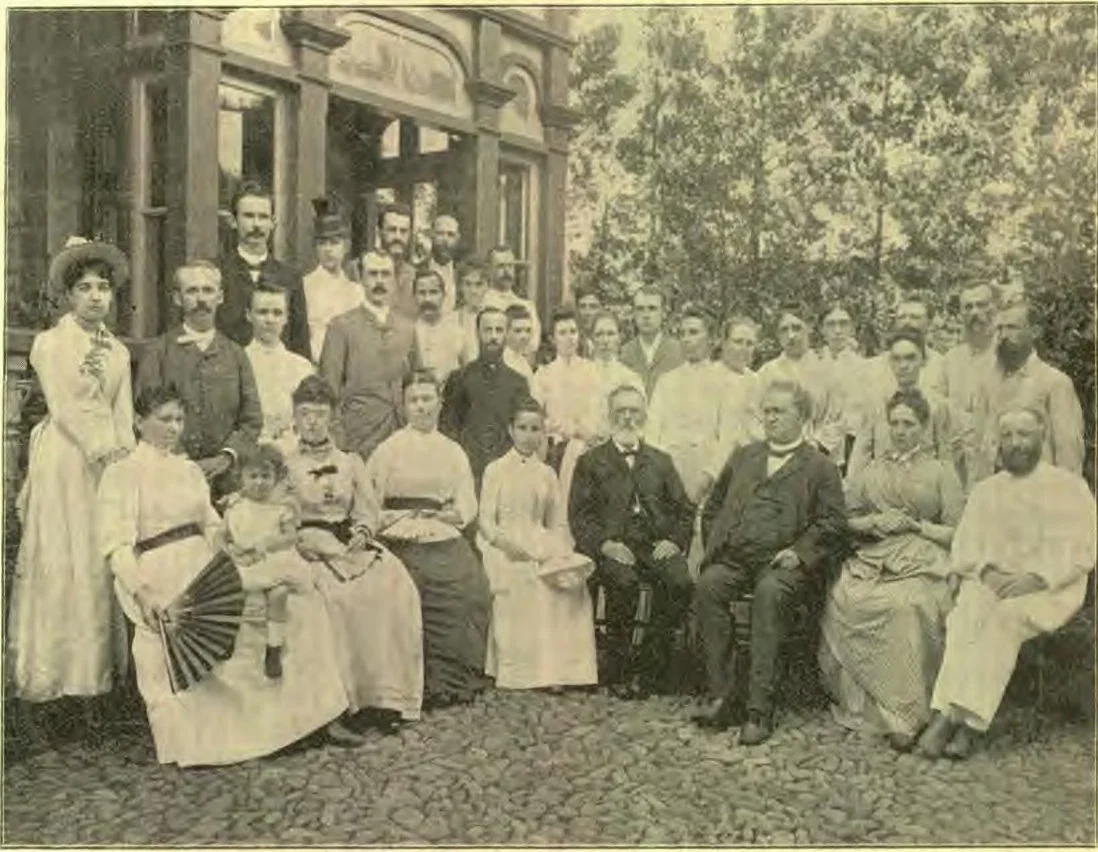
A GROUP OF MISSIONARIES.
In the face of this, God’s messengers went there with the gospel; but they found it very difficult to reach the people, so great was the terror in reference to Christianity. The majority of the people supposed that Protestantism and Catholicism were identical. A missionary who was there at the time says: “We were regarded as persons who had come to seduce the masses of the people from their loyalty to the ‘god country’ (Japan) and corrupt their morals generally.” It was impossible to rent a place in which to preach, and very difficult to procure a language teacher. Humanly speaking, a missionary going to Japan, as late as twenty-one years ago, took his life into his own hands; for a Christian was looked upon as no better than a thief or a murderer.
But though the Bible was proscribed, infidel literature was widely circulated, and many of the influential men of the empire became followers of such men as Huxley, Spencer, and Ingersoll. But despite these great and seemingly insurmountable obstacles, the gospel is triumphing in Japan. The edict against Christianity has been virtually repealed, and religious liberty practically prevails in Japan. From ten Christians and no churches in 1871, there are now about thirty thousand Christians and several hundred churches and preaching places.
One great obstacle to the cause of Christ in Japan is the number of denominations represented there, all claiming to follow the Bible, and yet all interpreting it differently. This is very confusing to the Japanese, who often reject it altogether in their perplexity over the numerous creeds presented to them for acceptance. O that all men would permit the Bible to be its own interpreter, and let it mean what it says! What a glorious thing it would be for the advancement of mission-work the world over!
Another obstacle to Christianity in Japan has been the doctrine held by the Shintoists, and generally believed by the people, that the emperor is descended from the gods, and must be venerated as such. Now the Christians deny this; hence they were looked upon with suspicion, and were accused of being disloyal to their country. But the conduct of the Christians during the late war has forever set at rest the question of their patriotism.
Whether as soldiers upon the battle-field, sharing in the perils and privations of war, or as civilians toiling at home for the absent ones, they have proved themselves loyal to their country. Thus even war, despite its horrors, may be an instrument in God’s hands for advancing his cause.
Seeing the good work that the Christians were doing in ministering to the sick and wounded, chaplains were permitted to accompany the army. The government also granted permission to the agent of the Bible societies to distribute Bibles among the soldiers. The opportunity was gladly seized. At the opening of the war it was almost impossible for a Christian soldier to conceal a Bible about his person. Now it is seldom that any soldier will not accept some portion of the Scriptures.
The prospects for the spread of Christianity in Japan are brighter than ever before. Truly the field is white for the harvest. It is time that we, as a people, were turning our attention to Japan, and making our plans for sending out laborers there, who will preach the gospel of the coming kingdom. Let us pray to God, who is moving so mightily in the Island Empire, that he will speedily send forth laborers into this harvest. Then let us show our faith by our works, and each contribute to this cause as the Lord has prospered.
MRS. J. A. BRUNSON.