SUSANNA’S PEPPER-BOX

4%

S. D. A. Publishing Association · Battle Creek, Mich. · Dec 19, 1895

FromThe Youth’s Instructor, Vol. 43, No. 51.

Read the full edition

SUSANNA’S PEPPER-BOX.

By Myrta B. Castle.
“I say, Sue, get the money out of your pepper-box; there’s a tramp round the corner, and he’s coming this way!”
“O Phil! is there, really? and does he look hungry? and I do hope he hasn’t a sick wife and baby at home; ’cause I haven’t any money but the two dollars in my foreign-mission box.”
“Ho! ho! wife and baby—I guess not! He’s no bigger’n I am. But he does look hungry, that’s a fact, and awfully blue and cold.”
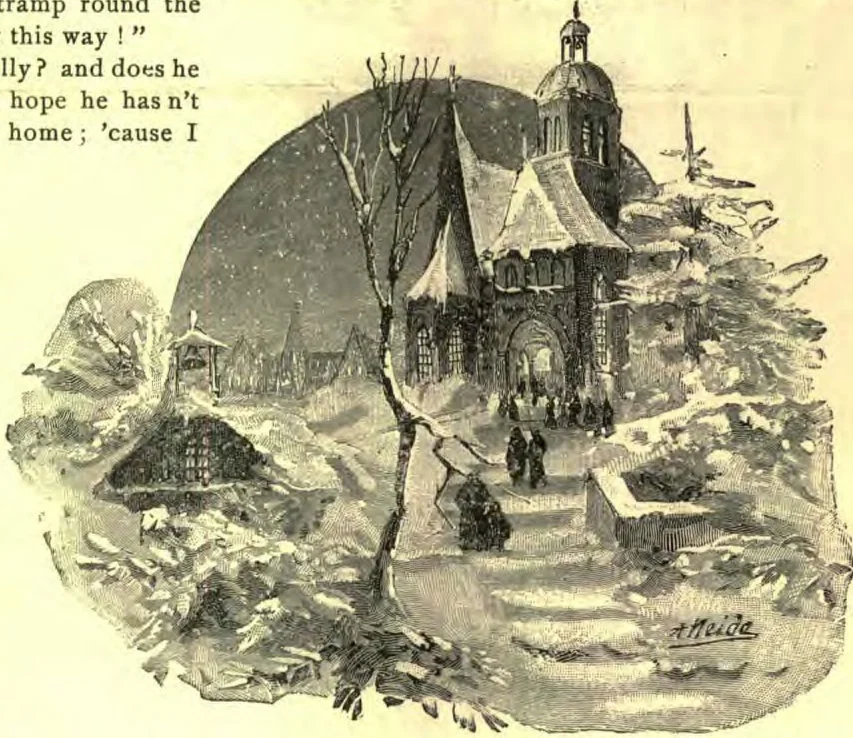
Just then, as a particularly wintry blast skurried the snow off the roof and down the path, a doleful little figure stopped at the garden-gate, and looked hungrily toward the home-like house back from the road. It was morning, and he could see through the wide windows the warm fire in the dining-room grate, the long family table set for breakfast, and Susanna’s mother bringing in the steaming food.
That splendid fire—oh, how his poor, half-frozen feet did ache for its warmth! That steaming food—he could almost smell the hot cakes and maple syrup, and his stomach was so empty! There stood a boy and a girl at the window, too, looking at him. He didn’t mind Sue; she was younger, and a girl; but to be pitied or laughed at for being a beggar by that boy just his size,—that he couldn’t stand, and he turned away with a big choke in his throat, and ran down the street as fast as his weak legs and numb feet could carry him.
But he hadn’t gone far when he heard a little girl’s voice calling: “Boy! O boy! wait! I can’t run so fast through the snow. Come back to breakfast. Mama says so, and so does Phil, and papa would too, only he’s away; and there’s plenty for you too, and a place all set—we always keep an extra place, ’cause once I had another brother,—Phil’s twin,—and he died!”
Just then Phil came running up with a shawl. “Here, old fellow, this will fix you a little snugger till you get into the house. This storm’s a regular northeaster, come to stay over Christmas—and so’ve you—mama said so—unless your folks live right near here. And you shall have my brother’s room while you stay—it’s always ready for company.”
“Company! O, that’s the first time I’ve been called anything but beggar and tramp since—since—”
“Poor child!” said Mrs. Phinney; “sit by the fire, and drink this hot milk right away; and I know Phil and Susanna are fretting to know what your name is and how old you are, and then you needn’t say another word till you feel like it.”
“My name is John Jones, and I’m fourteen to-day.”
“Hooray!” shouted Phil; “we’ll have a—”
“O Phil, come out into the kitchen this minute; I want to tell you something,” said Susanna. “Phil Phinney,” she exclaimed, the minute the door was shut, “what do you mean by letting cats out of bags like that—anyway, ’t would have been a secret if we’d had time to make it one. Don’t you see? we’ll give him a surprise! Won’t it be splendid?—and Christmas eve, too!” and she danced round on one foot till she was dizzy.
“What a jolly girl you are, Sue!” said Phil, with a look of brotherly admiration. “We’ll give the poor chap a day to remember or our name’s not Phinney. But come to breakfast now, or he’ll starve while we’re plotting.”
All day, as John lay on the couch before the fire,—he had taken a violent cold from his exposure,—he wondered what made the Phinneys so hilarious all over the house except where he was. He could hear them shouting through the chambers and in the attic, or from the pantry to the cellar. When they came into the sitting-room, though, they were as quiet and sober as if there were sick people in the house.
“I say, Sue, I’ve lots of old duds better’n those he’s wearing, but it’s no great thing to give away what you don’t want and would like to get rid of; and so I’ve been thinking, What’s the use of keeping all brother’s clothes, when they might do somebody some good? He willed his wardrobe to me,”—Phil’s voice faltered, for his twin had been dead only a half year; and Susie cried softly,—“and I think pa and ma will be glad if I give John brother’s school suit, which was almost new.”
“You’re so good, Phil! And—and—don’t laugh at me—but I think—he needs a pair of new shoes, not half worn ones—I’ll have to spend that two dollars I’d saved for foreign missions, and buy him some birthday shoes.”
“I knew it, Sue, I knew it! Didn’t I tell you to bring down the pepper-box? You always do, whenever a tramp comes along. If the heathen had got all the money you’ve put into that old pepper-box for them, some of them wouldn’t be heathen any longer.”
“I can’t help it; I think it’s worse to turn people away hungry and cold—just think of having no supper and sleeping in a snow-bank!—than it is not to send tracts to heathen who can’t read them; though I did want to help send a missionary to teach them to read the Bible. But never mind; I’ll save some more. John Jones is going to have some shoes (a boy ought to have something new, whose birthday is next day to Christmas), and you are going to the store to buy them right away—his feet are just as big as yours. Now I’m going to make him a birthday cake.”
That evening at seven precisely John Jones was invited into the dining-room, and there, near the head of the table, was a tall “birthday Christmas tree”—“presents look prettier on a tree than anywhere else,” Susanna had declared,—covered with loving Christ-tide gifts to each member of the family, and handkerchiefs, neckties, collars, underwear, stockings, new shoes, and brother’s warm school suit, for John. In the tip-top was a lighted candle, and underneath was the birthday cake, with—“John Jones 14” in red candles on the white frosting.
In a few days the uncle for whom poor orphaned John was looking came and took him away, and the children never saw him again, though he and Phil wrote to each other for a while. Then the Phinneys lost all track of their winter guest till, one day many years after, Susie got this letter from a far-away heathen land:—
“Dear Susanna: Phil told me before I went away from you, that winter so long ago, about your foreign-missionary pepper-box, and how your tender heart made you give the money always to the heathen that came to your door; and as you sacrificed your missionary savings for me too, I think you would like to know that the money which bought my shoes was foreign missionary money put out at interest; for Phil’s story of your sacrifice put the first thought into my mind that God might use me, some day, as he is now doing, in teaching the heathen in foreign lands to read the Bible. Yours, “John Jones.”