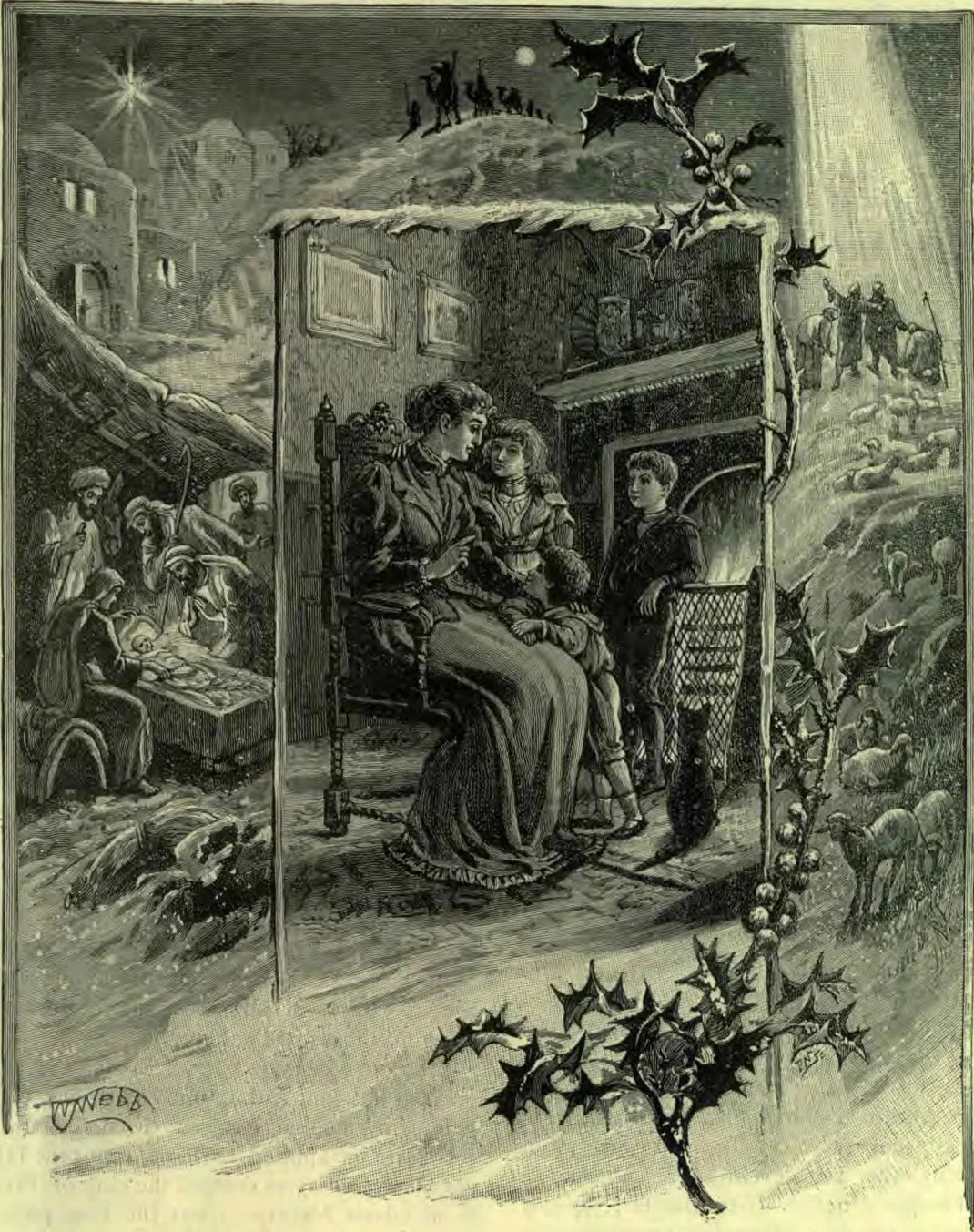
As, in childhood, play is the chief object of existence, so in the childhood of races, life is less prosy, more picturesque and playful, than in later and maturer periods. Our forefathers spent a fortnight upon Christmas; we find it hard to spare a single day. Machinery rules us now, and when it runs, we must run or fall behind, and so life has become an everlasting steeple-chase. Our fathers lived more slowly; their world was smaller; their obligations were lighter. Their duties to society began and ended in the parish; the whole world has claims upon us. They had few books; we are half buried in the multitude of ours. Their holidays furnished them with the substance, in its crudest form, of what we have, refined and concentrated, in music, literature, and art.
Not only the feverish haste of modern life, but the changes in our manner of living, have shut out many of the observances with which the winter festival was celebrated. In ancient times the Yule block was rolled into the immense fireplace, and lighted with a brand saved over from the last Christmas. In its light and warmth, the cheery customs of the season flourished. Long, wreathed candles added to the light of the fire a steadier beam.
The story-teller, who had fought Spanish buccaneers in the southern Atlantic, had seen the awful vision of the Flying Dutchman in the storm-clouds off the Cape, and the wonders of Calcutta and Cathay, began to unfold his wondrous creations. Now, for the fireplace, we have the steam radiator, the candles’ shining is dimmed by the electric lights, and the story-teller’s species is extinct.
The wassail, too, has lost its honorable place. In an age when many people are total abstainers, and intemperance is nowhere in good repute, the old customs of drinking are more honored in the breach than in the observance. The Lord of Misrule has departed also, his pranks not being in favor at the court of public opinion. All these have left a great breach in Christmas.
We still keep many customs, which we can manage to fit into our modern life, to remind us of the gay festival of past centuries, just as we keep a few withered wild flowers to remind us of a summer spent in the hills. Many observances are matters of course in England which are never followed by us, or followed only by way of reviving the past. Among these is the Christmas pantomime, a clumsy variety show which foreigners ridicule. We have, though, the holly and mistletoe, candles and Christmas gifts; while mince pie, among things eatable, is abundant, and plum pudding by no means rare. In addition to these things, we have the Christmas tree, which is not English, but German.
Nevertheless, the real spirit of the Christmas festivities is dying out. As a religious anniversary, Easter, which is not so much a holiday, seems to be taking the place of its sister festival. The pagan features of Christmas are too marked, since it is almost certain that Christ was not born in December; while on the other hand, it is just as certain that he did rise from the tomb at the Passover season, and, if we except Easter eggs, the pagan features of Easter are not at all prominent. As for mere holiday, we do not need such holidays as Christmas used to be. Our life is too full of excitement now; what we need is rest and opportunity for reflection. We need to unbend the bow, not to string it tighter. We have a wealth of literature and of art on every side of us, with which to make a holiday of every day, when our work is done. Every age and every country is our own. We may travel around the world in an easy-chair, and make nightly incursions into savage wilds, or visit the shrines of history and romance, lighted by our evening lamp.
But if we less often give up whole days to merry-making, we must not forget that we owe ourselves recreation and rest. The wealth of our opportunities often intoxicates us, and, in the effort to grasp all, we lose all. We should read slowly and reflect much; he who plows deep has a richer harvest than he who scratches a large surface. We should work carefully, and let progress be sure rather than rapid. And when festal days do come around, let us idealize them, so that they shall bring us strength and not weariness, and leave us broadened in mind and in character. If our holidays can be thus transformed, it will be worth the while to preserve them.