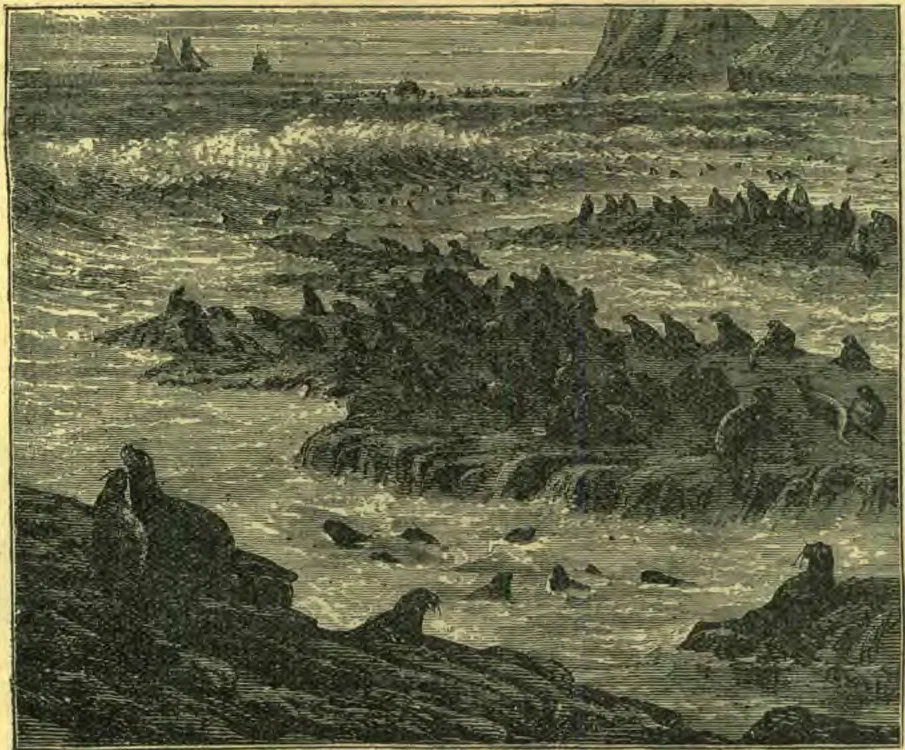
THE seal is a carnivorous quadruped, an amphibious mammal, inhabiting seas of the higher latitude. Its food consists of fish and water-fowl; it lives chiefly in the water, but spends part of its time on shore, reposing in the sunshine, on rocks, sand-banks, and ice-fields. The seal breathes but once in two minutes, even when in full activity on shore; and it has been known to suspend respiration under water for thirty minutes, and some say still longer.
These animals are fond of music, and it is asserted that they will follow a boat a long time if there is music on board.
Seals are of gregarious habits, and are found in their breeding-haunts in almost fabulous numbers. They bring forth their young on shore or on the ice once each year, and only one at a birth.
Before the young are old enough to leave the ice, is the opportune time for the hunter: the young seals are then very fat, and are easily killed by a light blow on the head. They are said to gain six pounds a day, and often have five inches of solid fat beneath the skin. When approached, the males stay to protect the young, and are shot, but the females flee to the water. The young are soon urged into the water by the old seals; and after the young learn to swim, they can not be caught in sufficient quantities to make the business of seal-hunting profitable, and the sealing-ship returns to port.194
There are several kinds of seals, but those found in the Gulf of St. Lawrence are the harp-seal and the crested-seal. The adult male “harps” have a light-colored body, with a harp-shaped mark of black on each side, whence their name. The face and the throat are also black. They weigh from four to eight hundred pounds. The young are pure white.
The crested-, or hood-, seal is a maculated gray, and receives its name from a hood, or crest, on the upper part of the head of the adult male. This hood is joined to the septum of the nose, and is capable of being distended and elevated or depressed at will. This seal is the fiercest and most dangerous of all the seals.
The venturesome Eskimo takes great delight in hunting the seal in his fragile canoe, fitted with harpoon and reel. The flesh and fat are used by him for food, and the skins for blankets and wigwams.
These are not the highly-prized fur-seals, but are called “hair-seals,” and are hunted chiefly for their fat and skins. No process has yet been discovered that will successfully prevent the fur from shedding in the skins of the hair-seal.
SEALS AT HOME.
The fat is converted into oil for lamps, and sells for from fifty to sixty cents a gallon. It is used in engine-rooms, on board ships, and in other places where a non-explosive oil is required. The skins are made into a light-weight leather, and used for book-binding, etc. Boots are sometimes made from the leather, which is quite impervious to water.
A typical sealing-ship is the “Harlaw,” which is fitted with all the necessary equipments for a trip among the ice-fields off the north coast of the Magdalen Islands, in the Gulf of St. Lawrence. The boat is made of iron, and is of about five-hundred-tons’ burden; the bottom is covered with deal, to protect it in the ice; the stem is overlaced with heavy plates for cutting a way through the ice. Between decks and below, great beams have been fastened around the steamer, with many stanch cross-beams, to prevent the ship from being crushed.
The captain of the steamer, D. E. Scott, has on board one hundred and forty men, provided with rifles; spears; gaffs [large iron hooks]; bats; harpoons; long poles; powder; dynamite; etc.
The dynamite is for breaking the ice when the ship is fast, and the long poles are for levers to pry the blocks of ice away. When a sufficient space has been cleared, the steamer backs to one end of the opening, and charges at full speed into the ice at the other end. This process is continued until the steamer plows her way through into open water again.
Ships are sometimes hemmed in by ice, and crushed. Last year the “Mastif” was crushed in this way. The crew were picked up, after thirty-six hours on an ice-floe without food or shelter, by a steamer from Halifax.
The harpoons are used to draw in the old seals from the water after they have been shot. Seals are usually taken on the ice, however; the old ones by being shot, and the young by a blow on the head with a gaff or a bat, with which every man is provided.
When being killed, the plaintive cries of the young seals pleading for life, with their large, round, expressive eyes, full of gentle brightness, streaming with tears, and so touching, have often moved the heart of the hunter to pity for the innocent creatures, and caused him to seek other employment ever after.
The “old hoods” (crested males) are very fierce; they will climb or run over the ice as fast as a man; one will keep two or three inexperienced men at bay, if they are armed only with gaffs. When attacked, these seals distend the crest, which protects the head from the hunter’s blow.
The seals are “sculped,” with fat and skin in one piece, and laid in a pile, called a “pan.” A flag, on which is inscribed the initials of the captain of the ship, is then hoisted over the pan, to distinguish it from pans belonging to other ships.
These pans are often as far as five or ten miles from the ship. They are left until the ship can make its way to them, or nearly so, when the “sculps” are taken on board, and stowed away below. These pans are sometimes stolen by other hunters.
A “barrel-man” goes aloft in the barrel-shaped lookout on the foremast, and with a strong field-glass watches the movements of the men and pans, and pilots the steamer through the best routes from pan to pan. The hunting is carried on till the ship is laden, or the best of the season is over, when the ship returns.
The “Harlaw” has just returned from her latest trip, being the first sealing-ship home. She brought with her fourteen thousand seals, weighing nearly three hundred tons, which sold for $18,385.39.
The men are furnished board, and receive one third of the “catch.” The captain and officers receive a percentage, which varies according to their rank.
By law, each steamship is allowed to make but one voyage annually—between March 12 and April 20.
Seal-hunting is very exciting, and is attended with many dangers. Blinding snow-storms overtake the hunters, and they often lose their way to the ship, and are drowned, or perish with cold. Sometimes they are carried away on ice-floes. Forty-eight men were thus carried to a watery grave last spring.