WILD ROSES

13%

Review and Herald Publishing Company · Battle Creek, Mich. · Aug 16, 1900

FromThe Youth’s Instructor, Vol. 48, No. 33.

Read the full edition

WILD ROSES

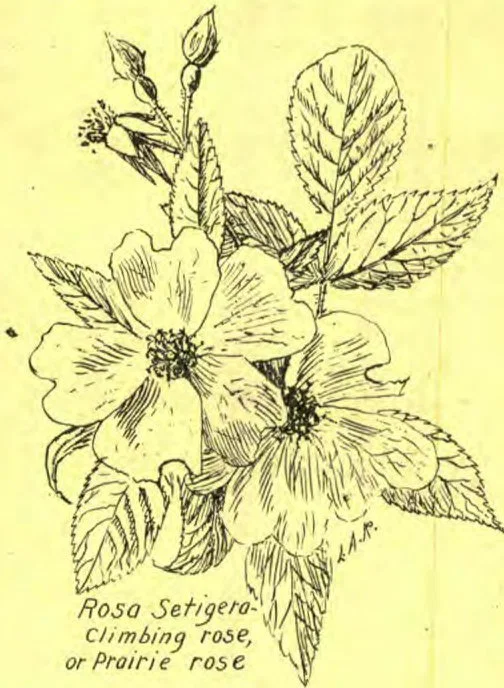
THERE are five native wild roses common in this country. The one most frequently met with in Illinois is the climbing, or prairie, rose (Rosa setigera). It is the only American climbing-rose, and the only one that has united, protruding styles. The stems are armed with stout, nearly straight prickles, and these are not bristly. The petals are a deep rose-color, but gradually turn white. From this plant, by cultivation, was obtained the beautiful garden rose called the “Baltimore Bell.” This climbing-rose is found only in the West and South.
A rose that always grows in low or boggy soil is the swamp-rose (Rosa Carolina). The stems are from four to seven feet high, and the prickles are hooked. It has numerous flowers, which are of a delicate, but not uniform, pink color.
The dwarf wild rose (Rosa lucida) is much lower in height than either of the two already mentioned. The stems are usually one or two feet high, armed with unequal, bristly prickles. The flowers grow singly, or in clusters of two or three. It is to be met with in dry soil, or on the outskirts of swamps.
The early wild rose (Rosa blanda) may be known by its stems having few or scarcely any prickles, and these are easily shed. The flower is very pale pink, nearer white than any other of the wild roses. It grows near rocks and along banks, especially in stony soil.
There are two wild roses which have been naturalized from Europe. They are popularly called sweet-brier roses, and are much alike in general appearance. But Rosa rubiginosa may be distinguished from all others by the aroma of its crushed leaves. On the underside of these leaves are russet-colored glands, which produce the fragrance. L. A. REED.