Solar Eclipses

7%

Review and Herald Publishing Company · Battle Creek, Mich. · May 17, 1900

FromThe Youth’s Instructor, Vol. 48, No. 20.

Read the full edition

Solar Eclipses

Astronomical Study—No. VI

Solar Eclipses
The eclipse of May 28 will afford an opportunity for interesting observation by our INSTRUCTOR family; and it will be in place for all to understand the cause of the phenomenon. Generally speaking, eclipses are of two kinds,—those of the sun and those of the moon. The one to occur Monday morning, May 28, will be either total or partial to our readers, depending, of course, on the latitude in which they live. To those living in the extreme south and southeastern part of the United States, the eclipse will be total; while to those living farther north it will be partial. The farther north the observer, the less of the sun’s face will be covered by the disk of the moon. To those living in Battle Creek, Mich., or on the latitude of about 42°, 42′, north, the sun will show about one fourth its upper surface.
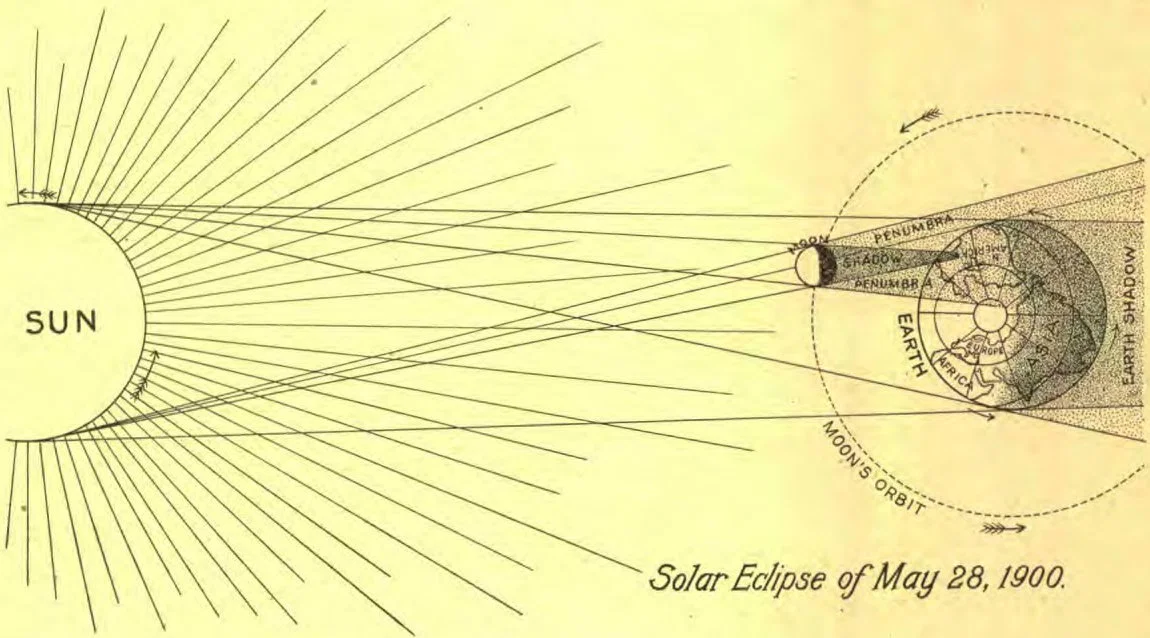
Solar Eclipse of May 28, 1900.
All this will be explained and illustrated in next week’s INSTRUCTOR.
So far as our study is concerned, eclipses of the sun are of three kinds,—total, partial, and annular,—the last-named being the most beautiful of the three. Not that this kind occurs once each year, as might at first be inferred; but that when it does occur, it is round, or ring-shaped. To explain: it will be seen, by noticing the large illustration, that an eclipse of the sun is caused by the moon’s passing directly between the earth and the sun. Now if the moon were always the same distance from the earth, and always passed exactly between the sun and the particular spot on the earth where we happen to live, the eclipse would be always the same; but this is not the case. The moon sometimes swings closer to the earth than at other times, when we say it is in “perigee.” Should it pass between us and the sun at such a time, its disk would completely cover the sun’s disk, and the eclipse would be total to us, and partial to those living some distance either north or south of us. At other times the moon swings farther away from the earth, and we say it is in “apogee.” Now notice the diagram, and see what the effect would be on the shadow of the moon to place the moon farther away from the earth and nearer the sun. By drawing a line from the top of the sun past the top of the moon, and on toward the earth, also one from the bottom of the sun past the bottom of the moon, and on toward the earth, you see that these lines would meet before reaching the surface of the earth, and in that case the whole of the sun’s disk would not be covered. The moon would simply cover a portion of the sun, but not the whole; and to a person living at such a point on the earth that a line drawn directly from him to the center of the moon would reach to the center of the sun, the eclipse, when central, would show the center of the sun darkened, leaving a ring of light all around the outer limb, or edge of the disk, of the sun. This would be an annular eclipse,—an interesting sight indeed.
The diagram explains itself. In order to show the eclipse as coming to our part of the globe at seven o’clock in the morning, we have been obliged to draw this diagram showing the view from above; that is, we are looking down upon the north pole of the earth, the moon, and the sun. Please stand facing the south, with the picture directly in front of you, and you will see it as it would appear to one looking down from above. The sun will be in the east, with its south pole inclined toward the earth, which is the case at this season of the year. The earth’s north pole will be seen to incline toward the sun. The arrows show the direction of the earth’s revolution; this occurs once in twenty-four hours, and in that time brings all sides of the earth into the direct light of the sun, which also passes on around through the earth’s own shadow, thus giving the phases of night and day. It will be noticed that there is a portion of the earth’s surface near the north pole that does not, in the revolution of the earth, pass at all into the shadow of the earth; this explains the reason of the six-months’ day and six-months’ night at the poles. The north polar region is now having its long day, while the south pole is having its long, cold night.
The dotted line passing through the moon shows its path around the earth; and the arrows show the direction in which the moon is traveling. In the diagram the path lies directly through the shadow of the earth; and this much of the illustration is, of necessity, incorrect; for if the moon really did pass through the shadow of the earth, we should have an eclipse of the moon in about fourteen days following the eclipse of the sun, and this is not the case this time. The reason we do not have an eclipse of both the sun and the moon each month is that the moon, in its circuit about the earth, swings north and south, back and forth across our equator, and in so doing throws its shadow many thousands of miles away from our earth. It also passes many miles above and below the shadow of our own world. When it does get into direct line with the earth and sun, we have an eclipse such as will occur the morning of May 28.
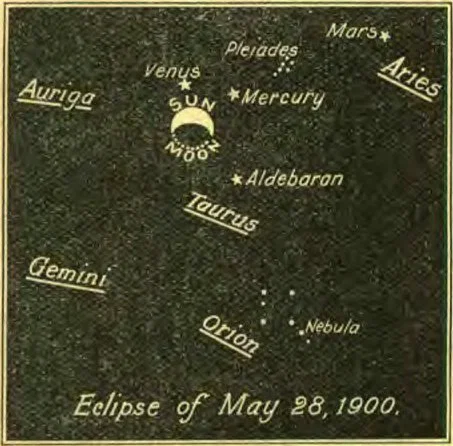
Eclipse of May 28, 1900.
It is impossible to give, in a diagram like the one herewith shown, the relative size and distances of the sun, moon, and earth, and give also what we have given,—their relative positions. In order to grasp the relative size of each, please think of the earth and moon exactly as given, but imagine the sun as a globe standing a trifle less than ten feet high, or a little less than ten feet in diameter; and so far as relative distance is concerned, think of the earth and moon exactly as we see them in the illustration, and imagine the sun nearly ten feet high, standing twenty-two feet away from the picture of the earth.
The smaller illustration shows the heavens as they would appear to us at the time of the eclipse, could the light be so shut off as to let the other planets and constellations appear. Venus and Mercury, you remember, are always to be thought of as being somewhere near the sun; and in this picture we see them exactly where they would appear. In the upper right-hand corner of the picture Mars is shown,—not because he is near the sun, but because he is on the opposite side, and we thought it best to show his picture, too.
Next week we will tell you more about this eclipse, and show how you may expect the sun to appear. For reasons about which we will tell you at that time, thousands of dollars are now being spent to make this coming eclipse an opportunity for special study.
DR. O. C. GODSMARK.