CARE OF NEGATIVES

8%

Review and Herald Publishing Company · Battle Creek, Mich. · May 17, 1900

FromThe Youth’s Instructor, Vol. 48, No. 20.

Read the full edition

CARE OF NEGATIVES

If a negative is worth keeping, it is worth taking care of; and if it is not worth keeping, it had better be thrown into the ash-barrel as soon as you find out what caused the failure.
All negatives should be numbered; and the number, name of subject, time exposed, and stop used, with such other particulars as to light, etc., as may be useful for reference in the future, should be recorded in a book kept for the purpose. All this may seem unnecessary while you have but a few negatives; but when you get two or three hundred (as you soon will if you continue to take pictures), you will find it a great help. It will not only assist in keeping your negatives in order, and in finding any particular one you desire, but will also give you a reference book by which you can readily see the effect of different times, lights, and stops on a great variety of subjects.
If you do not object to seeing a number on your print, it may be written in one corner of the negative with a pen and common writing-ink. The number should be written backward, in order that it may print right in the picture. A little practice will enable you to do this without difficulty. If you do not like to see a number on your print, it may be written with a lead-pencil; and then, unless it is written in some dark shadow, it will not be seen on the picture at all. It is more difficult to see a number that is written with a pencil than one written with ink; but this will be no great drawback, especially if you keep each negative in a numbered envelope.
Negative envelopes are cheap and convenient, but they are by no means essential to the proper care of negatives. An excellent plan is to store them, film down, in empty plate-boxes. The numbers contained in each box may be written on the outside. By following this plan, any desired negative can be found without difficulty. Be careful to pack the plates with the film side down; otherwise you will be likely to scratch the film with the plate lying on top of it when you attempt to remove it.
In storing my negatives, I have for some time followed a plan that requires some extra work to begin with, but has proved in the end to be a saver of both negatives and labor.
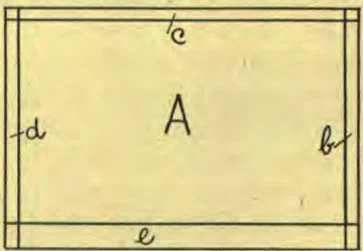
Around the edges of the best negatives, there are always frills, scratches, and blotches that necessitate trimming off at least an eighth of an inch from each edge of the prints. Often much more should be trimmed off, but there is always that much. My plan is to paste strips of black paper, just as wide as the strip that you would trim from the print, on the film side, along each edge of the negative. Let Figure 1 represent a five-by-seven-inch negative. A is the part that would be retained in the finished print; b, c, d, and e are the strips that would be trimmed from the print when it has been printed the full size of the negative: b and c are each one fourth of an inch wide; d is three eighths, and e one half.
Cut strips of black paper of these widths, and long enough to reach across the plate, and cover one side with common starch paste, such as you use in mounting your pictures. Be careful not to use too much paste, or when it is rubbed down on the negative, some may be pressed out at the edges, to make a stain on the film. When each of these strips is in position, b, c, d, and e will be covered with black paper, so that only A can be printed. If a print is made on paper of full size, the remainder will be white, and may be trimmed off entirely, or simply trimmed to an equal width all around, and retained as a border. With most pictures, especially if dark mounts are used, this white border is a wonderful improvement. At the corners of the negative the strips will overlap, and there they will be double thickness. This will in no way interfere with the printing, and will be an additional protection to the negative. Even if a grain of sand does get upon the plate lying under it, there will be little danger of its scratching the film of a negative protected in this way.
Of course if you intend to intensify, reduce, or otherwise “tinker” the negative, that must be attended to before you put on the mat.
Negatives prepared in this manner may be packed, film down, in plate-boxes, and handled with only ordinary care, without danger of being scratched or broken.
J. EDGAR ROSS.