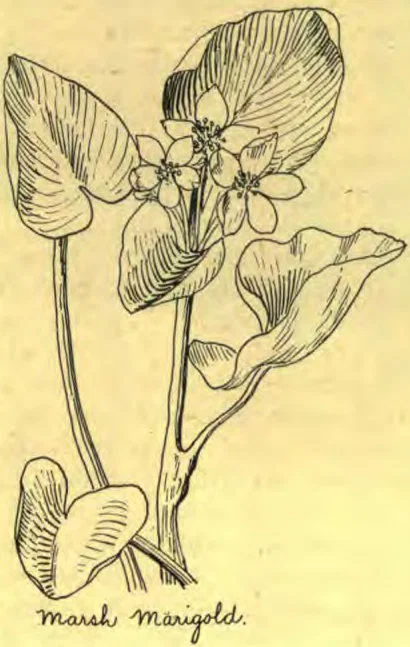
“CALTHA” means golden cup, and “palustris,” of a bog or marsh,—golden cup of the marsh. The plant is well known, and needs little description. Its flowers are yellow, scentless, and grow in clusters on long petioles. The leaves are kidney-shaped, the upper ones being nearly sessile (that is, attached directly to the main stalk), and the lower ones growing on long petioles, or leaf-stems. The stem is erect, branching at the top; it is hollowed and furrowed.
Marsh Marigold.
This plant boldly opens the spring in the marshes. It grows in both the Old World and the New. Shakespeare in one of his poems calls it Marybud. It is “so abundant along certain English rivers as to cause the ground to look as if paved with gold.”
The word “Mary” in the name probably refers to its use in church festivals during the Middle Ages, when it was one of the flowers dedicated to the Virgin Mary.
It resembles the buttercup, of which it is a relative. It should never be called cowslip; for it is not related to the English primrose, called cowslip.
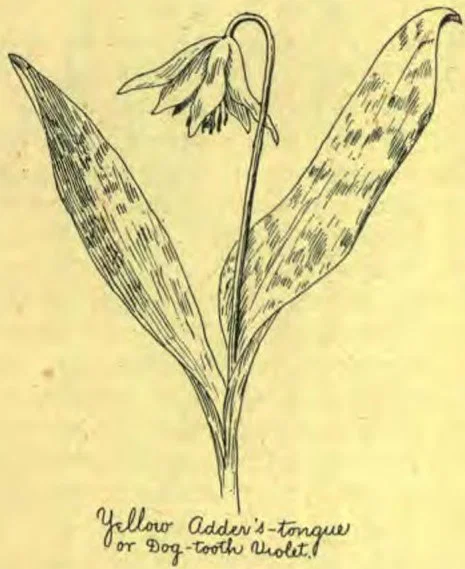
8—Adder’s-Tongue, or Dogtooth Violet
Erythronium Americanum
This plant has a solitary, terminal, nodding flower, with six slender divisions, streaked with purple. There are but two oblong, pointed leaves; they are spotted with dark purple and white.
The white adder’s-tongue is similar in appearance to the yellow. The flower is bluish white, and the leaves are not nearly so spotted. The plant is more common in the West than is the yellow.
There is a snaky look to the leaf, but why it should be called after a snake’s tongue does not appear. The blossom of the yellow adder’s-tongue is a russet yellow, spotted with a darker color in very delicate penciling.
The plant grows in hollows of the woods by some gurgling brook, in masses or beds. The flower closes at night, and opens in the morning. It has a faint fragrance resembling that of the tulip.
Burroughs has suggested “fawn lily” or “trout lily” as more appropriate names for this plant than those it bears.