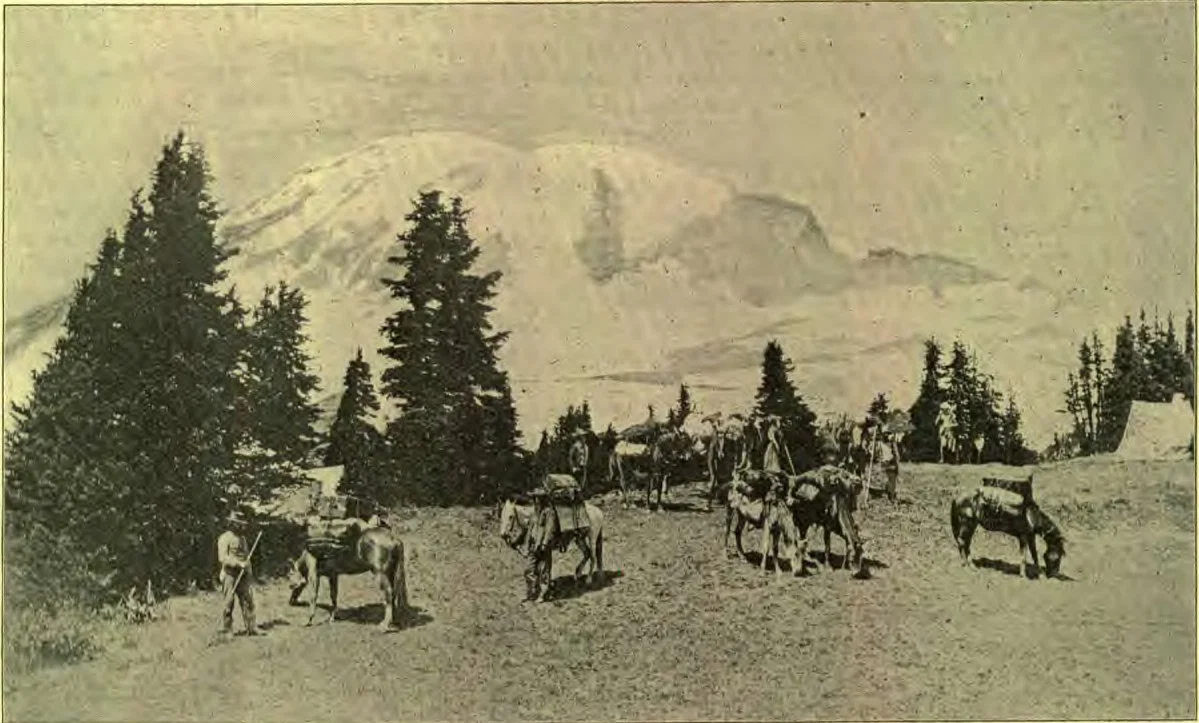
It has been the writer’s privilege to travel extensively in the Rocky Mountains of Colorado, the Sierras of California, and the Cascades of Oregon and Washington. In almost every part of these mountains, one will see something beautiful, grand, and awe-inspiring. Wild flowers rivaling in beauty and fragrance the most successful product of the florist’s care and skill, can be found growing within arm’s length of the snow. Precipices are often seen where a pebble, lightly tossed outward, will go whirling down more than a mile. Here, you see the marks of the earth’s struggles in the long ago,—a mountain thrown up at a single upheaval, or built more gradually by volcanic action; or a lake where once stood a mountain that the earth has swallowed up; there, some cañon, perhaps thousands of feet in depth, the work of a turbid stream that has been cutting away the solid rock ever since the flood. Or perhaps you may stand looking down into a deep ravine, whose sides are made up of loose rocks, lightly embedded in sand or gravel. It may not look steep, and you may be tempted to descend; but before doing so, kick one of the smaller rocks from its substantial foundation, and watch the result. The rock you have loosened may be no larger than your two fists; and at first it will move so slowly that you could easily overtake it, and without danger stop it with your hand or foot. But its speed increases as it goes, until it strikes a larger rock with sufficient force to start it downward. This, in turn, starts another, until from that small beginning, a great avalanche of rocks, some weighing hundreds of tons, is rushing down the sides of the ravine with an irresistible force. Watch some of the larger boulders. They will at first roll slowly, then move in short leaps, which gradually lengthen until they go whirling through the air hundreds of feet at a bound. Now they strike the bottom of the ravine; and you see a cloud of dust, from which fragments of rock fly in all directions, and presently you hear a report like the booming of a distant cannon.
Most people have heard of the famous peaks and glaciers of the Alps; but many are not aware that in the extensive mountain ranges of our own country are peaks and glaciers that outrank in height, and rival in grandeur, the most famous of the Alps.
In the Cascades there are nearly a dozen peaks that have an altitude of from nine thousand five hundred to fourteen thousand five hundred feet. Most of these mountains support several glaciers. In the Alps, glaciers are usually formed between two mountain peaks, and many of them are of great size. Those of the Cascades, however, are always found between two ridges of one peak, and are consequently smaller, although one of the nine supported by Mt. Rainier is nearly ten miles long, and at some points more than half a mile wide.
A glacier is simply a river of ice. In winter, and often in summer, more snow falls upon the mountain-top than can be melted by the sun. As it accumulates, the pressure of the snow above solidifies that lower down, until it becomes a solid mass of ice. When the weight becomes too great, it begins to creep down toward the valleys. Often where the incline is very great, a part of the ice becomes detached from the main body, and goes rushing down the mountainside in an avalanche, tearing up huge boulders, uprooting trees, and sweeping everything before it. As time goes on, the slow-moving ice forms beds for itself along the course of the least resistance, just as riverbeds are formed. Year after year the glacier tears up the bosom of the mountain that gave it birth, grinding the great boulders or blocks of lava into powder to be carried away by the stream that begins where the glacier ends.
About seventy-five miles east of Tacoma, in the heart of the Cascade Range, Mt. Rainier, or Mt. Tacoma, as it is sometimes called, towers high above the surrounding peaks, and stands the king of American mountains. Its altitude is fourteen thousand five hundred and thirty-two feet. The altitude of its timber-line is between seven and eight thousand feet; while the line of eternal snow is about one thousand feet higher.
Two of the principal glaciers of this mountain begin at about the same altitude, and are separated by only a high ridge of loose rocks. From this point they flow in slightly different directions, forming two sides of an irregular triangle. From each springs a river that bears the name of the glacier that gave it birth,—the Cowlitz and the Nisqualli. The Cowlitz River flows past the east end of the Tatoosh Mountains, while the Nisqualli passes to the west, completing the triangle. The Tatoosh Range, the third side of this triangle, is quite unique in formation. The peaks are nearly equal in height,—between eight and nine thousand feet,—and the range follows the points of the compass east and west almost as straight as a crow would fly.374
Within this triangle, nature has spread beauty and grandeur with a lavish hand. Paradise Park, it is called; and certainly no name could be more fitting. The soil is very rich, and the lower altitudes are covered with dense forests of cedar, fir, and mountain hemlock. Higher up, where the winters are more severe, the trees are dwarfed and ill proportioned. But the beauty of the wild flowers more than makes up for the plainness of the trees. More than four hundred varieties were gathered and classified by one man during a summer’s botanizing in Paradise Park. They grow wherever they find soil in which to take root. The most common flower is a pure white lily, called adder’s tongue. In some parts of the park these lilies grow so close together that they form a great carpet of delicate white and green.
Were Paradise Park divided into five-acre tracts, each would contain some charm peculiar to itself. There are cataracts from one hundred to one thousand feet in height, and lakes from a few rods to half a mile in diameter. There are deep cañons and high mountains, bare rocks and green meadows. Everywhere there is something new, something beautiful. Volumes might be written in description, and the reader would still have but a faint idea of what Paradise Park really is.