AFTER the gold excitement of ’49 and the early ’50’s had partially subsided, many of the disappointed gold-seekers in California began to look around for some other way to gain a competence. Most of the land had been granted by the Spanish and Mexican governments to individuals; and the newcomers found the original grantees or their descendants occupying large tracts for grazing purposes, while they lived a life of indolence and ease. These open-hearted, open-pursed dons were no match for the shrewd Yankees, and soon their lands passed from their control. Through mortgage and foreclosure, or direct sale, some of these grants were transferred intact, and usually became great fruit or grain ranches.
On such ranches, land is measured by the thousand acres, and crops are estimated by the thousand tons. The work is done by men who receive a fixed salary, and see their employer perhaps only once or twice a year.
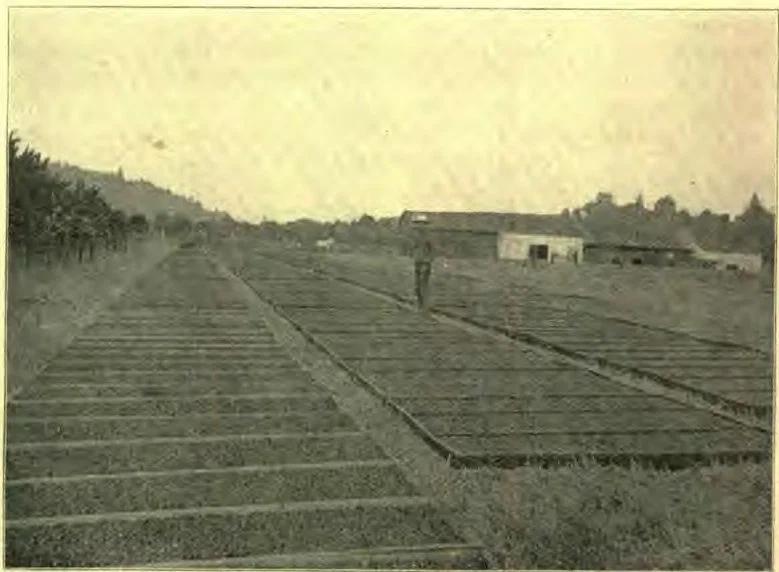
DRYING PRUNES.
These great ranches, and the methods of working them, have been described again and again, until the prevailing belief outside the State is that California is a land of great enterprises, where everybody is either a millionaire or a wage-earner. But California has its middle class,—the class that is neither rich nor poor, but is the mainstay of every nation,—the class from which spring the great men of all ages.
Most of the old Spanish land-grants were divided and subdivided until a tract of land that once boasted but a single ranch-house now supports hundreds of country homes, and perhaps several thrifty little villages.
California fruit has contributed more to the fame of the State than has any other one product except gold. But not all parts of the State are suited to fruit-culture. Some places are so arid that nothing can be grown without irrigation; in others the rainfall is so great that drainage must be resorted to. In some sections the summers are so long and hot that all but tropical plants will wither and die in the burning sun; while in others only the most hardy trees and shrubs can bear the rigor of the long winters. Some famed regions, however, nature has blessed with a happy medium between heat and cold, between drought and flood; and these are almost entirely given over to fruit-culture.
The Russian River Valley, a short distance north of San Francisco, is probably a fit representative of these regions. Within the memory of the “old-timers” this entire valley was owned by a few men, and was used wholly for stock-raising. Now it is occupied by thousands of fruit ranches.
Many of these contain but ten or fifteen acres; yet the smallest of them supplies work for at least one man throughout the whole year, and necessitates the employing of extra help in the busy seasons.
Grapes, prunes, peaches, and apricots are the fruits most commonly grown; but oranges, figs, olives, and, in fact, all fruits that can be grown in temperate or subtropical countries, find a place in this fertile valley. Because of the great diversity of the crops grown, there is no time in the year (except on holidays or during rain-storms) but some one will be found at work in the orchards.
January is fertilizing and pruning time.
In February comes the harvest of citrus fruit. This is sold in the open market, the principal part of the crop being shipped East.
About the first of March the early plowing begins. The soil is then thrown from the trees, leaving each row in a sort of trough, or ditch, made by the double furrow. The water from the spring rains is thus spread in about the roots of the trees.
The trees begin to blossom about this time, and by the middle of March the whole valley is filled with great patches of pink and white blossoms. It is a wonderful sight to stand upon a hilltop, and look down upon this vast flower garden, broken here and there by a green meadow or a dark, bare field, which marks a vineyard.
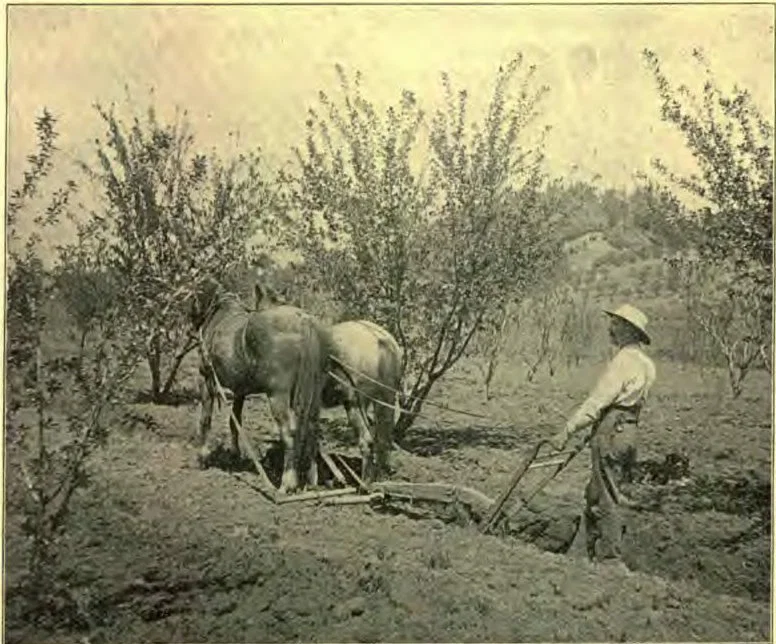
THE LATE PLOWING.
The orchards are often attacked by fungi and numerous insect pests. To guard against these, the trees are sprayed with poison while they are in bloom. The State Department of Agriculture is a great help to the farmers in this matter. Bulletins and pamphlets are periodically published, and circulated free of charge. By consulting these, the farmer is able to identify any pest that may attack his trees, and to apply the required remedy.
After the rains are over, the ground is again plowed; but this time the earth is thrown toward the trees, and the double furrow left between the rows. It is then thoroughly harrowed and “clod-mashed,” until the soil is soft and mellow, to prevent the moisture from evaporating too rapidly. When the spring rains are over, the trees must feed upon the moisture stored in the soil until the season’s crop is harvested. Sometimes when the ground is “laid by,” or prepared for the dry season, a late rain comes upon it. Then unless it is cultivated and harrowed again, the sun will bake a few inches of the soil into an adobe brick, under which the trees will not thrive.
Immediately after the late plowing comes the thinning of the fruit, to prevent the trees from overbearing. This will occupy the time until early in May, when the cherries begin to ripen. The local canneries use part of the cherry crop. The remainder is sold for home consumption, or shipped to the neighboring States.
June brings the apricots. The canneries take the best of these, and the remainder are dried.
Early in July some varieties of apples are ripe; and from that time until late in November462apples are in season. The flavor of California apples can not compare with that of those grown in the East; and for this reason there is little market at the canneries, and no call for shipment of this fruit outside the State. Some apples are sold for home consumption, but the principal part of the crop is either dried or left to rot where it falls. Seven dollars a ton is thought to be a good price for apples sold for drying. Despite the usual waste and small price, however, the trees are so prolific that apples are one of the best-paying fruit-crops.
About the first of July the first figs are ripe. A fig-tree is said to bear three crops during the season; but it really bears continuously from July till November. Very few of the first figs mature; but those that do ripen have a much finer flavor than those that come later.
The early peaches are gathered in July, and from then until September the later varieties, with the pears, plums, apples, and figs, keep the farmer busy. The most of this fruit, with the exception of apples and figs, is used by the canneries; the remainder is dried.
In September the prune crop must be cared for. There is no market for this fruit until it is dried. As soon as possible after the prunes are gathered, they are dipped in a hot solution of lye to break the skins. They are then washed, and spread out on large trays to dry in the sun. Within the last few years, machines that greatly facilitate the dipping and washing process have come into general use, but it is hard work at best. Undipped prunes require about six weeks to dry; but by dipping, the time is shortened to ten days. Before the drying is finished, the early fall rains sometimes begin, and then the trays must be piled up and covered until the storm is past. If the rains are frequent, or of long duration, part of the crop sometimes mildews, and must be thrown away.
About this time the olives are ripe, if they have not been picked green. Ripe pickled olives are now being placed upon the market, but as yet only a small part of the crop is utilized in this way and for the production of olive-oil. By far the greater portion goes to the consumer as pickled green olives.
October is the time for grape-picking. The grapes of this section are almost entirely used in wine-making. They are hauled from the vineyard directly to the winery, and are often crushed the same day they are picked.
Early in November the last of the figs and winter apples are gathered. Then, when the fruit-boxes and drying-trays are collected, the farmer has a few weeks for a general clean-up before the Christmas holidays; for his year’s work really begins and ends with the year.