The Volume.
In one of the visions recorded in the Apocalypse, the apostle saw a book “written within and on the back side, sealed with seven seals.” This was the volumen, or scroll, the ordinary form of a papyrus book. Most scrolls were written only on the inside; but the original copies of authors were often written on both sides, and this one was written in that way.
The papyrus was usually made up into rolls of a convenient size; twenty sheets usually went to a roll. The first, or left-hand, sheet was of the best quality; for it had to endure much wear. This sheet was called the protocol, a term now used of the first draft of a treaty. The last sheets, which were well protected, and were often, when not needed, cut away entirely, were of the poorer grades of papyrus. After a book was finished, the last sheet was fastened to a round stick, with knobs at the ends, called the umbilicus, upon which the papyrus was rolled. In reading the book, the umbilicus was held in the right hand, and the part which had been read was rolled up with the left. No doubt this was very clumsy; at least we should find it so. It may have seemed easy and convenient to those who knew of no better way.
The edges of the roll were trimmed so as to make an even surface, smoothed with pumice-stone, and sometimes handsomely stained. The backs of valuable manuscripts were rubbed with cedar-oil to keep away moths. A wrapper, called the “traveling cloak,” made of colored vellum, was rolled about the book. Finally a strip of vellum, usually colored, was pasted to the upper edge of the papyrus, so as to hang out; and upon this was written the title, or label, of the book. This was called the index, or syllabus.
A large work could not be written on a scroll of convenient size, so authors usually divided their writings into small “books,” about long enough to cover an ordinary roll. This roll was sometimes called a tomos, or cutting. We still have all three words applied to the larger divisions of a book,—book (liber), volume, or tome. The last two of these, at least, remind us of the time when books were scrolls of papyrus; while the first carries us back to the original roll of bark.
To make reading easy, the writing was arranged in narrow columns called paginæ,—pages,—from a word which originally meant a plank. They were also called by another name, which meant a gang-plank. To rule the papyrus into lines and columns, a rolling disk of lead was used; a pencil would have torn the fabric. If errors were to be erased, the ink was wiped off with a sponge. In the older books the title was written at the end; but afterward it was written also at the beginning, on the protocol, which usually bore the signature and trade-mark of the makers of the papyrus. The back of the manuscript, like the fly-leaves of a modern book, was used for notes, for scribbling, or for any sort of writing that waste paper is likely to receive.
The several volumes of a book could not be tied together; that would have destroyed the papyrus. They were kept in a round chest, or capsa, made for the purpose. Each book had its own chest, or chests; for if the book was very large, one chest would not contain it all,—the chest having room for from three to ten volumes. The luggage of a literary gentleman on his travels in those days included an assortment of these chests.
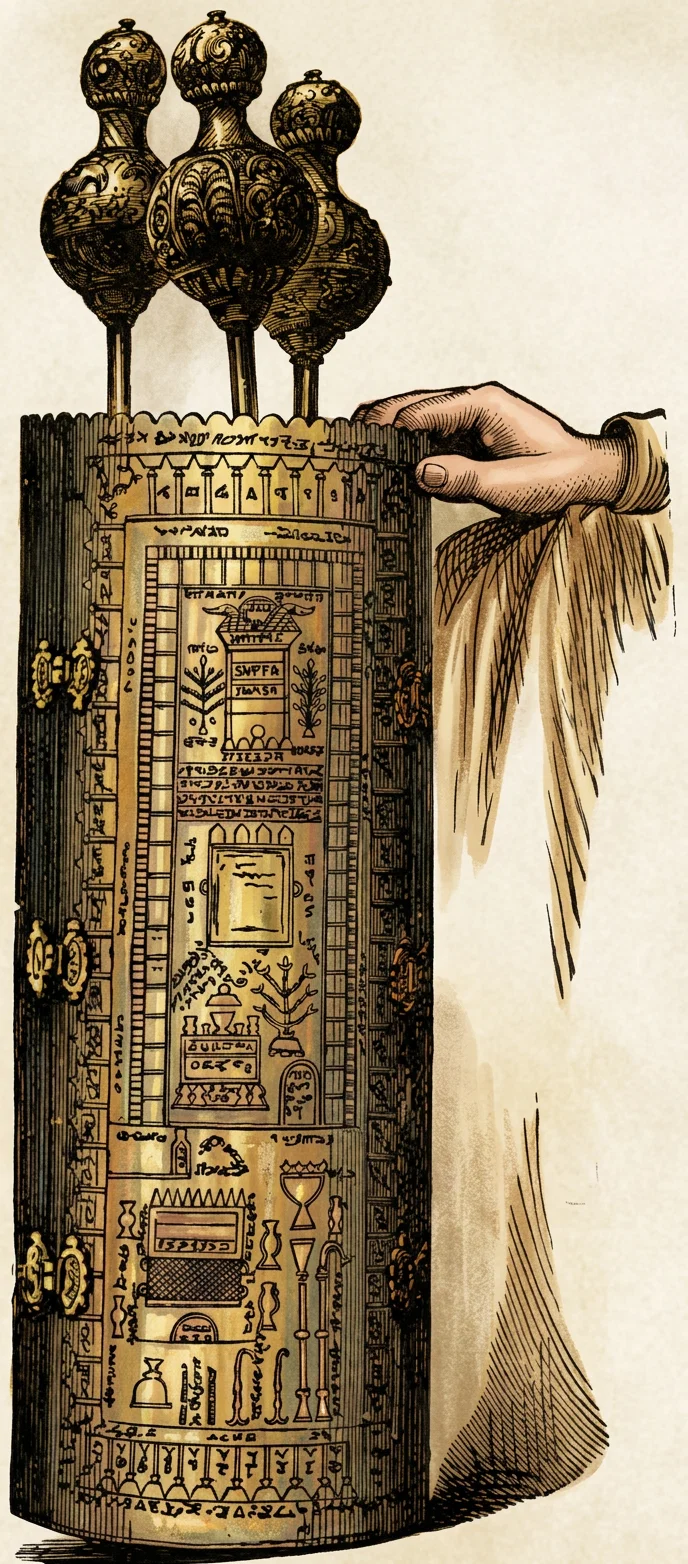
If we could walk through one of the great libraries of classic times, we should see on each side, not shelves, but tiers, of boxes, like pigeonholes, and from each box would project the ends of several scrolls. Some would be wrapped in traveling cloaks of rough shipping-papyrus,—charta emporetica,—others in gay coats of scarlet and blue and costly purple vellum, with umbilici of handsomely carved ivory. Some would have plain white edges, others would be stained or gilded, and from all would hang the little bright-colored tags bearing the syllabus. In places handy to get at would be the catalogues,—heavy volumes with endless lists of books. There would be attendants, too,—in Greek costume, of course,—passing back and forth through the aisles.
Though the scroll belongs to the age of papyrus, it was not always of that material. The Jews always wrote the law upon scrolls of skins, and invariably on the inner side; to write any part of the sacred text on the back was thought to be a sacrilege. Vellum was sometimes made into rolls; but by the time it came into general use, the modern form of book had become common. Enumerations, genealogies, charters, and similar documents were written on rolls, even up to recent times; but always crosswise, and not lengthwise, as ancient books were written. From the use of the roll in England for such records, we have the expressions “enrolment,” “tax-roll,” and the like; and to call out the names of the members of a body in order is to “call the roll.”
C. B. MORRILL.