WISH to tell the young people of the INSTRUCTOR family about a beautiful Yellow Queen, who is not only pretty to look at, but is also the most wonderful mother I ever saw or heard of. Her children never quarrel, nor get jealous of one another. She never has to scold one of them, or even tell them to go to work; for they are always busy, either in the house or outdoors, cheerfully attending to their duties; and instead of leaving home as soon as they are old enough to help, as many young folks do, they remain her dutiful and loving subjects. What do you think of that?
Perhaps I ought not to call them subjects; for where there is no disaffection, there is no need of a ruler; so, after all, this queen is only the mother, and the subjects are her children. And they are such loving children, too! Ten or a dozen of them follow the queen about continually, forming a circle around her, caressing her, and offering her the daintiest food they can prepare.
Now I know you are beginning to think about the size of her family, and the number of the children. Do you doubt that there are a dozen waiting on the queen, and wonder how many more there are, and what they do? Why, there are ever so many more! She never has to hire any servants; for her own children do all the work themselves. Some take care of the babies; some clean the house; others work in the fields, or carry water and food; and a good many are busy all through June and July, and sometimes in August, making its odd six-sided boxes, in which they keep their food. When these boxes are empty, they are often used as cradles for the babies.
But you are still thinking that I am mistaken in regard to the size of the family. Well, you’re the ones that are mistaken, this time. The Yellow Queen I am talking about is the mother of over one hundred thousand children, counting both dead and alive. Just think!—as many as three thousand five hundred new babies in a single day! Where do you suppose the mother finds names for them all? Perhaps she calls them by numbers. Wouldn’t it seem queer to have Eighteen-hundred-and-ninety-nine for a name?
Oh, I didn’t tell you that the Yellow Queen is a bee, did I? Before a bee is fully developed, it must be, first, an egg; secondly, a larva; and thirdly, a pupa. The queen lays two kinds of eggs,—one for workers, and the other for drones.
As the queen walks over the beautiful cells of honeycomb, some filled with babies and some with food, she comes to one that is empty. Then down she goes, head first, to the bottom of the cell, to examine it. If it suits her, she will draw herself up, and, turning around, will back down into it and deposit an egg. There are always enough bees in a hive, or colony, to keep nice and warm the eggs laid by the queen. In about three days the eggs hatch, not into bees, but larvæ. You would never suspect that one of these tiny white worms, not much larger than a poppy seed, would grow into a bee that could chase the strongest man ever seen. This very often happens, though.
As soon as the baby bee hatches, it is fed by the workers. They always have on hand many cells of bee-bread, and this they mix with honey till they have a substance that looks much like cream, and makes the proper food for bee-larva. The baby bees never have to wait for anything to eat; for their faithful nurses feed them “between-meals” and at all times, so they grow very fast.
These little worms eat and grow in their cells, curled up like sleepy puppies, till they get too large for their skins, and too fat to lie in the bottom of their cells. Then they begin to stretch, and their skins crack and rip open; but, luckily for them, there is another skin underneath each old one. Presently the larvæ straighten out in their cells, and the nurse bees give them some more food, and cover them all up, so no one could see one of them. It is while they are in this state that they are called pupæ.
Just twenty-one days after the egg is laid, the pupa cuts the cover off its cell, and crawls out, a bee. It is very pale and weak at first; but after sipping some honey, and walking about awhile, it grows strong.
Besides the workers, there are the drones, or male bees. These bees never work. While there is plenty of honey to be found, they live in idleness, feasting on the sweets that the workers have toiled hard to store up; but as soon as the flowers fail, these loafers are killed, and their bodies dragged away from the hive by the workers.
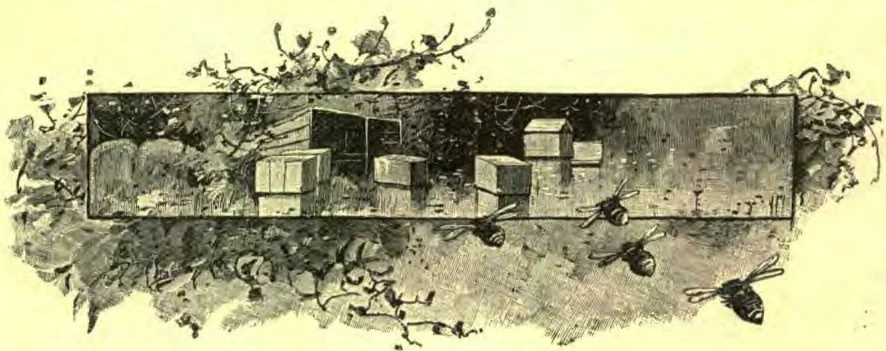
A hive full of bees that are at work, is called a colony, and a number of colonies is an apiary. In every apiary there are many queen bees just as wonderful as the one I have told you about. Occasionally strange bees begin robbing a weak colony; then a tent made of netting is set down over it for a while. Very often robber bees bother the person working a colony, in which case the tent is used for shelter to both the man and the colony he is handling.