Our lesson this week is on making patterns for the foot-lathe spoken of in the previous number.
The trade of pattern-making is a good one, not only because it is pleasant work, but also because a first-class pattern-maker always commands good wages, and instead of having to seek employment, his services are in demand. The work is light; but it requires painstaking, and a workman who can readily understand a draft. It is well for boys who are interested in the use of tools to have some knowledge of this kind of work; for many times they can put it to good use in repairing some piece of household furniture. For instance, many times the grate to a cook-stove burns out, rendering the stove almost useless; but if one can make a pattern, he can get a new grate cast at a foundry, which, in its proper position makes it as good as new again.
In making patterns you need first to know something about the shrinkage of metal. A pattern-maker's rule is always one eighth of an inch longer to the foot than a carpenter's rule. All patterns that are required to fill a certain space must have this addition to size.
One who has never worked in iron hardly knows what can be done with cast iron. I have worked a good deal in a machine-shop and foundry, molding and making iron. At one time, when wanting a quantity of shafting for the shop, we made it of cast iron, in sections eight feet long and three inches in diameter. In cooling, some of it sprung an inch; but by peening (repeatedly striking) it upon the concave side, we straightened it.
My first experience in pattern-making was when I was about thirteen years old. I wanted to make a model for a trip-hammer; so I made my patterns for a drive-wheel, which had to be made in sections, and went out to the sand in the garden, and started a small foundry, using lead instead of iron for my castings. I had no thought then that I should ever work in a foundry; for at that time I had never seen one. All the knowledge I then had of one was imparted to me by a cousin. It is a good plan to study up these things, in order to be ready for any emergency.
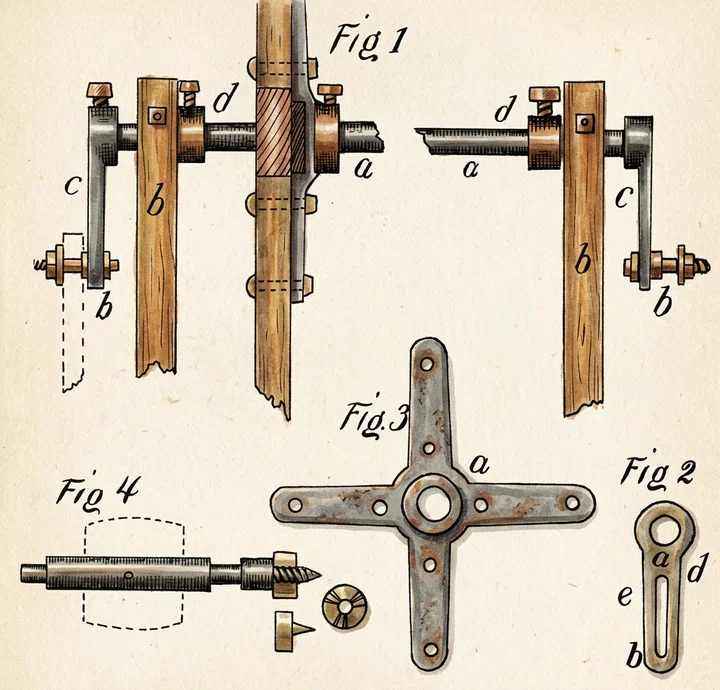
Now for the lathe patterns. In Fig. 1 you will see the shaft mentioned in the last article, broken in two at a, a. At b, b are the two end planks in which the shaft revolves. Upon each end of this shaft, at c, c, you will see a crank made of cast iron. In Fig. 2, d represents the face side of the crank. This crank should be about eight inches long, two and one-fourth inches wide at the largest end, with a hole in the center seven eighths of an inch upon the smallest end of the hole, which, by giving one-sixteenth-inch draft, makes it one inch upon the other side. At e, three fourths of an inch from the end of the pattern, you will notice a slot three and one-half inches long, and one-half inch wide. This gives place for the bolt to the treadle-rod to move up or down in adjusting the length of the tread.
In Fig. 3 you will see what is called the spider, in the center of which is a round ring two and one-half inches in diameter. At a this is placed upon the arms, which are made of two pieces twelve inches long, two inches wide in the center, and an inch and a half wide at each end. The ring should be made one inch thick, so that when placed upon the arms, it will be an inch and a half thick where the hole is made for shaft. Make the hole seven eighths of an inch upon one side, and one inch on the other. Make half-inch holes through the arm-pieces for bolting spider to driving-wheel.
At d, d, Fig. 1, are shown some movable collars for keeping the shaft in place. The pattern for these should be one inch thick and two and one-fourth inches in diameter, the center hole the same as in the spider.
In all these you will see a set-screw, as shown in Fig. 1 at d, d, so that when the holes are drilled out or filed to fit the shaft, the screws will hold them in place. File a little flat place in shaft for screws to rest upon to prevent their turning upon shaft. Now taper or bevel the edges of all your patterns about one sixteenth of an inch, placing the large size of hole upon the narrow side of patterns.
In the end of crank, c, at b, is a bolt with double nut for holding it in place in slot, e, also a nut and washer; or you can drill a hole, inserting a washer and a cotter-pin to hold the rod in place.
The mandrel is shown in Fig. 4. It is made with a screw upon the end, and the nut has three projecting spurs to hold the wood for turning.
This article is already so long it will be necessary to reserve for our next study the finishing up of patterns, making cores, moldings, etc.
W. K. LOUGHBOROUGH.