It seems as if the prophet Jeremiah must have had a view of our day when he spoke of a people saying, “Peace, peace; when there is no peace.” Not many months ago there was proposed a peace and disarmament conference of representatives from the leading nations of the world, with the ostensible purpose of bringing about universal peace, and yet at the same time the very ruling power that has proposed and furthered this move has been, and continues to be, the most eager and active in extensive preparation for war. What, then, did the czar of Russia, that most despotic of all civilized rulers on earth, mean by his proposed “peace conference”?
The 18th of May was the day when this peace conference convened. It was made up of delegates from all the leading civilized powers of the world. Our own government sent no fewer than six prominent men to represent its interest in bringing about that much-desired universal peace. There were Andrew D. White, educator, historian, and diplomat; Stanford Newel, a typical Western citizen; Seth Low, administrator; Alfred T. Mahan, interpreter of naval history; Captain Wm. Crozier, military inventor; and Frederick W. Holls, lawyer.
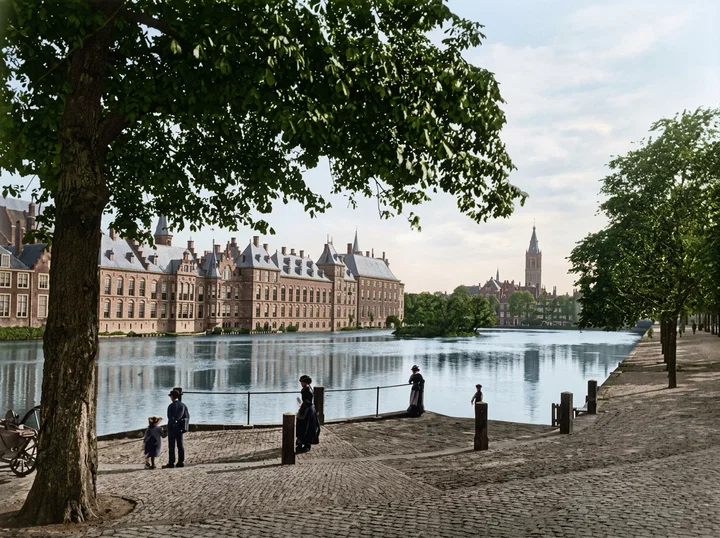
The place selected for this extraordinary convention was the beautiful city of The Hague, in southern Holland; and the purpose of this article is to give the readers of the INSTRUCTOR some idea of this noted place. It lies about thirty-six miles from Amsterdam, thirteen miles northwest of Rotterdam, and two miles inland from the North Sea. In 1874 the total population was stated at 94,895.
Though Amsterdam, from its size and importance, is looked upon as the commercial capital of Holland, The Hague is the real governmental capital, being the residence of the ruler and the foreign ambassadors, and also the place for all diplomatic and legislative assemblies, in this respect corresponding to our Washington, D. C. On account of its political character, the population is largely made up of government officials, members of the nobility, and of the army and the navy. Broad, regular streets, extensive avenues and drives, and spacious squares, all beautifully lined with trees, also numerous shady canals, large and beautiful buildings,—these, in brief, constitute the general features of the city. It is described as “the handsomest, the most fashionable, and the most modern-looking” city in the Netherlands.
The Hague is mentioned as early as 1097 in a document by Count Floris II, and seems originally to have been a shooting-lodge, or hunting-park, of the counts of Holland. During the reign of William II it became the residence of the court. In the fifteenth century it attained the importance of a town, though frequently called a village, even down to the time of Louis Napoleon. In 1479 Austrian soldiers put the place to ransom; in 1525 Johannes Pistorius suffered martyrdom there; in 1528 it was plundered by the people of Guelderland; and in 1572-4 it was laid waste by the Spaniards. In 1576 it was restored by William I, and became, in 1584, the seat of the sessions of the states of Holland. Important conventions of European powers have been held at this place from time to time. In 1808 it became the seat of the government administration. Such, in brief, is the history of The Hague.
In the center of the city stand the buildings of the court, the oldest of which date back as far as 1249. A beautiful Gothic building, with towers at each corner of the façade, contains the historic knights’ hall, a noble chamber one hundred and thirty feet in length, sixty-two feet in breadth, and sixty-nine in height. Among the public institutions may be mentioned the royal library, with upward of one hundred thousand volumes, and a valuable collection of manuscripts, coins, and gems; the museum, with many wonderful antiquities and curiosities; the royal picture-gallery; the Vyverberg hotel, which also has a fine collection of curiosities; the town museum of antiquities and modern art; the zoological gardens, founded in 1862; the royal school of design and music; and the new buildings for arts and sciences, erected in 1874. Of the twenty or more churches, the Groote Kerk (Great Church) is architecturally the most noted, being three hundred feet long and one hundred and fifty-four broad, with a lofty hexagonal tower, in which is a carillon of thirty-eight bells. This church was founded in 1308. The country around the city is embellished with many handsome residences.
The industries of the city are printing, lithographing, metal-founding, silk-dyeing, carriage-building, cabinet-making, distilling, and a few others.
From the city leads a broad causeway, beautifully skirted with trees, to Scheveningen, a favorite bathing-place on the seacoast.
From a large book on the world’s great nations we quote the following:—p. 358
“Notwithstanding the drawbacks of its situation, it is a splendid town; the public buildings are stately; the streets broad and regular, well paved with small bricks, traversed by canals, crossed by bridges, and lined with trees; and surrounded by a moat with drawbridges. The principal streets are the Voorhout, containing many fine hotels; the Prinsengracht, Kneuterdyk, and Noordende. A trifling rise of the ground here, dignified with the name of a hill, forms the site of the Vyverberg (the hill of the pond), which is a square, planted with trees in formal avenues on one side, forming the public promenade, with the pond on the other. . . . Tame storks are seen parading about the fish-market; and a residence something like a dog-kennel has been built for them.”
Between the Vyverberg and the Binnenhof lies the prison gate-house, in which Cornelius de Witt was confined on a charge of conspiracy against the Prince of Orange in 1672, and whence an infuriated mob dragged him and his brother John, who had been induced to visit him, and murdered them in a most inhuman manner, literally tearing them to pieces. The humble dwelling in which the elder of these brothers lived stands within a few yards of this spot, in the Kneuterdyk. A. SWEDBERG.