“Mama, where have the butterflies gone? Do they go away to the South, where it is warm, when the cold weather comes, as the birds do?”
Nell had been standing at the window, watching the first snowflakes of the season as they floated down, and covered the sear brown leaves scattered over the lawn; but now she turned from the window, and sat down on an ottoman at her mother's feet.
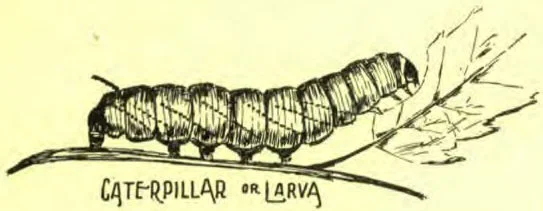
CATERPILLAR or LARVA
“No; the butterflies do not go away to spend the winter; for they, like most other insects, have lived as long as nature intended, and die before the winter really begins.”
“Where do the next year's butterflies come from, then?”
“That is an interesting question, Nell. Do you remember that big green caterpillar we put in a fruit jar early last fall?”
“Yes, and we filled the jar about half full of earth, and tied a piece of mosquito-netting over its mouth, to keep the caterpillar from getting out; but one morning when I went to give it some fresh leaves, it was gone, and you said to let the jar alone, and sometime we would see what we could find in the jar.”
“Well, suppose you bring it here, and we will see if we can find any trace of Mr. Caterpillar. Now spread a newspaper out on the floor, and empty the earth out on that. What do you find?”
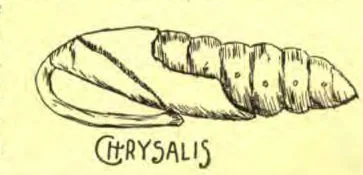
CHRYSALIS
“Nothing but some lumps of earth. Oh, yes! here is a queer-looking brown thing. What is it?”
“That is the Mr. Caterpillar of last year, and the Mr. Butterfly of next year.”
“A caterpillar and a butterfly both? How can that be?”
“It does seem strange, and yet it is simple, too, when you understand it. During her short life each female butterfly deposits, in some suitable place, a large number of tiny white or yellow eggs. It is not long before these eggs burst, and send out a swarm, not of little butterflies, but of tiny, crawling, hairy things, which you would no doubt call worms, but which scientific men call ‘insect larvæ.’ Some day we will talk about the real worms, and then you will understand the difference better.”
“For lack of a better name we will call these little creatures insect-worms; but we must be sure to remember that they are not real worms, and that we use this name only because it is convenient.”
“But what becomes of these little insect-worms? and how do they get to be butterflies?”
“As soon as they come from the eggs, they go to eating as if to eat was the one thing worth doing. Sometimes when they find a tender plant just to their liking, they do not leave it until nothing is left of it but the woody stems. The result of this great appetite is that the little insect-worms grow very fast. In many species, the larvæ grow so fast that it becomes necessary for them to change their skin more than once during their short life in the larval state. When one of these insect-worms has grown to its full size, it stops eating, crawls away to some quiet spot, and goes through a wonderful change. If you leave the place for a while, and then go back, you will not find the lively creature you left, but a lifeless looking object like this one you found in the jar. This stage of the caterpillar's life is known as the ‘chrysalis state;’ and the particular form the insect takes in this stage depends upon the kind of insect. Some spin themselves beautiful silk houses; others fold leaves about them; others like the one we are keeping, go into the ground. It would be interesting for you to see how many different varieties you can find, and make a collection of them.
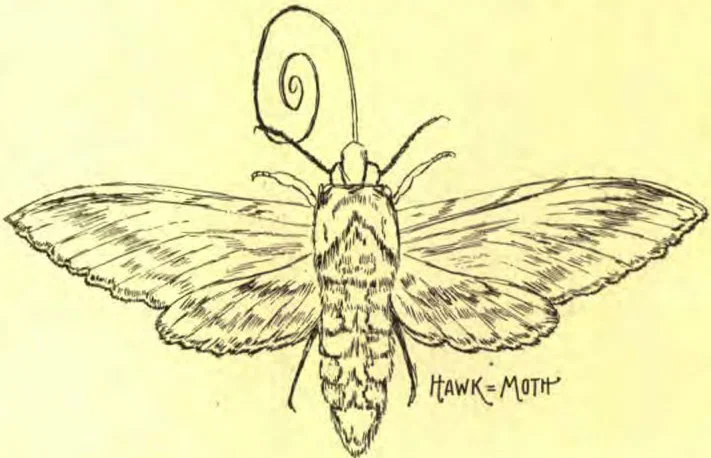
“After the insect has been asleep in its curious little house as long as Mother Nature thinks necessary, she helps it make itself a door; and out steps—not a caterpillar—but a butterfly, just like the one that laid the eggs from which the little insect-worms came in the first place. However, when this chrysalis opens, it will not be a true butterfly, but a great soft-winged moth, that will come out. Moths and butterflies are near relatives, and their habits are very much alike. This is one of the great hawk-moths, which you have often seen hovering over a bed of flowers in the summer evenings, and which are sometimes mistaken for humming-birds as they flutter above some flower, and draw their food from it by means of their long tongues.”
Nell picked the queer brown thing up in her fingers, and looked at it with wondering eyes. “First an egg, then a worm,—”
“Insect-worm,” corrected Mrs. Dean.
“An insect-worm,” went on Nell, “then a chrysalis, and then a butterfly, or a beautiful moth! It’s more wonderful than a fairy story.”
“And this is only one of the many wonderful stories that nature will tell you if you are a good listener, and keep your eyes open,” answered Mrs. Dean, as she replaced the earth in the jar, with the brown lump that would some day open to release the beautiful hawk-moth.