I.—AMŒBA.
Did you ever consider how brimful our world is of life, and what a different place it would be if no living thing had ever been upon it? There is scarcely a waking moment of our lives in which our eyes do not rest either on some living thing or upon things which once had life. Even in our rooms, the wood of our furniture and our doors could never have been without the action of life. The marble from which our beautiful monuments are chiseled, is the remains of once living creatures, being composed of their broken shells. The food we eat, the clothes we wear, the very paper upon the wall, are all made of materials which life has produced for us.
Wherever we go, living creatures are to be found, and even if we sail out over the silent deep, and try to search what is hidden beneath, there, too, we find abundance of life.
Now since we live in a world teeming with living beings of every description, many of them leading very curious lives, but trying, like us, to make the best of their short time here, is it not worth our while to learn something about them? They, each in his way, all proclaim the love and skill of the heavenly Artist, and show forth the glory of God; for his character is manifested in all the beautiful objects of life and nature. Mrs. E. G. White says: “Every created thing has in it charms which interest the child of God, and mold his tastes to regard these precious evidences of God’s love above the work of human skill.” So let us continually keep this thought before us, as we study the works of the great Life-giver.
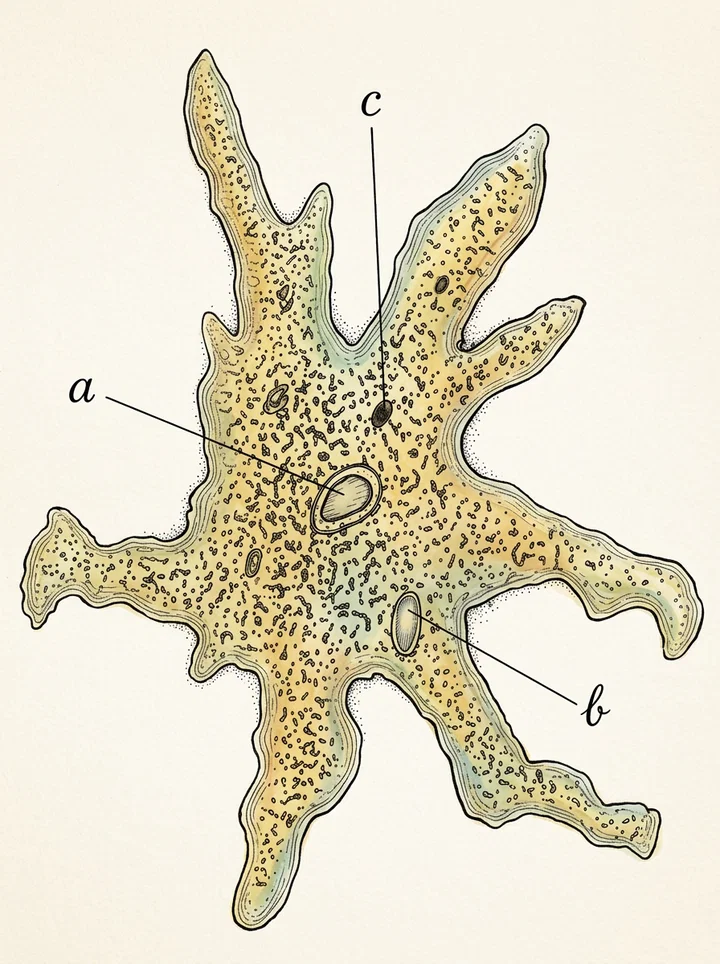
We will begin with the simplest form of living beings, aided in our search by the microscope. If we dip some water up out of a standing pool, where the leaves or stems of submerged plants are found, and place a drop of it under a microscope, we see thousands of living creatures floating in search of food. Selecting one, let us examine it. As we look at it, gliding over the glass, sometimes it appears like a mere drop of gum. Sometimes we see it with its pseudopodia, or false feet, stretched out and seeking food. But examine it as we will, we can find no mouth, no stomach, no muscles, no nerves. It is merely a cell,—a bit of protoplasm, which is the basis of all life.
This little animal is called the “amœba,” and belongs to the lowest class of life, the Rhizopoda. Its food consists mostly of portions of thread-like plants. But how does it eat without mouth or stomach? After selecting its food, as for example a minute plant, it swallows it by moving toward the object, and gradually closing around it, until it is enveloped within the creature’s body, which is so transparent that the food can be seen through it. The animal then has power to digest it and absorb it after digestion.
Throughout the body are granules which have a rude sort of circulation. Besides the food particles, there is also in or near the middle a clear round body called the nucleus, and, usually, a hollow, round, pinkish space, which enlarges and contracts, called the “contractile vesicle.”
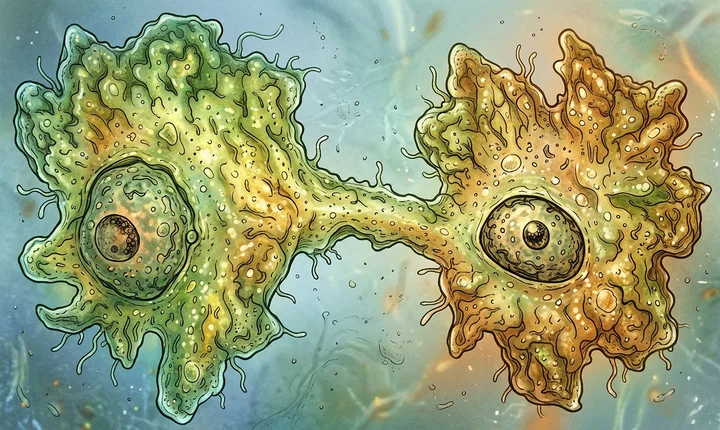
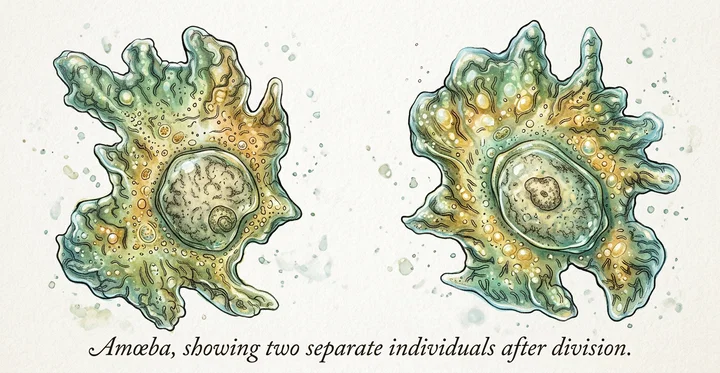
The amœba reproduces its kind by simply dividing into two portions. The division begins by the nucleus separating itself into two parts, and this continues until the entire animal has split in two, and each half goes on its way rejoicing, as a living animal. It divides and subdivides itself in this manner several hundred times in a few moments.
But how can we be sure that it lives?—In the first place, it breathes. If we keep it in a drop of water, it uses up the oxygen, and makes the water impure by breathing into it carbonic acid. Then it moves, and can drag in and throw out its false feet, when and where it chooses. It eats; it grows; it reproduces itself. This little drop of slime, without eyes or ears or parts of any kind, knows how to find its food; without muscles or limbs, it is able to creep; without a stomach, it can digest the food in the midst of its own slime, and throw out the hard parts which it does not want. Thus are foreshadowed in this exceedingly simple organism all the important functions of higher animal life.
T. J. ALLEN.