On the eve of February 20, in his seventy-eighth year, and unexpectedly, the greatest of America’s colored men died at his residence on Anacostia Heights, in the suburbs of the national capital. His death is an irreparable loss to the colored race, leaving a void which none is ready to fill. Commenting on his career the Inter Ocean says: “Few names in American history are surrounded with so much of the romance that delights the youth or instructs the old as is the name of this man, born a slave on a Maryland plantation [at Tuckahoe, Talbot county, in February, 1817] more than three quarters of a century ago, yet who, through his own practically unaided efforts, and at times combating against odds that would have overwhelmed a weaker man, climbed to the dizzy heights of fame. Though of an origin humble even for a slave, he has numbered among his friends the possessors of the brightest intellects that have adorned the century in this country and in Europe, and the wearers of all titles and patents of nobility. He probably was alone in the world in having lived to see all the hopes of his earlier years realized, beyond, indeed, his most fanciful longings. As an orator he probably had no peer, and he has enriched the language by the addition of many particularly striking epigrams, one of which—‘One and God are a majority’—will serve as an example of their originality and strength.”
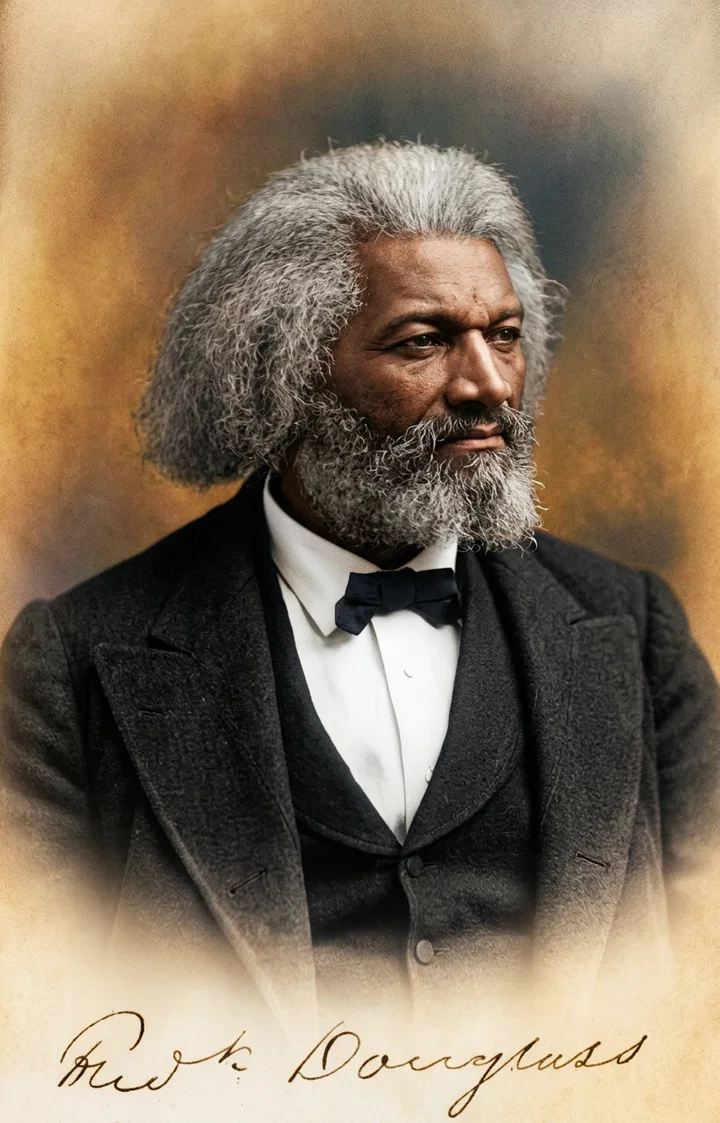
His real name, given him by his mother, a slave, who like most colored persons was fond of high-sounding words, was Frederick Augustus Washington Bailey. At the age of ten his master sent him to Baltimore, having been hired, slave-fashion, by the proprietor of a shipyard. He soon earned good wages, but—every penny of the most scanty pittance his cruel master had allowed him he used to satisfy his great thirst for knowledge.
After this a good opportunity presented itself, and he, under the assumed name of Johnson, fled to New England, married, and settled down at New Bedford, Mass., where he obtained for several years permanent employment in a shipyard. As the Johnsons seemed to abound in that locality, he was induced by a certain gentleman who was a great admirer of the character of Douglass in Sir Walter Scott’s “Lady of the Lake,” to assume the name by which he became universally known. He was a reader of William Lloyd Garrison’s Liberator, and soon heard this great leader of the abolition movement lecture on his chosen subject, in which he made the famous declaration: “Prejudice against color is rebellion against God.” By this Douglass himself was won as an active worker in the cause that made him eventually so famous—the emancipation of the colored race. One of the first books he had ever purchased with the meager allowance of his slavery days was the “Columbian Orator,” for which he laid out all he possessed—fifty cents. Of the value of this book to him in after years Mr. Douglass himself says in his “Memoirs”:—
“This volume was indeed a rich treasure, and for a time every opportunity afforded me was spent in diligently perusing it. Among much other interesting matter, that which I read again and again with unflagging satisfaction was a short dialogue between the master and his slave. The slave is represented as having been recaptured in a second attempt to run away, and the master opens the dialogue with an upbraiding speech, charging the slave with ingratitude, and demanding to know what he has to say in his own defense. The slave rejoins that he knows how little anything that he can say will avail, seeing that he is completely in the hands of his owner, and with noble resolution calmly says, ‘I submit to my fate.’ Touched by the slave’s answer, the master insists upon his further speaking, and recapitulates the many acts of kindness which he has performed toward the slave, and tells him he is permitted to speak for himself. Thus invited, the quondam slave makes a spirited defense for himself, and thereafter the whole argument for and against slavery was brought out. The master is vanquished at every turn in the argument, and appreciating the fact, he generously and meekly emancipates the slave with his best wishes for his prosperity.”
“It is unnecessary to say that a dialogue with such an origin and such an end, read by me when every nerve of my being was in revolt at my own condition as a slave, affected me most powerfully. I could not help feeling that the day might yet come when the well-directed answers made by the slave to the master in this instance would find a counterpart in my own experience.
“This, however, was not all the fanaticism which I found in the ‘Columbian Orator.’ I met there one of Sheridan’s mighty speeches on the subject of Catholic emancipation, Lord Chatham’s speech on the American war, and speeches by the great William Pitt and by Fox. These were all choice documents to me, and I read them over and over again with an interest ever increasing because I was ever gaining in intelligence. The more I read them the better I understood them. They added to my limited stock of language, and enabled me to give tongue to many interesting thoughts which had often flashed through my mind, and died away for want of words in which to give them utterance. The mighty power of heart-searching directness and truth, penetrating the heart of a slave-holder and compelling him to yield up his earthly interest to the claims of eternal justice, are finely illustrated in the dialogue, and from the speeches of Sheridan I got a bold and powerful denunciation of oppression, and the most brilliant vindication of the rights of man.”
Here, then, we have a glimpse of the simple elements which entered into his make-up, like timbers for the framework of a mighty orator. He read many works of the leading minds, past and present, of different nations. His library was well equipped with standard English,p. 90 French, and German works, and with current literature; for Mr. Douglass kept well abreast with the times up to the very day of his death, during the afternoon of which he attended the Convention of the Women of the United States, for whose work he had for many years manifested a very lively interest. He is the author of several works on slavery, and kindred topics, as well as of a history of himself entitled, “Life and Times of Frederick Douglass.” For several years he also edited a weekly paper, first (1847) called Fred Douglass’s Paper, and afterward the North Star, which he conducted with marked ability in the interests of the anti-slavery movement, although he met much opposition, even by such papers as the New York Herald. He filled various offices under the government, lectured in Europe and this country, on the abolition of the slave-system, and held equal rank with the foremost minds in the country in the great forensic art, the peer of the strongest men that dared to measure lances with him. Sneered at, hissed, mobbed, stoned, assaulted, he stemmed the tide, and came off conqueror every time. When even white men did not dare to speak the truth on the slavery question, he dauntlessly raised his clarion voice against that giant evil with no uncertain sound. And, thank God, he lived to see the fruition of his labor, his race freed from their disgraceful chains, their manhood vindicated, their civil rights recognized.
During the war he was one of the safest and among the most welcome counselors of President Lincoln. By his efforts several colored regiments were enlisted, and two of his own sons, Charles and William, served in them.
During the last years of his life Douglass lived quietly at his home, and spent his time with his friends and his books. Having learned to play the violin in his youth, he loved, when the young folks of Washington gathered about him at his Cedar Hill home, as they often did, to accompany some expert pianist with his violin, to the general satisfaction of his guests as well as his own; for he loved young people and their society very much.
He has gone to his long restingplace suddenly, but peacefully, and, as the writer has ample reason to believe, to rise in the first resurrection. Having been privileged to cross the ocean with him in 1887, when he returned from an extended stay in Europe, we frequently sought his society, and whilst conversing freely on current topics, in which we found him ever at ease, no matter what might be brought up, we sought to know his faith. In humble but frank and candid words he acknowledged his trust in the Great Redeemer for the salvation of his soul; and his whole life has been a bright and consistent one with such a faith, although he did not seem able to appreciate the importance of the seventh day Sabbath in distinction from first-day observance, as we could have wished he might.
A. K.