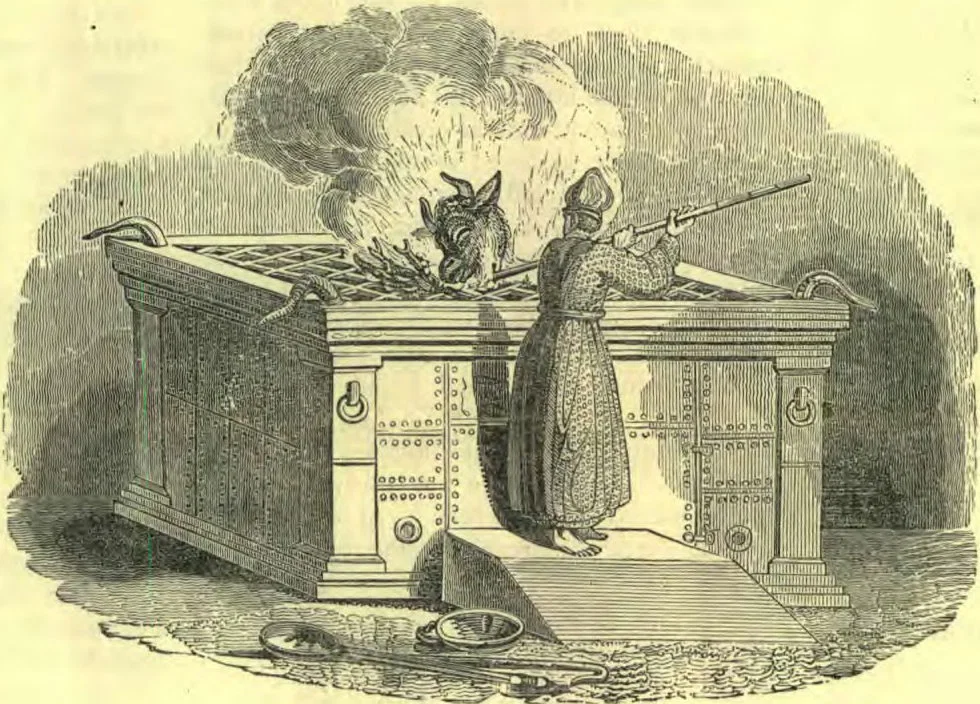
THE ALTAR OF BURNT OFFERING

10%

S. D. A. Publishing Association · Battle Creek, Mich. · Mar 21, 1895

FromThe Youth’s Instructor, Vol. 43, No. 12.

Read the full edition

THE ALTAR OF BURNT OFFERING.

This altar, as erected in the wilderness, was five cubits long, five cubits wide, and three cubits high. This would make it perhaps eight feet long by eight feet wide by five feet high. It would be too high for a man to take care of the things that were offered upon it, unless there was a step to it. No account was made of the altar step in the wilderness, but in the direction given to Ezekiel the Lord told him where to place the step.
The altar was hollow, and on the top was a grate, like a register, only with larger openings, through which the ashes would fall as the wood and offerings were consumed. This grate had rings in it, so that it could be lifted out when necessary. Ex. 27: 1-8; 38: 1-7.
The fire upon this altar was to be kept burning continually. Every morning the priests would put the offering in order upon it for a burnt offering, and all during the day parts of the various offerings were put into the fire on the altar; then all during the night the fire burned. In the morning the priests threw the ashes out at the side of the altar; then, taking off their priestly robes, they carried the ashes out to a clean place without the camp, and deposited them. At this place where the ashes were placed, the parts of the offerings that were not burned upon the altar, were made to burn with the wood, set for that purpose.
When an offering was made by one of the children of Israel, the priest would take the blood of the sacrifice, and sprinkle a little of it before the veil, and with his finger he would put some of the blood on the horns of the altar of incense; then the rest of the blood would be carried out, and turned out at the side of the altar of burnt offering, on the side where the ashes were thrown out.
But that sacrifice which gave the altar of burnt offering its name, was the burnt offering of the morning, sometimes called “a whole burnt offering,” because the whole of the victim was consumed upon the altar.
Nothing was kept back, nothing saved; and so we are asked to present our bodies to God, “a living sacrifice, holy, acceptable unto God,” which for us is a “reasonable service.” If we do this, all the wrong and evil that are within us will be burned away; we will be tried in the fire until the gold is pure, and then we will be fit for the kingdom of God.
If we do not make this gift to the Lord now, by and by we will be compelled to be burned in the fires of the last great day, from which death we will never awake. Let us give ourselves unto God now, and then we will not be afraid to meet him when he comes; for we really are his, anyway. J. G. LAMSON.
THE ALTAR OF BURNT OFFERING.
The altar of incense was placed in a line between the door of the court and the door of the tabernacle, but nearer the door of the court. Ex. 40: 6, 29. The laver, with its foot, or base, stood between the altar of burnt offering and the door of the tabernacle. The laver was used to hold water for the priests. Here they were to wash their hands and feet before ministering in the tabernacle. The Israelites all came within the court to present their vows and offerings to the Lord. The door of the court and the tabernacle, when erected, always faced the east, as did also Solomon’s temple. The people turning to these to worship before the Lord would therefore turn their backs toward the east, to distinguish them from the idolatrous nations round about them who worshiped the sun, facing the east in so doing. (See Eze. 8: 5-16.) M. H. BROWN.