For the first time in their history, the Southern States have attempted an exposition of truly international character. Since its first inception, the proportions of this undertaking have extended far beyond what was originally contemplated. Its indorsement by the United States government with an appropriation of two hundred thousand dollars has been followed by similar movements in the legislative bodies of many of the States, both north and south, which have appropriated amounts of from seven thousand to twenty-five thousand dollars each for State exhibits. Mexico and many of the countries of South America are preparing for elaborate exhibits of their productions. The Argentine Republic leads out with the sum of twenty-five thousand dollars in gold for this purpose. Through the state department of the United States invitations have been sent to all the important countries of the old world, asking them to participate in this enterprise. Our consular officers in those countries report much interest, especially among the textile manufacturing centers. England, Germany, Austria, Hungary, Italy, France, and Belgium will send exhibits of their important industries. Several of the large railway corporations will have buildings for the exhibition of the resources of the country through which their lines pass, and the progress made in railway building in America.
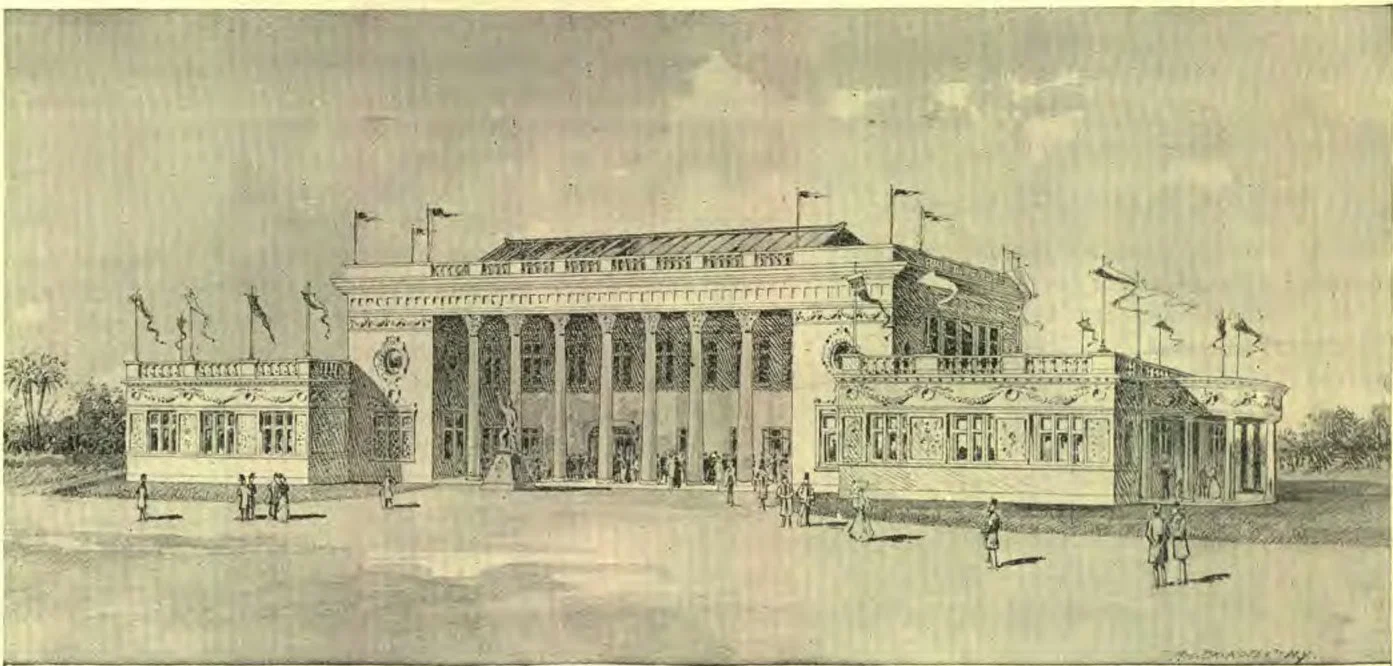
THE FINE ARTS BUILDING.
The United States government exhibit will be arranged by a commission composed of gentlemen selected from each department because of their special qualifications and experience in the work. Notable among the interesting features of the state department will be a group of historical documents in which may be seen the Declaration of Independence in fac-simile, interesting relics of Thomas Jefferson and Benjamin Franklin, early treaties of our government with foreign powers, including letters from Napoleon Bonaparte, and the famous emancipation proclamation of Abraham Lincoln. The exhibit of the interior department will include the patent office, the bureau of education, the Indian office, and the geological survey. The latter exhibit will be very elaborate; especially is it intended to display as never before, the geological wealth of the South. The Indian office display will show the progress of education of the Indians at our national schools. The patent-office exhibit will be a comprehensive display of mechanical tools, particularly those relative to the cotton manufacturing industry.
One of the most complete and interesting features in the government building will be the exhibit of the fish commission. Its tanks will occupy ten thousand square feet. A great variety of rare and beautiful fish, both from the American inland waters and from the ocean, will be found here. The salt-sea fish will be supplied with water from the ocean. This vast aquarium will be arranged in a grotto, with the aisles ingeniously lighted from the water, producing a peculiarly beautiful effect.
The navy department will contain large models of many of the ships owned by the government from the beginning of the century to the present time, together with models of ships of an earlier period. These models will enable the observer to note the changes in the designs and armaments of men-of-war from the time of the Spanish Armada to those of Trafalgar, and thence to the wooden steam frigates that bombarded Sebastopol, until we reach the huge iron-clad monsters of the present day. A torpedo boat, belonging to the armored cruiser “Maine,” will also be exhibited. There will also be a full exhibition of all modern war equipments, and a large collection of war relics.
A special effort is making for a superior exhibition of the fine arts. This department is under the management of Horace Bradley, of New York. The building for this exhibit, though not among the largest, is one of the very handsome structures on the ground. The exterior is finished with beautiful designs in the Italian Renaissance style of architecture. The long fluted columns in the portico recall the stately old southern mansions of former days. The two immense galleries at the ends will be devoted to the exhibition of large oil paintings contributed by the leading artists of Europe and America. The floor space in the central part of the building will be devoted to sculpture. Special galleries will be set apart for the exhibition of water colors, pastels, pen and ink, and other drawings. Artists of the highest rank will exhibit in this art palace the most notable examples of their work. The people of the South, as well as those who visit the exhibition from abroad, will have the opportunity of seeing the finest display of artistic work ever presented in this section.
Another interesting feature of the exhibition will be a department under the management of a board of ladies for the exhibition of woman’s work. The building for this purpose is a beautiful structure one hundred and fifty feet long, one hundred and twenty-eight feet deep, and ninety feet in height. Its architectural design was the work of a lady architect, Miss Elise Mercur, of Pittsburgh, Penn. In this building will be seen a vast library of books written by women, a large collection of musical compositions and magazines which are the work of women, models of their patents and inventions, their artistic work, paintings, and sculpture. Space will also be provided in this building for educational exhibits, including industrial arts, decoration, wood carving, and sloyd work. The cooking-school and kindergarten will be notable features. There will be a large collection of woman’s work in210past ages, including valuable relics of the colonial days, and a rare collection of the works of the aboriginal women of America. The interest manifested in this department, and the demand for space, have been so great that the woman’s board having the matter in charge has been compelled to ask for an annex to the building, which will probably be granted.
One of the unique features of the exhibition will be the negro department. This race, which thirty-one years ago emerged from the bondages of slavery, without money or education, will be given the opportunity of exhibiting to the world evidences of their progress. The building, which is their own work, is a large, artistic structure, and will be a credit to the builders. They are manifesting commendable zeal in showing to the world what use they have made of their freedom since their emancipation from slavery. About fifty industrial schools will give exhibition of their work. Models of the more important inventions patented by them will be exhibited. The literary advancement of this people will be seen by the one hundred bound volumes which they have produced, and the two hundred newspapers and magazines which they are now editing. Special numbers will be prepared for inspection. Their home life will be represented by photographs of residences all the way from the Uncle Tom’s cabin of the days of slavery, to some of the better homes now owned and occupied by them.
This exhibition, which will bring large numbers from all parts of this country together at the Gate City of the South, it is confidently hoped will do much to break down all sectional feelings, and unite more closely than ever the North and the South, the East and the West, into one fraternal union.