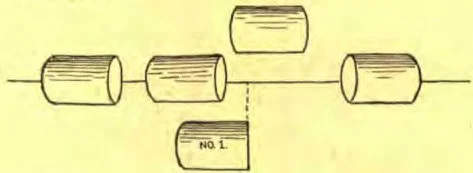
WHEN the cylinder is placed horizontally, the same principles are observed in drawing it that are observed when it is vertical, except that the curves become straight when they come in line with the eye, as shown in cylinder No. 1 below.
Notice that the more the cylinders are moved to the right or left, the more of the end closest to the point of vision is visible. This end becomes more circular, while the opposite end line becomes more curving, the farther away from the point of vision it is moved. This rule is the same when the cylinder is lowered or raised, when horizontal.
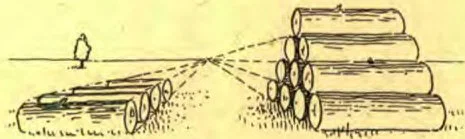
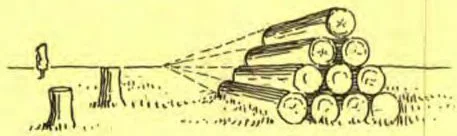
The accompanying drawing shows the way several cylinder-shaped objects should be drawn when horizontal. If the observer is standing so that the ends of the logs are facing him, they would look thus:—
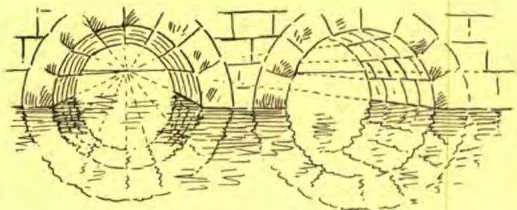
In drawing a stone bridge, be sure to have the perspective of the stones correct. Below, you will see what is meant. The lines formed by the stones in the reflection should recede toward the horizon as well as those formed by the stones in the bridge.
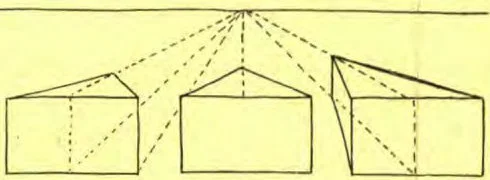
The prism is somewhat more difficult to draw in perspective than either the cube or the cylinder. By a little study, with the aid of the drawing here given, you will see how a vertical prism should be drawn.
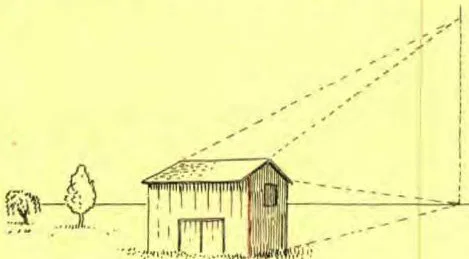
The lines formed by the roof of a house meet at a point, but not on the horizon line. As has been said, only lines at right angles with the observer meet at the point of vision on the horizon line. For instance, all the lines on the house shown below are at right angles with the observer (except the roof lines), and so meet at the point of vision.
A vertical line should be drawn up from the point of vision; and according to the slant of the roof, so should the point to which the roof-lines converge be placed on this line. If the roof slants much, the point should be placed high; if the slant is gradual, the point should be placed low. This is illustrated in the drawing herewith given. PEDRO LEMOS.