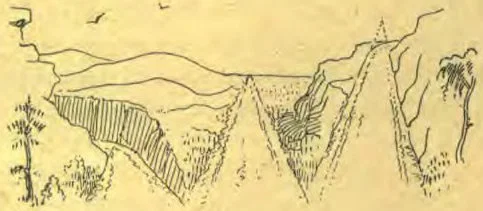
As we have learned, parallel receding lines converge at a point called the vanishing point. Only when they are parallel with the ground plane, do they meet on the horizon. In the drawing shown below, the road in the center is level, or parallel with the ground plane, and therefore meets at a point on the horizon.
Where the receding lines are not parallel with the ground plane, they converge at a point outside the horizon line. For instance, the road on the left is at an angle with the ground plane, and meets outside the horizon. As the road is downhill, the lines meet below the horizon. The uphill road to the right meets at a point above the horizon.
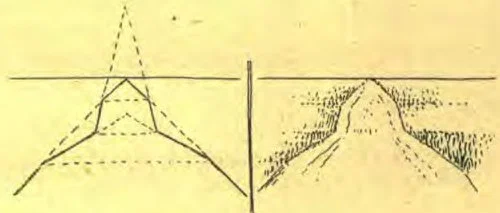
Now as we know that all upward lines meet above the horizon, and that all lines running down meet below the horizon, we shall have no difficulty in drawing roads so they will appear to be uphill or downhill, as the case may be.
Below is a picture of a road so drawn that it appears to be level, then downhill, next uphill, then level again. Notice how, in the outlines, the uphill and downhill lines meet above and below the horizon.
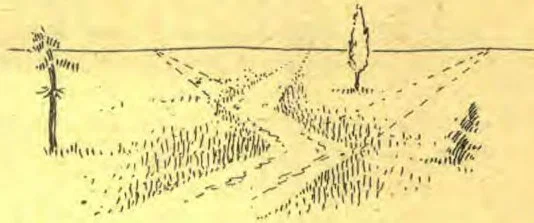
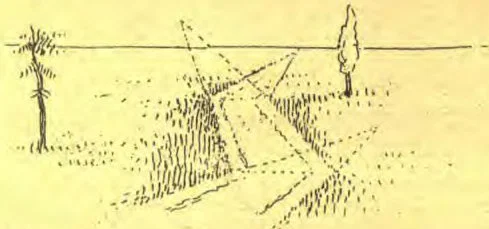
When a road is not straight, but has several bends in it, there is, of course, more than one vanishing point on the horizon. In other words, as soon as any part of the road is not in line with the observer’s eye, it follows a different direction in receding toward the horizon, and converges at a point of its own.
If part of the road goes uphill or downhill, there are just as many points, only those parts that are not level do not meet on the horizon, but above if uphill, or below if downhill. In the accompanying drawing are shown the directions in drawing a road when some parts are not level, or not at right angles with the ground plan.
This lesson ends the study of Perspective in Nature. In the remaining lessons the study of form, light, and shade, in Drawing from Nature, will be begun. PEDRO LEMOS.