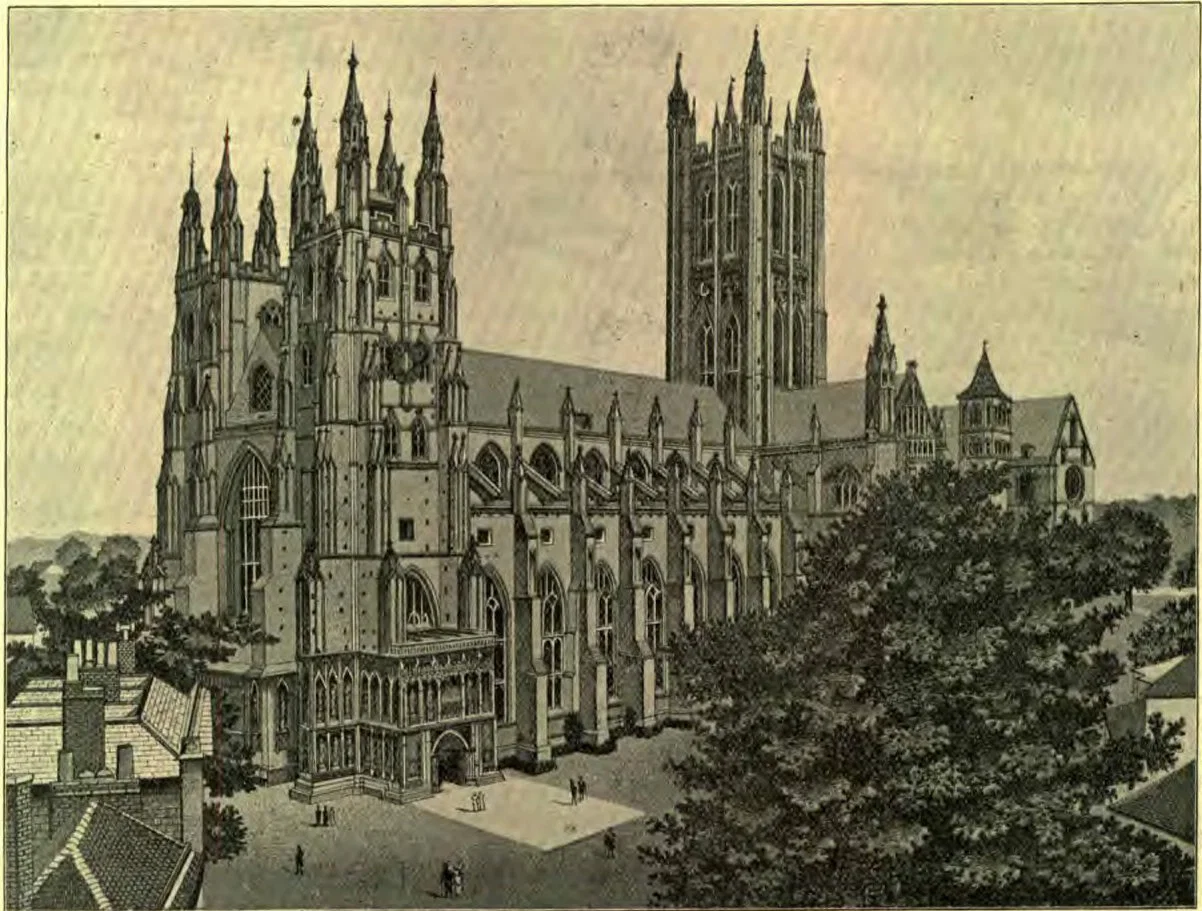
In the year 560 Ethelbert ascended the throne of Kent, the southeastern part of England. For a time his authority was limited to that section, but afterward he extended his rule as far north as the Humber. Fifteen years after he became king, he married Bertha, a French princess of Paris. The French had previously accepted Christianity, and Bertha is said to have brought a knowledge of the gospel with her, being the first representative of the Christian religion in England. The king, doubtless prompted by Bertha, received with kindness and hospitality some missionaries who came into the country soon after this. He even gave up for their use his own house in the Roman city Durovernum, afterward called Canterbury. Adjoining the house he built a church, and on the site of this early church the cathedral was in later years erected.
Augustine was one of these first missionaries who shared Ethelbert’s hospitality. He was later appointed the first archbishop of Canterbury, which office to this day includes the highest authority in the English Church. Including Augustine, there have been ninety-five archbishops in the succession to the present time. One of the duties of these ecclesiastical officials is to crown the heir apparent to the throne when England’s sovereign dies.
After the death of William the Conqueror, in 1087, as mentioned in a former article, the throne of England fell to his son, William II, surnamed Rufus, because he had red hair. He was accidentally killed by an arrow, while hunting in the New Forest near Southampton. Henry I, another brother, then took the throne, and at once made war with a third brother, Robert, duke of Normandy, whom he defeated, and imprisoned in the castle of Cardiff, Wales, until his death, twenty-eight years later. After visiting France, and making peace with the king, Henry sailed for England. His only son, William, with his sister, remained a short time on shore after their father’s boat set sail. The captain and crew of their boat drank so freely before starting that they were unable to manage the ship, which was driven upon a rock, with the result that all on board were drowned except one man, a butcher of Rouen. After this another daughter, Matilda, married Goeffry Plantagenet, a Spaniard; and their son, as Henry II, became the first heir to the throne representing both the Norman and the Saxon line. He received this inheritance through his mother, as her father (Henry I) was a Norman, and her mother (“good Queen Maud”) was a Saxon.
The reign of Henry II brings to our notice Thomas à Becket and the Canterbury Cathedral, with which the name of à Becket is always associated. Just what nationality he represented is now uncertain. One historian says that he was “the first Englishman who emerged from the obscurity to which his race was consigned when the Normans seized all the higher offices of the church and state.” Another says: “His parents were both, there can be little doubt, of Norman extraction.” However this may have been, he certainly assumed a state in which no Englishman had lived before his time. When Henry became king, à Becket, who was then archdeacon of Canterbury, was given the office of Lord Chancellor. He was entrusted by the king with the education of his son, and was given much wealth. He was installed archbishop of Canterbury in 1162, and at once sent a resignation to Henry in these words: “I desire that you will provide yourself with another chancellor, as I find myself hardly sufficient for the duties of one office, much less two.” From this time à Becket gave himself entirely to the work of the church, trying to extend the authority of the pope. It was a fierce conflict between the church and the state, and resulted, as such conflicts almost always have resulted, in bloodshed.
The question whether clergymen were amenable to the civil courts was one on which there was much disagreement between à Becket and the king. One day, while in a passion, Henry said something expressing wonder that some of his household did not free him “from this turbulent priest.” At this four of his courtiers at once went to Canterbury to do away with à Becket. When the king learned their intention, he tried to recall them, but too late. The archbishop took refuge in the cathedral. His assailants demanded that he revoke certain excommunications. This he refused, whereupon he was violently murdered in the building, the sacredness of which he had hoped would secure his protection. This occurred in December, 1170. Two years later he was canonized as a saint by Pope Alexander III. From that time until the Reformation his shrine in the cathedral, called the Shrine of St. Thomas, was annually visited by troops of pilgrims, the number one year amounting to one hundred thousand. The superstitious reverence and wicked idolatry shown by these pilgrims to this dead man are attested by the official records of470the offerings made at three altars there. In one year the offerings at God’s altar were nothing; at that of the Virgin Mary, £4 1s. 8d. (about $20); at St. Thomas’s shrine, £954 6s. 3d. (about $4,770). The enormous amount of this sum is better appreciated when the purchasing power of money in those times is considered. Henry VIII, more than three hundred years later, pillaged the shrine and destroyed it; and according to a foolish custom of those days, caused the saint himself to be cited to appear in court, where he was tried, and condemned as a traitor.
The connection of Canterbury with the early introduction of Christianity into England, and also this history of Thomas à Becket, led me to visit the quaint old town while spending a vacation at Margate, a seaside resort near by. While there, I obtained the photograph from which the accompanying illustration was made. The place is one of the few in which is still preserved one of the old Roman stone forts, with its gates to the main street of the city. In these forts are holes made to fit bows for shooting arrows at attacking foes. The cathedral and its surroundings are still held in great veneration. In an old church not far away it is said that Ethelbert must have been baptized. In it a baptismal font is pointed out, supposed to be of that age. The older portion of the cathedral was erected in 1070, to which various additions have been made. Services are held twice daily, consisting mostly of music by the large choir, which I was fortunate enough to hear. Several monuments to noted persons have been erected in different places in the building, the most striking of which is that over the tomb of the Black Prince. Above this hangs a coat, torn and stained, which was worn by the prince in battle.
The records of the city for hundreds of years are still preserved, and contain many curious things. Among these may be found the cost of entertaining the king and his servants during a visit to the place. It includes a detailed account of provisions purchased,—cheese, wine, rabbits, etc.,—and throws considerable light on the diet of the people of those times. Mention is made of a machine called a “cucking-stool,” in which women who did not obey their husbands, or who were given to undue gossiping, were placed, and ducked into the water till sufficiently punished. A record is also preserved of the cost of burning a heretic. The items of the wood, ropes, fees, etc., are given in detail, the whole amounting to less than a dollar.
It is sad to think that this place, where the gospel was first preached in that country, afterward became a place of persecution for the followers of the same religion. In this it was like Jerusalem itself, which turned from teaching of the Messiah to come, to the wicked act of putting him to death when he did appear. All these evils come from following the words and teachings of men instead of those of the Lord himself.
H. E. SIMKIN.