HER MAJESTY'S COLONIES

9%

Review and Herald Publishing Company · Battle Creek, Mich. · Oct 26, 1899

FromThe Youth’s Instructor, Vol. 47, No. 42.

Read the full edition

HER MAJESTY'S COLONIES

Concluded
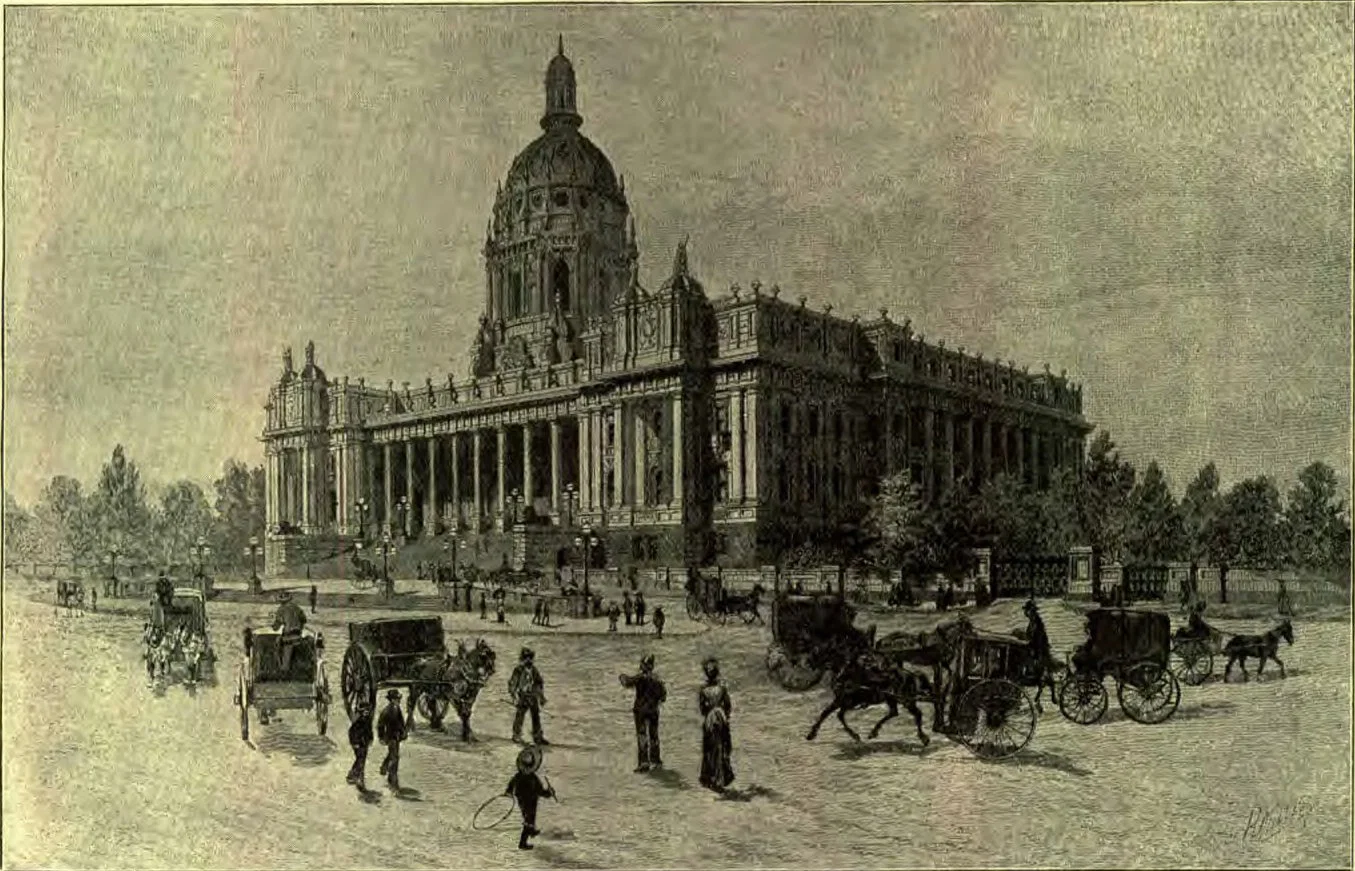
PARLIAMENT HOUSE, MELBOURNE.
Melbourne is the most American of the colonial cities. According to the census of 1891, its population numbers about five hundred thousand, though during the last few years, through bank failures and high tariffs, it has lost somewhat,—a loss by which Sydney and the new gold-fields have gained. It is now, however, steadily improving. Its wide, clean, well-paved streets; its beautiful buildings; the river running through its center, spanned by the fine Princess Bridge; its comfortable and noiseless cable tram-lines,—all combine to impress the American visitor that he is in a new Chicago. The residence portion is much handsomer than that of Sydney, except in Sydney's newest suburbs. The houses and cottages are of varied pattern, with large lawns, and present a general air of room and comfort; and the business blocks are tasty and up-to-date. Prices are higher than in Sydney, but the quality is generally better. In its system of sanitation, Melbourne has been far behind Sydney, its open sewage being both dangerous and disagreeable. Epidemics of typhoid fever and diphtheria occur every year, with a high death-rate. Thousands of pounds are annually expended in the drainage of the river to accommodate steamers, and thousands more are squandered in a futile attempt at drainage. At the present time a plan for forced drainage is on foot, which it is hoped will prove successful, but which will be very expensive.
The journey from Sidney to Brisbane, Queensland, is over some beautiful country. We get many a peep at real Australian “bush” and farm life. The trip past the Hawksbury River is rarely surpassed in railway travel, the view constantly changing as we wind in and out among its many curves, and are treated to views of what appear to be beautiful lakes, where the river widens into great basins between mountains and hills.
In Queensland we are delighted with the scenery on the Darling Downs Range, an ideal farm district lying two thousand feet above sea-level, and covered with luxuriant crops of grain and fruit. Oranges, grapes, peaches, pears, apricots, plums, passion-fruit, almonds,—almost everything, in fact, but good apples,—grow here in abundance. Some apples are raised, but the climate is too warm for a really fine apple, such as is grown in the States. Toowoomba, the principal city on the Darling Downs Range, is in the midst of this fruit district. It has a fine climate, and is a favorite summer resort for the city of Brisbane as well as the colony generally.
The colony of Queensland has a coast-line of two thousand two hundred and fifty miles, an estimated area of over six hundred and fifty thousand square miles, and a population of about five hundred thousand. Brisbane, the capital of the colony, is a fine city on the Brisbane River, fourteen miles from Moreton Bay. The river is navigable by ocean-going vessels. Moreton Bay is the home of the “Moreton Bay Fig-tree,” an evergreen of surpassing beauty, with wide, overspreading branches, covered with large leaves, which afford the finest imaginable shade. In this respect it is in marked contrast with the gum and eucalyptus, whose slender leaves seem to have a fashion, as an American expressed it, “of making a successful effort at turning themselves slantwise at the sun, so as to let its bright rays right down on you.” This tree sheds its bark annually instead of its leaves.
Queensland has about twenty towns of importance, varying in population from one to thirteen thousand inhabitants, and many villages. The colony has abundant resources in its agricultural, cattle, sheep- and wool-raising and fruit-growing districts, besides its productive gold-mines. Around Brisbane the pineapple is grown in large quantities, supplying not only the home market, but also Sydney and Melbourne. In the far north, the mango, guava, and banana are grown. The climate south of the tropic of capricorn is generally a delightful one, but in the far north it is too warm for comfort.
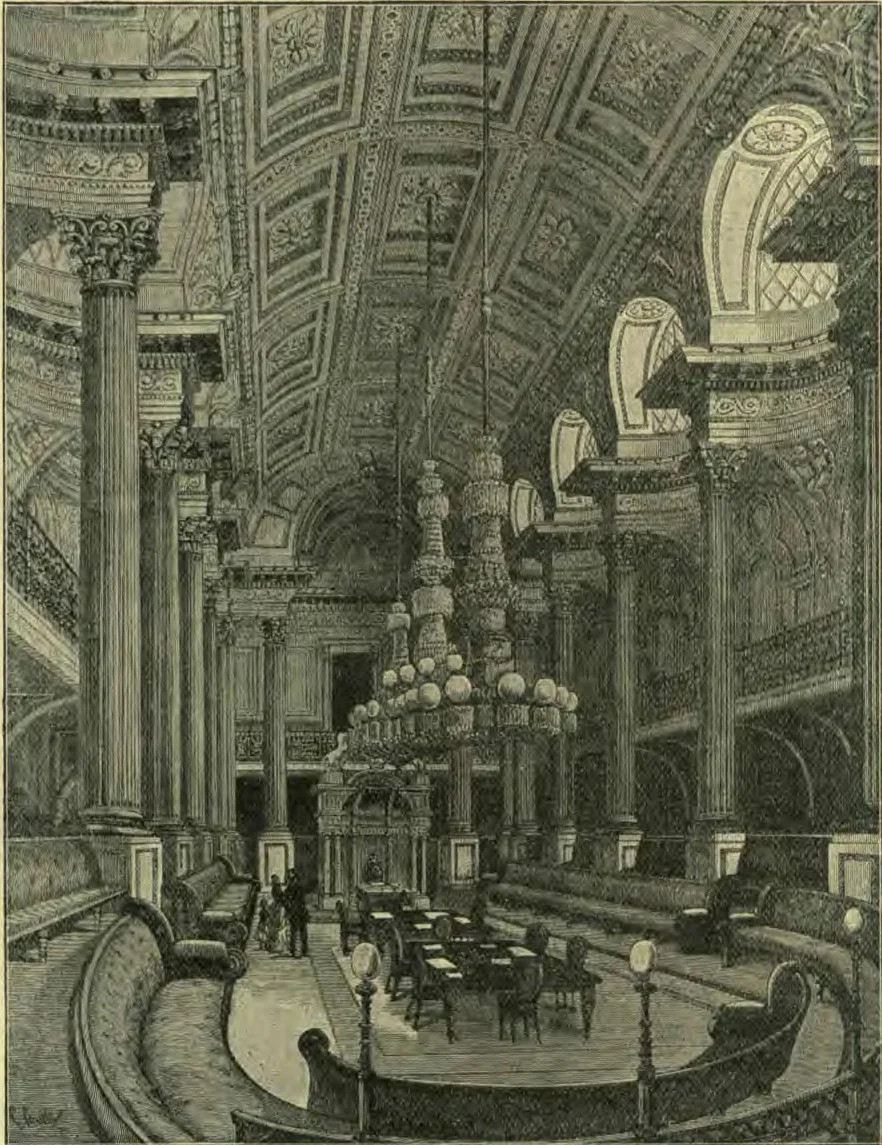
THE COUNCIL CHAMBER.
An article on Australasia would be incomplete without a reference to its “southern skies,” which must be seen to be appreciated. In its clear atmosphere, the heavens seem to be brought startlingly near. The casual observer remarks it, and the lover of astronomy is delighted beyond expression. He visits the large telescopes of the various colonial astronomical societies, and never tires of viewing through them the fine nebula, “The Jewel Casket,” near the “Southern Cross,” as well as the nebula of “Orion,” and other familiar constellations of the northern hemisphere. We invite the reader to come and see it all for himself.
G. B. STARR.