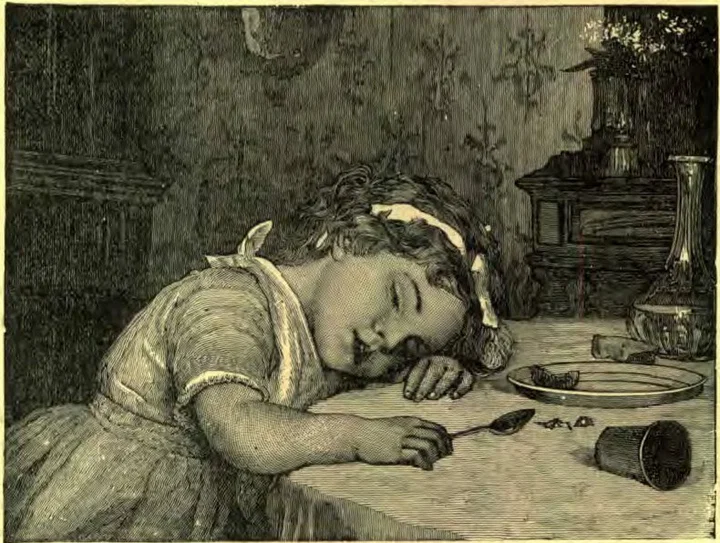
The first day of the New Year, and the children were quarreling! A bad beginning, truly!
“Alice and Harriet, take your knitting-work. John and Henry, you may each bring nine armfuls of wood into the woodshed. Mabel, you may take your slate and write; and I guess if they are left alone, the two babies can take care of themselves. Now, for half an hour let us have silence. If anybody speaks, let it be in a whisper.”
So there was silence in the kitchen, except the pleasant clatter the little mother made with her pie-making, and the occasional prattle of the two babies.
There was generally considerable noise at Number Thirteen; and sometimes — pretty often — it wasn’t pleasant noise. The children were all young, and all wanted their own way. But they had learned to mind their mother.
Little Mabel sat with her slate on her knee, looking thoughtful. She wrote and erased, and wrote again, with much painstaking labor. At last she seemed satisfied, and going to her mother, said, in a whisper: “May I have a little piece of white paper and a pencil out of your drawer? I want to copy something.”
“What is it? Let me see,” said her mother.
Mabel hesitated and blushed, but held it up to her, saying, “You won’t tell, will you, mother?”
Her mother read it twice over. Tears gathered in her eyes.
“No, no, certainly not; it shall be a little secret between you and me.”
“You won’t tell anybody, will you?” entreated little Mabel
She got a clean piece of paper, and sharpened the pencil anew for the child, although she was pie-making.
Mabel copied it very carefully, and laid it away in the bottom of her handkerchief-box, saying: “I shall see it often there, and nobody goes there but mother and me.”
But it happened one day that Harriet was sent to distribute the pile of clean handkerchiefs from the ironing into the different boxes; and as Mabel’s was empty, she saw the writing. It was so short that she took it in at a glance:—
“Resolved, To Alwas spek pleasant when Enny body speks cros. MABEL FORD.”
Somehow it fixed itself in Harriet’s mind; and that evening she was busy with pen and ink. The result was a paper in Harriet’s handkerchief-box, with the resolution written more neatly, but the same in effect.
“Resolved, That I will try this year to return pleasant words for cross ones.”
“HARRIET FORD.”
It made a difference that was easy to see when two of the children began to practice this resolution. There was less of quarreling.
“That’s mine! You’d better mind your own business!” said John to Harriet, one day, when she took up his top, and was putting it in his drawer.
“But, John, mother wants me to clear up the room,” said Harriet.
“Well, I want the top to stay there,” said John, obstinately.
“Well, perhaps it’s no matter. A top isn’t much litter,” said Harriet, pleasantly.
John was fully prepared for a contest. I’m afraid he would rather have relished one. He stared. Then he looked ashamed.
“What made you say that, Harriet?”
Harriet laughed, and colored a little.
“Tell me! what made you?” John insisted.
“Come here, and I’ll show you,” said she.
She took him into the clothes-press, where was the row of pretty handkerchief-boxes, each labeled.
She opened little Mabel’s and took out the clean, soft pile of handkerchiefs. “Look there!” said she. John read.
“The good little thing! She never does quarrel anyhow,” said John.
“So I thought I’d better put one in mine, too,” said Harriet, and she showed hers.—Youth’s Companion.