ASTRONOMICAL STUDY—NO. XIV
Saturn and Its Rings
IN our last study about Saturn we learned some interesting things concerning this, the most beautiful of all our solar brothers. That which makes Saturn especially attractive when seen through the eye of the telescope is its accompanying system of satellites and rings. The rings compose the feature that becomes the special object of interest and attraction. The first illustration shows the rings as they appear to us when the planet is in such a position as to give us their fullest view; while the second shows them as they appear when their thin edges are turned exactly toward our earth, which occurs once in fifteen years. The extreme thinness of these great rings makes them almost invisible to us at such times, only the larger telescopes showing them at all. Their appearance then is merely that of a fine thread of light. These rings are estimated to be about one hundred miles in thickness. At present the rings are widely exposed, as shown in the first illustration, and a beautiful sight they are, when viewed through even an ordinary telescope. They will grow less and less conspicuous, until, in 1907-08, they will present their thin edges again, as they did in 1892-93.
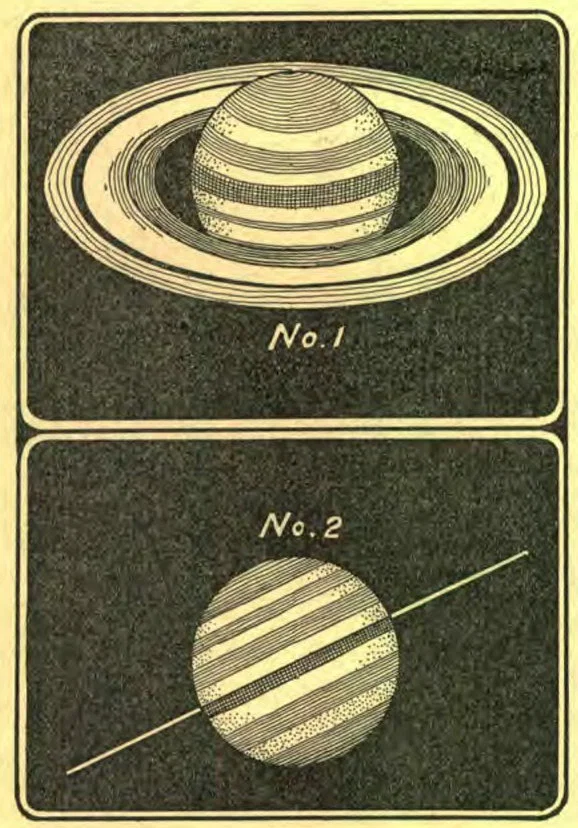
These rings, as shown, are three in number, the inner one being extremely thin, and seemingly of a vaporous substance. This innermost of the three rings was not discovered until the year 1850, by Astronomer Bond, of Cambridge. This ring has a width of about nine thousand miles, and its inner circle is between nine and ten thousand miles distant from the equator of the planet. The middle ring, which is the broadest of the three, is about seventeen thousand miles wide, while the outer ring is about ten thousand miles broad. This outer ring has a diameter of about one hundred and sixty-eight thousand miles. The distance between the central and outer rings is estimated at about seventeen hundred and ninety miles; through this space the distant fixed stars are plainly discernible. These rings each revolve about the planet in about the same time, and in nearly as short a period as the planet makes its own axial revolution,—which time was mentioned in our last study on Saturn.
As to just what these rings are, we do not know. We learn, however, by the aid of the spectroscope, that they are not solid, continuous planes; but are composed of small particles, which move among themselves as the whole ring revolves about its primary. Each ring might be said to be composed of a swarm of small meteors, or some substance of that nature. We know the rings are not solid; for in their daily revolution around the planet the outer edge of each ring falls behind the inner edge, which could not be the case were they composed of solid materials, firmly bound together. They differ also in thickness, as is seen when their thin edges are turned toward our earth.
We believe the object of these rings to be not only to give light,—that is, to reflect light,—the same as do its moons, but also to produce its changes of seasons; for, personally, we can not see how Mercury, with its axis perpendicular to the plane of its orbit, can have any marked changes of seasons other than as they would be effected by the long-continued reflected light received from its rings when in a certain position, and then the withdrawing of that extra amount of light, and those parts of the planet being thrown in the darkness of the shadow that is cast so strongly by these rings, for another period of time.
We can have but little conception of the beauties of the heavens of a world furnished with such objects as these rings of which we have been studying, circling inside a retinue of eight moons, all making their eastward journey about their primary in different periods of time, and undergoing the various phases through which we love so much to watch our own one moon make its beautiful changes. Again we repeat the text, “The heavens declare the glory of God, and the firmament showeth his handiwork. Day unto day uttereth speech, and night unto night showeth knowledge.”
Dr. O. C. GODSMARK.