III
Among the objects of interest that all tourists visit in Paris are the Church of the Madeleine, Notre Dame Cathedral, and the Louvre. These were visited the next day by our travelers At the Madeleine the wealthy gather on Sundays to see and to be seen. The effects of the action of the elements are seen on this building, as on St. Paul's and Westminster Abbey, and workmen are almost constantly employed in making repairs. Notre Dame Cathedral, situated near the Palais de Justice, or the police headquarters, as it would be called in this country, is the seat of the archbishop of Paris. Its architecture is striking, but can not be carried in mind sufficiently to give a detailed description several years after a visit. One thing that impresses an American is the great number of candles of all sizes used in the place. Many of these are kept continually burning.
The Louvre is the great picture-gallery of France, and of the world. Like the National Gallery in London, it has an international reputation, but it is much more extensive than the latter. Here are found the great masterpieces of dead artists. An extensive museum of antiquity is also connected with the Louvre. It was in a window of this building that Charles IX stood and fired on the fleeing victims of the St. Bartholomew massacre. The old palace of the Tuileries, with its beautiful gardens, is close by. This is the place from which Louis XVI was taken when led to imprisonment and execution.
On Tuesday a visit was planned to Versailles, and the beautiful palace and grounds of Louis XIV. It was soon learned that in order to be understood in Paris, when speaking of Versailles, one must pronounce it “Versa,” as softly as possible. It is much easier to make one's self understood by writing than by speaking, as French pronunciation is so different from English. When asking for railway tickets on this side-trip, one of the men wrote on a card: “Versailles and return; two; second class.” Without hesitancy the young woman attendant handed out two second-class, round-trip tickets.
This palace of the Louises, with its surroundings, is one of the grandest sights in France. It is said that at one time during its construction there were six thousand horses and thirty-six thousand men employed. The palace contains some of the finest paintings of war scenes in the world. One picture, which makes a lasting impression on the mind, is on a large canvas about fifteen by thirty feet in size. In the center are three life-size horses with their uniformed riders, apparently charging at breakneck pace. As the room is entered at one end, they appear to be coming directly toward the visitor. As the middle of the room is reached, they all appear to have changed positions entirely, still looking at the one approaching. At the other end of the room they appear to have turned squarely around. A good artist can so paint one figure as to make it present this deceiving appearance; but it is a mystery how three horses abreast, with their riders, could be made to have this appearance.
The grounds back of the palace are beautifully laid out, in sections, each of which is covered with trees of a different kind. Having been growing so many years, these have now attained a great size. As the grounds are higher than any others in the immediate vicinity, the thought suggests itself, Where does the water for the ponds and fountains come from? The explanation given is that it is brought many miles in underground aqueducts. The place is a beautiful sight to behold, but one can not repress a thought of pity for the poor laborers who were so terribly oppressed by the proud monarchs of France when it was built. The fact that royalty reveled in luxury, and hesitated at no extravagance in carrying out its ambitions and pandering to its desires, was the most potent cause of the terrible Revolution in which France forgot all justice, religion, and morality.
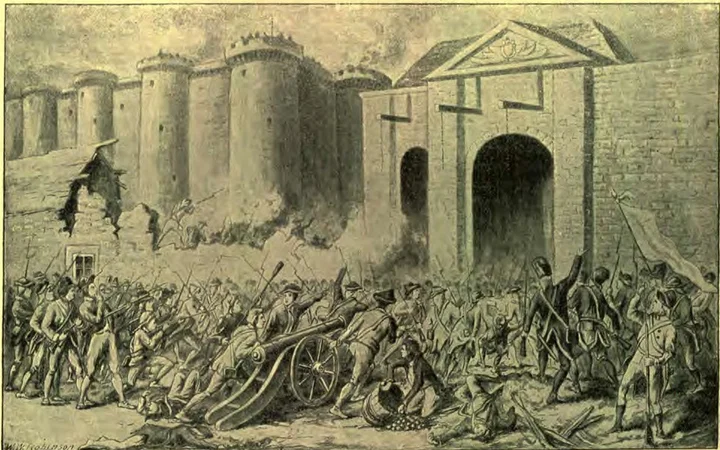
The accompanying illustration, “Storming the Bastile,” gives some idea of the fury of the insane mob that took things into its own hands in that memorable year 1789. La Bastile, situated in the Faubourg Saint-Antoine, was built in the fourteenth century, and was originally used as a fort, but later was made a prison, in which inconceivable tortures and cruelties were perpetrated. The people utterly destroyed the whole structure; and after peace was restored, a monument was erected on the spot, which still stands as a reminder of the great struggle between princes and paupers, rulers and subjects, labor and capital.p. 298
On the banks of the Seine in the heart of Paris stands a statue of Voltaire. His greatness, commemorated by this elegant work of art, consisted largely of his infidelity. His character is so common throughout the country that the expression, “Infidel France,” has become a stereotyped phrase. This unbelief in God followed as a natural result of the selfish actions of rulers who, while they professed Christianity, lived such wicked lives, and indulged in such unrivaled excesses, that men were led to think that if this was Christianity, they did not care to have it. What a lesson for all who profess to follow the meek and lowly Jesus of Nazareth!
A beautiful boat ride for a distance of several miles to St. Cloud and return, on the ever-turning Seine, was enjoyed on one of the last days of the visit. Hundreds of little launches run up and down the river continually, and a ride on one of them the length of the city gives views of life among certain classes not well seen in any other way.
At seven o'clock on Tuesday evening a train was entered at the Station du Nord for the homeward journey. Being “excursionists,” our tired travelers were obliged to occupy a compartment well filled with men who could not understand how the odor of bad tobacco could be objectionable to any one. Just before going into the car, a loaf of Paris bread was purchased by the younger man, which he took home and varnished, to preserve as a souvenir and curiosity. It is a yard long, about the size of a man's wrist, and is still well preserved.
The passage across the Channel was even rougher than before, and the boat was smaller. As a result, both tourists were thoroughly seasick, and had to repair to couches in the cabin. Once the waves broke entirely over the boat, and the water came pouring down the carpeted stairs into the cabin. During the violent tossings of the boat, a lighted lamp broke its fastenings, and fell, striking within a few inches of the older tourist's head, and breaking into many pieces, the oil running all over the couch and out upon the floor. It was a narrow escape both from the fall of the lamp and from fire.
As the early morning fog began to lift from the steaming Thames, and the hundreds of butcher's carts were hurrying away with their day's supply from the Smithfield market to their respective shops in every part of the great city, the two travelers alighted from the train, and boarded another on the Underground Railway for Holloway Station, near which was a place where some good cooking and an opportunity to sleep were appreciated to their fullest extent. H. E. Simkin.