The southern tropical line passes through the midst of the Australian continent a distance of nearly three thousand miles. It is quite safe to say that few, if any, have ever traced its entire course, as the country is uninhabited and uninhabitable. Ten thousand pounds’ reward was offered to the one who would first penetrate the country from north to south; and it was only on the third attempt that it was accomplished. A telegraph-line followed the track thus opened. But there has as yet been no call for a consecutive transcontinental journey from east to west.
Starting at the city of Rockhampton, Queensland, where the tropical line strikes the eastern coast, a railway follows it for nearly five hundred miles westward. The interior of Australia is in appearance a monotonous plain, arid, and burning with heat. Rains seldom fall, and flowing streams are unknown. Between this great desert region and the more genial coast lies a wide expanse of country, generally appropriated by sheep- and cattle-raisers. Much of the land is fertile, and would be exceedingly fruitful but for the want of rain.
The vastness of this section may be understood when it is stated that Queensland, one of the five colonies, covers an area of six hundred and sixty-eight thousand square miles,—territory equal to a large number of the United States combined.
For four years the western districts have been experiencing the worst drought in the history of the country. Some rains have fallen recently, reviving hope in the hearts of settlers and squatters. But it is said that in Queensland fifteen million sheep have perished by starvation, and over half the cattle have been consumed.
Journeying through this region, one tires of the changeless scenery. But upon stopping to examine more closely its minute details, the traveler discovers much of interest. Occasionally a pair, or even a drove, of emus are seen stalking away as on stilts. Kangaroos will be seen sitting on their haunches, or leaping away with tremendous bounds. The wallaby, a diminutive kangaroo, is altogether too common, being a nuisance wherever gardens or fields are attempted. Flying foxes haunt “the scrub” in great numbers. They hang pendant from trees through the daytime. In some places the scrub timber is literally covered with these great, bat-like creatures. At night they make havoc with fruit-trees.
Wherever a lagoon is found, its waters and muddy borders are inhabited by great black swans with red beaks; flamingoes with beautiful plumage and long, pipe-stem legs; pelicans with their ugly pouch bills; ibises in droves, with long, crooked beaks; and plenty of ducks and geese. The larger timber regions are the home of cockatoos, parrots, magpies, laughing jackasses, and a numerous variety of smaller birds.
Insects and reptiles are not lacking. There is a variety of snakes, all venomous, and myriads of ants of every kind. Ant-hills in many places stand thick as hay-cocks, and about as large. Once in a while the sight of a tarantula, centipede, or iguana gives a stranger a start, and causes his teeth to grind together for a moment. Beneath our feet a few modest purple daisies blossom, varied with buttercups; while overhead various trees are from time to time in bloom.
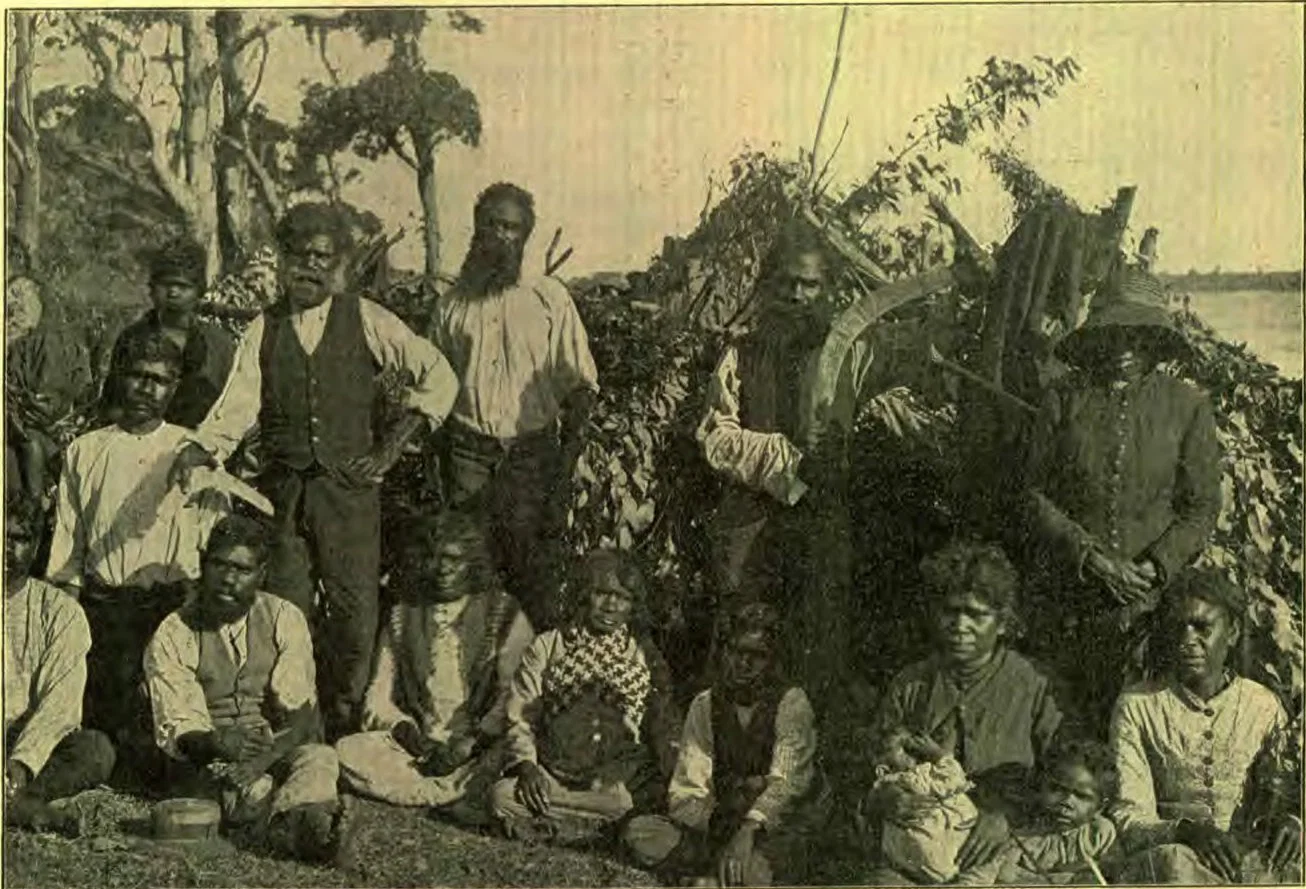
It is in this country that the few remains of aboriginal life are seen. We visited a native camp near a railway station, and what we saw is well shown in the illustration. Parents and children were outnumbered two to one by ugly, ill-fed dogs, which barked and growled around us. The wretched people live on anything they can get that is at all eatable,—snakes, slugs, grubs, beetles, roots, leaves, carrion, and whatever they can beg. A lady friend who will not see this told me that once, in company with a friend, she visited a black fellow’s camp, where one of the women (“gins”) was known as an excellent cook. She was even then engaged in preparing a meal for the men who were lying about the hut. Spying some dainty-looking food just prepared, the friend asked the cook for a sample. It was given, on green leaves, to each of the ladies, and by each was pronounced “delicious,” “lovely,” “exquisite,” etc. Just before leaving, the visitor asked the cook what that particular food might be. “Snake!” said the black woman, with her arms akimbo. There was a violent effort on the part of the ladies to unswallow what they had just eaten. They were both violently sick, much to the amusement of the men on the grass. But the snake did not come back.
At the time I visited this region, it was a common sight to see horses and cattle in the last stages of starvation left to perish where they finally staggered and fell. For days the poor creatures would lie there with no one to pity them, no one to offer a drop of water or a mouthful of food. The crows would pick out their eyes, and mangle their heads, and at last death would come slowly along. In many places, piggeries have been established, and a still more horrible chapter is thus added to the awful story. For when it became certain that the creatures would soon die, they were driven into the inclosure, and pigs and crows vied with each other in the horrible feast. What was done with the pigs? Don’t ask! We know what is done with pigs.
Sin and the curse hang heavily over a large portion of our fair world. What a change will take place when He comes whose right it is to reign! G. C. TENNEY.