A WEARY TRAMP

8%

Review and Herald Publishing Company · Battle Creek, Mich. · Oct 25, 1900

FromThe Youth’s Instructor, Vol. 48, No. 42.

Read the full edition

A WEARY TRAMP

The Spanish village of Lemoncito is situated about seven miles from the Carib town of Lemon. For a week we had been anchored off the coast, and contrary winds prevented our sailing on the night we had planned; so one of the men proposed that we visit the Spanish town, and see if we could buy oranges to complete the cargo. Any change that takes one on land is acceptable after being on board a small boat for a few days, so I gladly volunteered to accompany him.
Learning that the roads were muddy, we put on our oldest clothes; and taking each a native machete,—a long, heavy knife used by the natives,—we started along the beach. After passing the Carib town, we soon came to a pool of fresh water, where the women were washing. They assured us that we could wade through, which we did, the water coming up to our waists. The path was fairly good for a mile or two, but grew rapidly worse as we neared the river flats. Some of the natives had been down to the coast that same morning, and we followed their footprints in the soft mud till the trail was lost in the bog.
My companion was a large man; and being born in these parts, splashed along good-naturedly, having removed his moccasins when they became filled with mud. Tempted by the apparent ease with which he progressed, I followed his example. While my bare feet pulled out of the mud much easier than before, the ragged roots, hidden knee-deep in the soft ooze, cut my feet badly. However, there was no choice but to push on or be left behind.
Half an hour later we came to a swollen stream, red from the up-country clay. A single log, slippery with the floods that could not flow under it, spanned the stream. My companion advanced cautiously, the bridge swaying under his weight; but its hold at either end was better than it appeared, and we hastened on, walking where the mud was up to our ankles only.
We could see, by the light that came through the heavy foliage, that the sun was getting low. A splash now and then told of the movements of some disturbed alligator, but we saw none; the shadows were too deep. Parrots could be heard in the branches far above us, but they said nothing that we could understand.
Reaching higher ground, we found a plantation of plantain and bananas; also a casa, or native house. A sow and pigs were wallowing in mud at the door; and in spite of their chorus of grunts, we were made to understand, by the frizzle-headed, dried-up woman inside, that Lemoncito was only a short distance away.
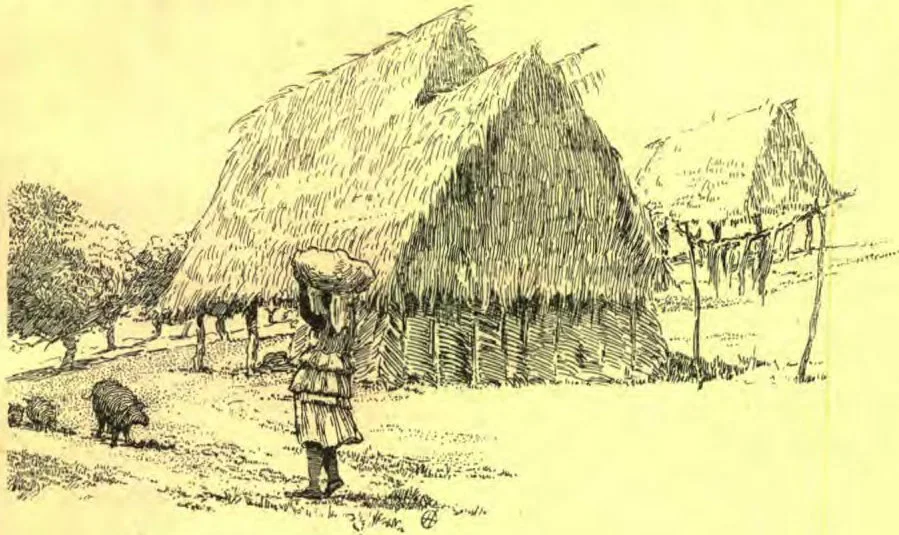
The trail led over hillocks of debris piled up by recent floods, over fallen trees, and across the stream, which was here much more swollen and swift than at the lower crossing. About sunset we came to Lemoncito. We had climbed a steep bank from the river flats, crossed a narrow ravine on a log, hewed flat on top, and now stood in an orange grove. At the right, and thirty feet below, was the stream we had just forded. The village consisted of five houses, and we approached the best one. It was a mud-walled structure, with a thatched roof. At some remote period the walls had been tinted cream-color, and must have looked very dainty; but now only the most sheltered spots preserved the hint of better days. The thatch was black with smoke and time. In the doorway stood a woman, who made us welcome. There was only one room in the house, lighted by two tiny windows and as many doors. At the left, as we entered, flickered a fire of sticks in a broken-down clay fireplace, the smoke finding its way out as best it could.
Learning that we were hungry, the village was ransacked for food, but the only thing available was green bananas. These were peeled, and put in an earthen pot with water from the muddy stream: a bit of salt was added, and, notwithstanding our protests, which were understood by the good woman as the result of reticence on our part to accept so many good things, she poured in a tablespoonful of manteka, or lard, from a soiled bottle. The oranges had only sharpened our appetites; and when, armed with an iron spoon apiece, we sat down on a low bench, with the pot between us, we ate the evening meal gratefully.
A NATIVE HOME
A NATIVE HOME
The fire was brightened after supper by adding pieces of pitch pine. In its flaring light, the villagers chatted, sang, and danced as only Hondurasians can. We sang some of the gospel songs so full of hope to them as well as us, and how my heart went out to those poor creatures! One of the younger women asked us to visit her mother, who was sick. We found her sitting on the bare ground in a wretched hut of thatch and poles, with her arms folded over her knees, to which her chin appeared to be glued. She had not straightened out her body for four years. We could give her little encouragement of a radical change in this life; but we asked the young people to clothe her warmly, also to make a bit of floor of hewn planks under her, and to inclose the hut, that she might be out of the reach of the winter storms. These things they promised to do, and the next morning they were at work on the needed improvements.
How many aching hearts, and aching bodies, too, all over the world, are waiting a word from you and me! Let us go or send help to every needy soul we can reach. H. A. OWEN.