MATERIALS

6%

Review and Herald Publishing Company · Battle Creek, Mich. · Nov 1, 1900

FromThe Youth’s Instructor, Vol. 48, No. 43.

Read the full edition

MATERIALS

At the present time the public look as much to the pictures in the magazines and papers for instruction and amusement as to the reading-matter. Most illustrations must be regarded as part of the decoration of the printed page, and therefore should harmonize with it in color and line. Perhaps nothing harmonizes so well with type as bold pen-drawings, photographically reproduced.
It will be best first to explain to the reader the photo-engraving process (the process by which drawings are reproduced for printing), that he may understand what class of work is necessary to make a successful reproduction.
Pen-drawings are generally made larger than they are to appear on the printed page. By the photo-engraving process, they are reduced to any required width, this width being marked under the drawing. When a drawing is reduced, the proportions always remain the same.
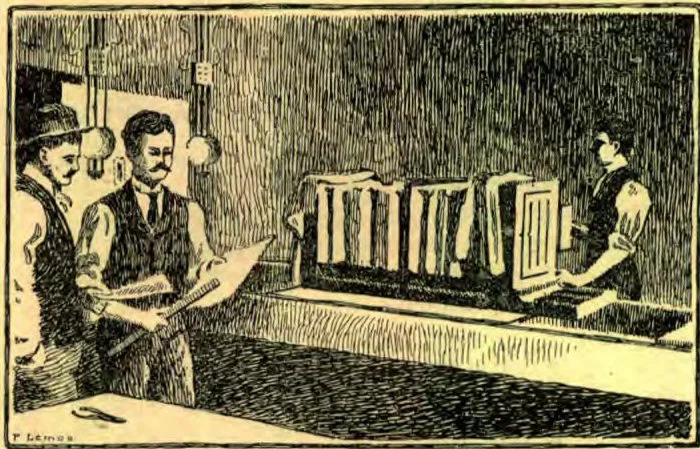
When a drawing is made for reproduction, it is sent to the photo-engraver. Here it is photographed and “printed” by electric light on a sensitized zinc plate. By chemical action the lines of the drawing, as they appear on the plate, are impervious to the action of nitric acid. Into this acid, then, the plate is immersed until the zinc around the lines is eaten away, leaving the lines in relief. (If the reduction of the drawing be too great, the smaller lines are eaten entirely away by the acid. All small and weak lines are lost; therefore one of the principal requirements in pen-drawing is firm lines.) More of the zinc is then removed from around the lines and open spaces by the “routing machine;” a few touches are sometimes given by a hand-engraver; the zinc is nailed to a block to make it “type high,” and is then ready for the printer.
In the following lessons I shall endeavor to give the student some instructions and suggestions in the making of pen-drawings. It will be supposed that he already has some knowledge of the rudiments of drawing, so very little of that part of the subject will be touched upon. These lessons may be taken as supplementary to the previous series, “Drawing from Nature,” or studied as a separate series; but in either case the student must look to them only as a guide. No teacher can be more than that. The student can be taught the use of materials, what work is necessary, etc.; but unless he has a love for the work, and the true artistic sense, he will not reach the mark.
It is impossible to tell another just how to go to work with pen and ink, or any other medium. True art is, above all things else, a matter of individual expression. All that is expected of the student is that he shall get out of these lessons suggestions for work, which he will do in his own way.

Now as to materials.

One naturally finds a difference of opinion among artists as to which drawing-ink is the best. Some still use the old-fashioned imported India-ink cake, and rub it down with a little water in a saucer. While this ink is excellent for wash-drawings, I would not recommend it for pen-work, as with its use the point of the pen becomes clogged, and requires constant attention; it is almost impossible, also, to keep the fluid a uniform black.
“HERE IT IS PHOTOGRAPHED AND ‘PRINTED’ BY ELECTRIC LIGHT”
The best drawing-ink is a little thicker than writing-ink, and of a perfect black. Most writing-inks have a more or less blue tone, which is unsuitable for photographic purposes, as blue can not be reproduced. A good drawing-ink, recommended by all pen-artists, is that known as Higgins’s drawing-ink.
A Gillot pen, No. 200, is suitable for the fine lines in a drawing, while a Gillot pen, No. 170, can be used for the heavier lines. For filling in large spaces of solid black, a brush is often used instead of a pen.
Bristol-board or any paper with a smooth, hard surface should be used to work on.
For the preliminary pencil outline, I would suggest a medium pencil. The lines from a soft pencil can not be easily and completely erased, and will leave a smudge that may interfere with the reproduction, and a very hard pencil is liable to scratch the surface of the board.
A soft eraser will be best, as a hard eraser will spoil the surface of the paper for ink.
A water-color pigment known as Chinese white can be used for putting in sharp lights or for correcting slight errors. It can be thinned down with water to the consistency of the ink, and used on the pen, or it may be used with a small brush.
These materials can all be purchased in any store that deals in artist’s materials, and are all that it is necessary for the student in pen-work to equip himself with. PEDRO LEMOS.