In the old ivy vine that shades our porch a strange industry is being carried on by ants. All day long I can see them hurrying up and down, to and from their work. They appear to be as much absorbed in it as are men in business. And as I watch closely, I observe that in some ways they are quite as knowing and shrewd as men. Indeed, they must be wise; for their business is nothing less than the herding and milking of cows, and that, too, in a land full of enemies.
Ant-cows are properly called “aphides,” but most often we call them simply “plant lice,” “green flies,” or “blight.” Every summer they live on our rose-bushes and garden plants; and unless we sprinkle them with tobacco water, often do much injury. But as one man’s loss is often another’s gain, ants find aphides valuable for their honey.
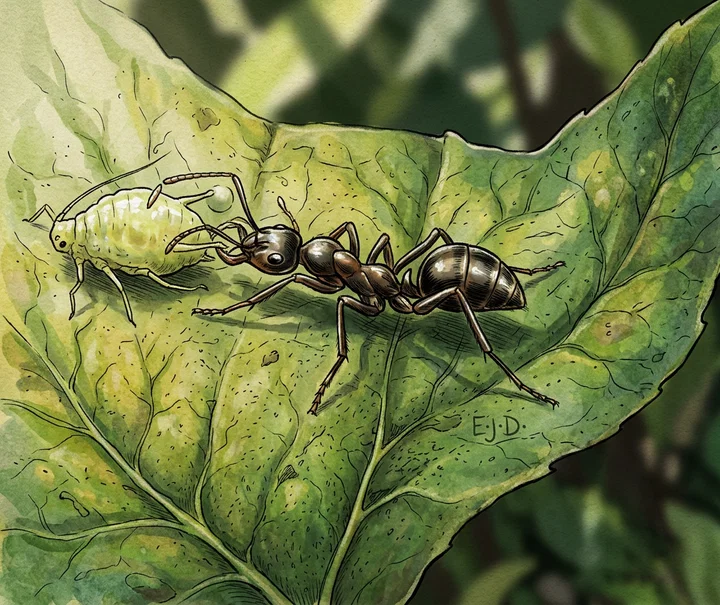
The illustration shows a common garden ant milking one of his cows. This he does by tapping the little creature gently, thus coaxing it to yield its store of honey-dew. If successful, the ant will greedily devour the sweet nectar, and then go to another “cow” for more, and so on till he has milked five or six. Imagine your dairyman drinking the milk from half a dozen of his cows at one meal!
Do you know what this honey-dew that the ant likes so well really is?—It is glucose. In drinking the juices of plants, the aphis gets more sugar, or glucose, than its body can use, but only little muscle-making food along with it. The insect must continue eating, and in some way get rid of the sweet, which otherwise would clog its system. So nature has provided for it the little tube-like strainers shown in the picture. Through these it yields glucose at the call of the ant.
But ants do more than milk their cows. They also keep them on good pasture. If you will notice, you will often see the aphides gathered in large numbers on the juiciest shoots and leaves. From this it is plain that ants know the best food for their stock, and also that it is easier to protect their herd when gathered closely together; for, as I said before, they live in a land of enemies.
Only a few days ago I saw a small worm creeping stealthily among them, leaving their skins and dry bones in his path. Then there is the little ladybug, which drinks their blood. Another foe lays eggs within them, and the young from these eggs actually eat the poor creatures out of their skins. But their worst enemy is intense cold. The frost of winter would soon destroy the whole aphis race, could it but reach them. Only two things prevent this,—greenhouses, where the aphides may live during the winter, and ants.
Early in October the aphides lay their eggs and die. Ants find these eggs, carry them into their warm nests, and carefully tend them during the winter months. Then when spring comes,p. 350 they are brought out, and placed on buds and leaves. In the warm air and light they quickly hatch; and the little aphides at once begin drinking the sweet juices, and making honey for their protectors. Edison J. Driver.