PEN-DRAWINGS, as stated in the last lesson, should be made larger than the size to which they are to be reduced. The finer the work, the less reduction it will stand; if reduced small, and the lines have been drawn too close together, the spaces between the lines will be apt to fill up with ink, even with very careful printing, and the artist must not count on that.
A good course to follow is this: If you are merely practicing to learn the handling of your pen, make your drawing large; but if you are making the drawing for publication, do not let it be more than twice the size you expect it to appear on the printed page. By this means the lines come out clean, distinct, and sharp-cut, which they are not likely to do when reproduced the same size as drawn.
In charcoal or pencil it is possible, in drawing an outline, to build up a line by drawing lightly, and then partially erasing, again drawing and again erasing, till the line is complete. In penwork it is possible first to draw an outline in pencil, and then go over it in ink, but the final outline, once in ink, must remain. Of course the line may be erased with a penknife or obliterated with a little Chinese white, and a new line drawn; but this method is resorted to only in case of an error, and is never as satisfactory as to draw the line correctly the first time. But there can be no continual erasing, as the student who has been trained in an art school does when drawing in charcoal or pencil.
There are many different ways to make your lines, or technique; but there are three methods which are more generally used, and under which all other techniques may be classed.
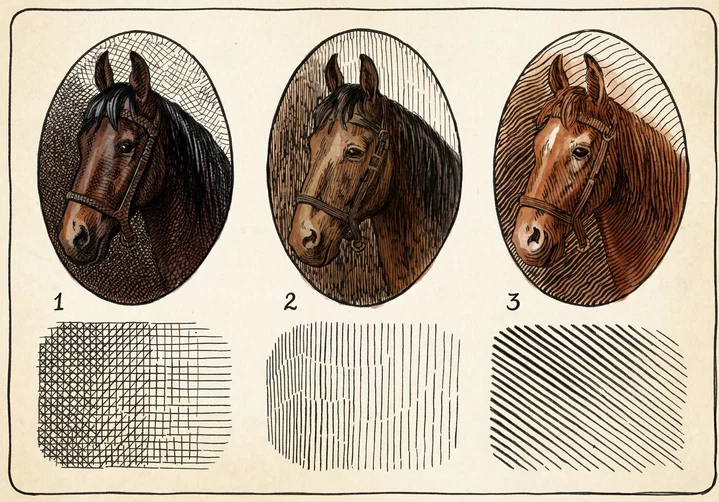
First, is the crosshatching. This is employed a great deal for shades and shadows, and in backgrounds, but is seldom used nowadays throughout a drawing, as it has a tendency to make a picture look mechanical and unnatural. Crosshatching is made by drawing parallel lines, and crossing these with a second set of parallel lines; the deeper the shade, or shadow, the more lines will be required, all crossing each other.
This method is illustrated in the lines of the accompanying drawing (1). The drawing above each set of lines illustrates their use in a picture.
The student should be careful not to run the lines, in crosshatching, too close together, as the least reduction will make the shade print solid black. For curved surfaces, curved lines, crosshatched, are used.
The second method of expressing shadow, or depth of tone, is by increasing the number of lines. The deeper the shadow, or tone, the closer the lines should be drawn to each other, as in the lines shown in 2. Do not attempt to make very long strokes, and do not overlap the ends of the lines, as this will leave an uneven shade.
The third method is by pressure of the pen, as shown in lines 3. This can be done by beginning at the light end of a line, and gradually thickening the line as you approach the shades, by pressing the pen; or the process can be reversed, and the dark end of the line drawn first, whichever is easier for you to do. Do not allow your pen to run dry before recharging it, as you will then have gray lines, which will reproduce brokenly.
The first thing to acquire is firmness of touch. You must get your hand under control, just as a pianist does in running scales and practicing exercises on the piano. Practice of the foregoing methods for some time will do much toward steadying the hand. Draw the lines boldly, and do not hesitate, as a quick, free stroke is necessary to give the evenness of tone that you wish to acquire.
When you have gained a certain proficiency in the handling of your pen, you will, of course, not be bound down by these precise methods of expressing light and shade; but at the beginning, at least until you have trained your hand correctly, it will be better to use them. Artists are continually striking out in paths of their own, and discovering new ways, peculiarly their own, of obtaining effects. One thing the student will find of great help is the study of good examples. He can supply himself with materials, and learn how to use them, he can learn from nature to interpret what particularly interests him; but the quickest and best way to gain the proficiency desirable is to study the work of the best pen artists, in which he can learn both the handling of the pen and how to interpret nature. PEDRO LEMOS.