BEREAN LIBRARY STUDY

8%

Review and Herald Publishing Company · Battle Creek, Mich. · Nov 22, 1900

FromThe Youth’s Instructor, Vol. 48, No. 46.

Read the full edition

BEREAN LIBRARY STUDY

Revelation 6; “Thoughts on the Revelation,” pages 402–434

NOTES ON LESSON 6

  • (November 25 to December 1, 1900)*
The Lamb.— The wonderful love of God for us is shown by Christ’s being recognized as a Lamb in the midst of the throne. This is a constant reminder to the heavenly host that he is the sacrifice for fallen humanity. In heaven as well as on earth it can be said, “Behold the Lamb of God, which taketh away the sin of the world.”
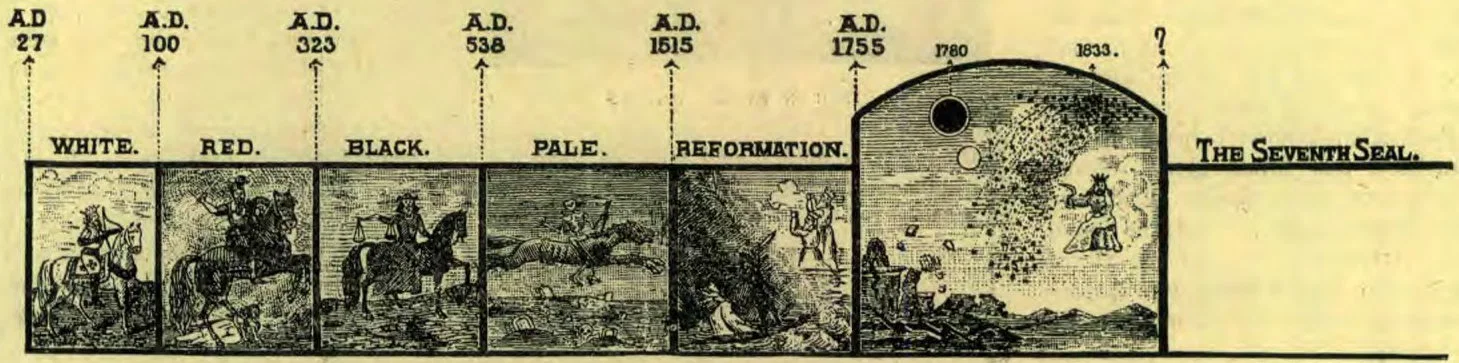
The White Horse.— White denotes purity. The church went forth as an aggressive power, and in a few years the good news of salvation had spread over all the then known world. This condition of prosperity continued until the close of the first century.
THE SEVENTH SEAL.
THE SEVENTH SEAL.
The Red Horse.— The purity indicated by the white horse had now departed from the church. Persecution came in; and a great sword, not a very peaceful weapon for a church to wield, was given the rider. When Constantine nominally accepted Christianity, and the church began to compromise principle in order to gain worldly favor, it placed a great power in the hands of the church. This was not an omen of good, but a sword that inflicted a severe wound upon the church.
A Black Horse.— This is one of the saddest periods in the history of the church. Persecution from without was not to be compared with the calamity that befell the church when it was wounded by its friends. Heathen customs found their way into the church almost imperceptibly. When the persecution ceased, it became popular to be a Christian. In the courts and palaces of kings, persons accepted the form of Christianity, but rejected the simplicity and meekness of the true followers of the lowly Nazarene. They took, instead, the pomp and ceremonies of the pagan religion. “The nominal conversion of Constantine in the early part of the fourth century caused great rejoicing; and the world, cloaked with a form of righteousness, walked into the church. Then the work of corruption progressed rapidly. Paganism, while appearing to be vanquished, became the conqueror. Her spirit controlled the church.” But God’s care is over all, and from the midst of the four beasts of heaven comes a voice limiting their power, and warning them not to hurt “the oil and the wine,” the true Christian graces. He who has set bounds for the sea, and said, “Hitherto shalt thou come, but no further: and here shall thy proud waves be stayed,” also places a limit on the power of darkness. He will not let the waves of worldly policy completely overwhelm his people.
The Pale Horse.— The mystery of iniquity was now established, and began to show forth the satanic spirit of its master. The Bible was taken from the people, and heathen superstitions were taught in its place. The Sabbath of the Lord was dethroned, and a spurious rest-day was given to the people. “In the early part of the fourth century the emperor Constantine issued a decree making Sunday a public festival throughout the Roman Empire. . . . Vast councils were held from time to time, in which dignitaries of the church were convened from all the world. In nearly every council the Sabbath, which God had instituted, was pressed down a little lower, while the Sunday was correspondingly exalted.” Thus the pagan festival came finally to be recognized by the mass of the people as the Sabbath; but there were always a faithful few who honored the Sabbath of the Lord.
The Fifth Seal.— During this period God raised up men to stand in defense of the gospel, and one by one the coverings of falsehood that the papacy had spread over the pure gospel were removed by these resolute reformers. The Bible was brought out from its hiding-place. It was no longer chained either by literal chains or by being kept in a dead language. It was translated into the language of the common people, and placed in their hands. The martyrs who had given their lives for the gospel under the fourth seal were now given white robes of character; and they, with all other martyrs, will also be honored on the new earth. From “Early Writings,” page 14, we read as follows: “As we were traveling along, we met a company who were also gazing at the glories of the place. I noticed red as a border on their garments; their crowns were brilliant; their robes were pure white. As we greeted them, I asked Jesus who they were. He said they were martyrs that had been slain for him. With them was an innumerable company of little ones; they had a hem of red on their garments also.”
The Sixth Seal.— The scene of action changes; no longer is it confined to the people upon the earth; but the old earth itself is mightily convulsed, telling in unmistakable language that the end of all things is near. Then the heavens take up the refrain; and the sun, that faithful witness in heaven, testifies to the fact that the end of all things is at hand. The moon, which for six thousand years has transmitted to man what it has received from the sun, now re-echoes the faithful testimony, and hangs as a great ball of blood in the sky in fulfillment of the words, “The moon became as blood.” A few years later the stars fell as untimely figs. We are living between the thirteenth and fourteenth verses of Revelation 6. There are three heavens,—the first, or atmospheric, heaven (Jer. 4:25; Zeph. 1:3), where the birds fly; the second, or starry heaven (Rev. 6:13); and the third heaven, where God dwells. 2 Cor. 12:1–4. The first heaven is tainted with the effects of sin, and will be rolled together. Peter says, “The heavens shall pass away with a great noise.” The air is composed of various gases; and when the Great Master sees fit to roll it together, there will be an explosion that will echo through the universe of God. Every island and mountain will be moved out of its place.
Read the chapter on the Deliverance of the Saints, in “Early Writings,” or Chapter XL in “Great Controversy,” Vol. IV.