“Manaho!” (hallo!) my friend said, cheerfully, as we neared the little group on the mountain-side.
“Manaho! manaho!” was echoed by a dozen tongues. A group of Indians, some brightly, some soberly dressed, were sitting on and around a great flat rock, over which bent springy boughs. Here were the Indian “mills,” and we had come to witness the interesting process of making the famous Indian bread known as wy-o-ta.
The mills themselves are simple affairs. Long, cylindrical rocks, tied sometimes to springing boughs, are pounded up and down in little hollows in the rock. In these hollows shelled and blanched acorns are placed, and quickly pounded to a fine meal. Some of this meal was handed me on a leaf. I tasted it, and to my surprise found it intensely bitter. I must have made a grimace; for the Indians who were watching me burst into laughter, and broad grins showed pearly teeth in almost every mouth. And here I may say that nowhere can a people be found whose teeth are better than those of the Sierra Indians. Aged men and women will display grinders still sound, though worn almost to the gums.
In speaking of the Indians I must not forget the children. While their mothers are making flour,—pound, pound, pound, half a day at a time,—the little ones are by no means idle. An old hatchet or knife in hand, they go out to make war on the sturdy pine saplings. Around every Indian mill these trees will be seen scarred and barked through the destructive instincts of the young warriors. These children like blindman’s buff, also, and their shout and hurrah often make the forest ring. They have many other games and pastimes, some of which I may speak of another time.
For making meal the white oak yields the most valued acorns. To gather these, the Indians beat the boughs, and pick up the nuts that fall. Years ago, before reservation laws were passed, the men climbed the trees, and cut off the branches, while women and children picked the acorns. It is maintained that the trees were kept young and vigorous by this pruning process.
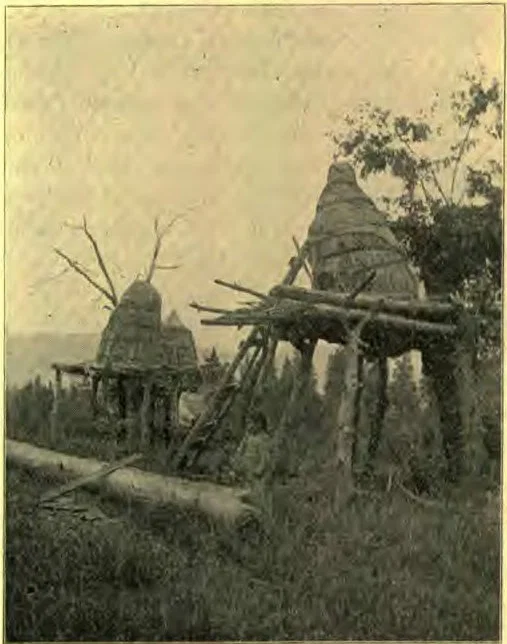
When the Indians go far from home to gather their crop, often they do not carry all the harvest home, but build cone-shaped storehouses of grass, bark, and twigs. These are always on some rock, stump, or platform open to wind and sun, that the nuts stored in them may cure nicely, without danger of molding. No matter how far from home they may be, the surplus harvest is always stored in these acorn houses. And all Indians respect them. No matter how strong their thieving propensities, some strange sense of honor keeps them from molesting another’s bread.
Often during the late harvest the weather is cold and damp; and the Indians, with scanty covering, must sleep on the bare ground. First they dig a hollow in some sheltered place, and build a great fire in it. When the earth is very hot, they rake away the embers, and sleep on the warm ground.
Now for the process of making bread. When the meal has been made, it is placed on a closely woven sieve made of fern roots. Scalding water is then prepared by throwing hot stones into baskets of water. This water is poured over the meal, gradually washing away the bitter tannin. When the meal has been made thoroughly sweet, it is mixed with water, and cooked in the same manner as the water is heated,—with hot stones. The mass quickly thickens, and when done, resembles heavy jelly in consistency. It is ashy gray in color, and in flavor is not unlike a raw chestnut, though not so sweet. The Indians eat it with fruit, milk, other nuts, and meat; for it combines well with all flavors. In their bills of fare it is as necessary as is bread in ours.