THE LION’S NAMESAKE

10%

Review and Herald Publishing Company · Battle Creek, Mich. · Dec 27, 1900

FromThe Youth’s Instructor, Vol. 48, No. 51.

Read the full edition

THE LION’S NAMESAKE

THE great tawny cat of the forest is not more cunning in his search for prey, nor more ferocious in the killing of it, than that little namesake of his, the garden ant-lion. Like the big lion, the ant-lion lives in dens, lies in wait for prey, and greedily drinks the blood of his victims. But he does more: he builds a trap, and in that trap catches his food.
Last summer, at the foot of a pear-tree, I found a whole family of these little lions, each living in a den of his own, and feeding on insects that were caught in his snare.
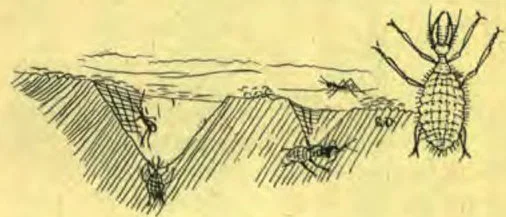
While observing them, I saw a snare made. The ant-lion began by marking out a circle in the earth about as large as a silver dollar. Then, walking backward, and digging with his tail, he dug other circles within this, throwing out the dirt by quick jerks of his head. Little pebbles, some as large as the insect himself, were balanced on his jaws, and with a quick spring of the neck, tossed several inches away. He continued this digging and tossing until a perfectly cone-shaped hole had been made, about an inch and a half deep. In the bottom of this he buried himself, leaving only his jaws protruding.
Presently, from a nest near by, came an ant, hurrying out to gather seeds. With his short-sighted eyes he saw nothing alarming in the little sandy hole, and so fell in, sliding part way down the side. This side was very poor footing at best; and now, from the bottom of the hole, came a blast of sand, thrown by the ant-lion’s head. Down, down slid the little climber, despite his best efforts, right into the cruel jaws. One snap—and he struggled helpless. The sharp, bony points sunk deeper and deeper, while the ant-lion drew his prey under the sand.
Small spiders, worms, and other insects are often thus taken in the snare, and eaten. But if some big, disagreeable bug, like the pinching-beetle, tumbles in, and the lion grabs it as usual by the leg, almost before he knows it, he finds himself drawn out face to face with a horrid stranger. Discovering his mistake, he appears to beg pardon instantly. At any rate, he hastens to withdraw, leaving the whole den at the newcomer’s disposal.
The ant-lion can live on a diet of one small ant a day; but if he can get them, he will eat a great many more. And the more he eats, the faster he grows, storing up energy and building-material for the great event of life—his metamorphosis.
By and by, when he has eaten enough, and grown big enough, he undergoes this change. As the ugly caterpillar becomes a beautiful butterfly, so the dusty little ant-lion changes into a wonderful winged creature, resembling the dragon-fly. Then he catches his food on the wing. The long, ugly jaws disappear; and as he dances in the sunlight, on fairy wings, only his best friend, the naturalist, will recognize in him the strange little digger of pitfalls.
EDISON J. DRIVER.