Did you ever visit the Yellowstone Park? If not, you may be interested in some thoughts that have been suggested by my trip through this Wonderland of the world.
In company with Elder W. B. White, president of the Montana Conference; Elder W. T. Knox, of Oakland, Cal.; Dr. Wollekar, of Butte, Mont.; and “our boy,” Ray Beggs, of Livingston, Mont., I started, July 19, up the Yellowstone River for the park, sixty miles to the south of Livingston. Our company had a team of horses, a wagon, and a camping outfit, all furnished by the kindness of our Montana brethren. We spent ten interesting and profitable days in the park, receiving not only physical rest, but spiritual refreshing as well.
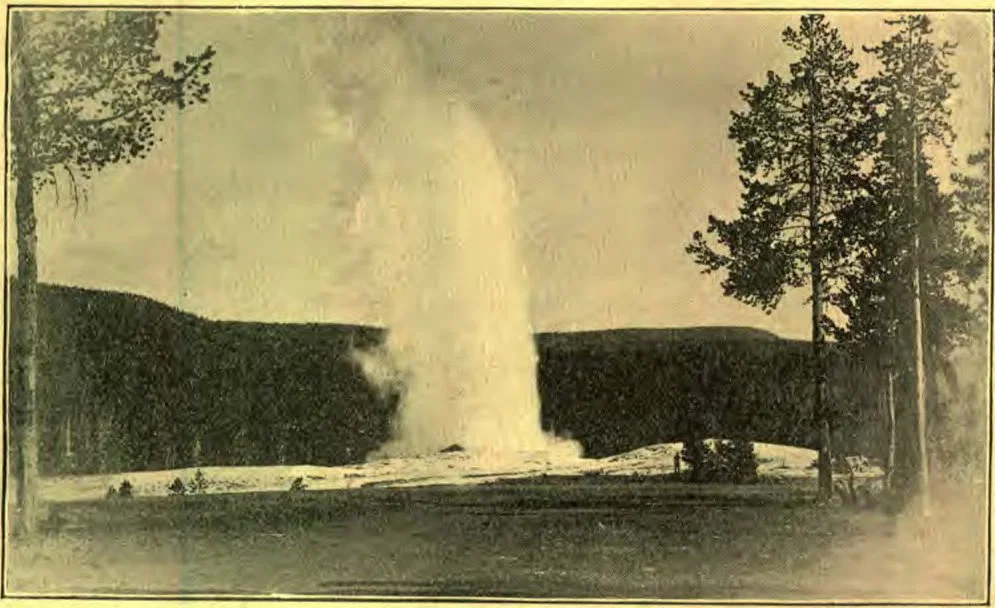
OLD FAITHFUL
Yellowstone National Park lies in the north-western corner of Wyoming, and extends a few miles into Montana and Idaho. The reservation is about fifty-three miles east and west, and sixty-one miles north and south. No valley within its limits has an elevation of fewer than six thousand feet, while many of the mountain peaks within, and adjacent to, the park rise from ten to fourteen thousand feet above sea-level.
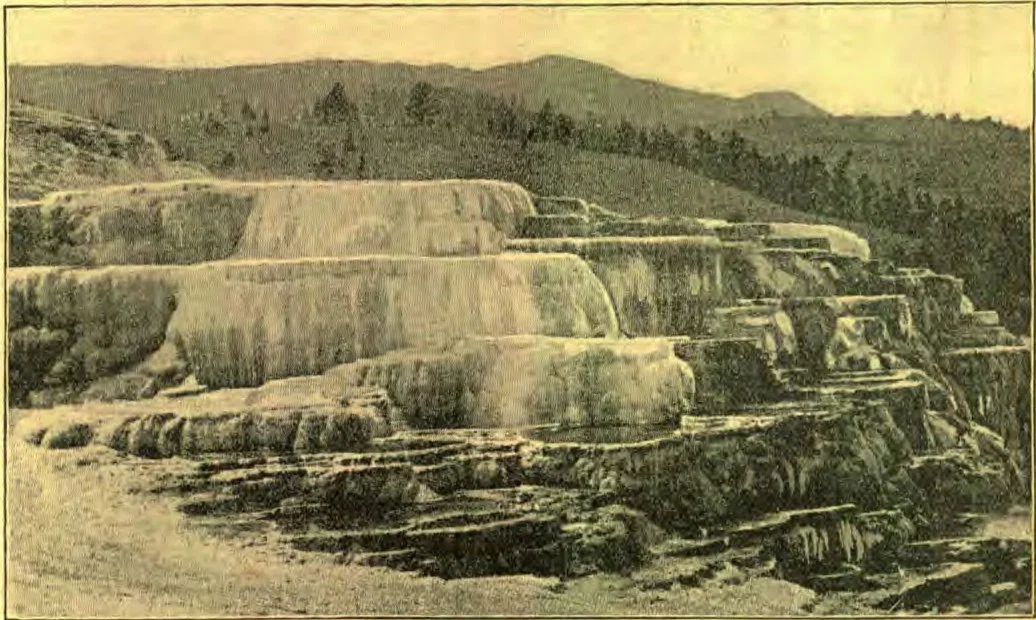
MINERVA TERRACE — MAMMOTH HOT SPRINGS
Yellowstone Lake, one hundred and fifty square miles in area, is the largest body of water at that altitude, eight thousand feet, in North America. Three of the largest rivers in the United States — the Missouri, the Yellowstone, and the Columbia — have their source in Yellowstone Park.
This is the land where the geysers gush, and the cataracts roar; where hot springs boil, and cool fountains flow,—the land where the mountain lion, the wolf, bear, buffalo, elk, and deer hold protected and unmolested right; where the nimble squirrel rejoices, the happy chipmunks skip, and all nature smiles. The eagle finds many a craggy peak on which to build her nest, and the fox can dig his hole in safety. There are also many beautiful birds and flowers. Everything is in its natural state. All the government has done is to build good roads, and to station soldiers here and there for the protection of the animals, and to enforce obedience to the rules of the park.
The animals seem to have lost their natural ferocity and timidity, and are remarkably tame, for the simple reason that no one is allowed to hunt or kill them. The deer and their beautiful fawns would come close to us, apparently saying, “We are not afraid; for here nothing is allowed to hurt or destroy us.” I am sure we had no desire either to kill or eat them.
The bears are an interesting feature of the park. They have learned, among other things, that there is no danger to be feared; but they have not learned the command, “Thou shalt not steal,” or at least they do not obey it; for one night after we had lain down to sleep, Bruin came and helped himself to the beans and prunes that we had left outside our tent, and walked away with an air of saying, “I am a vegetarian; I believe, with you, that beans and prunes are good for man and beast — especially for beast.”
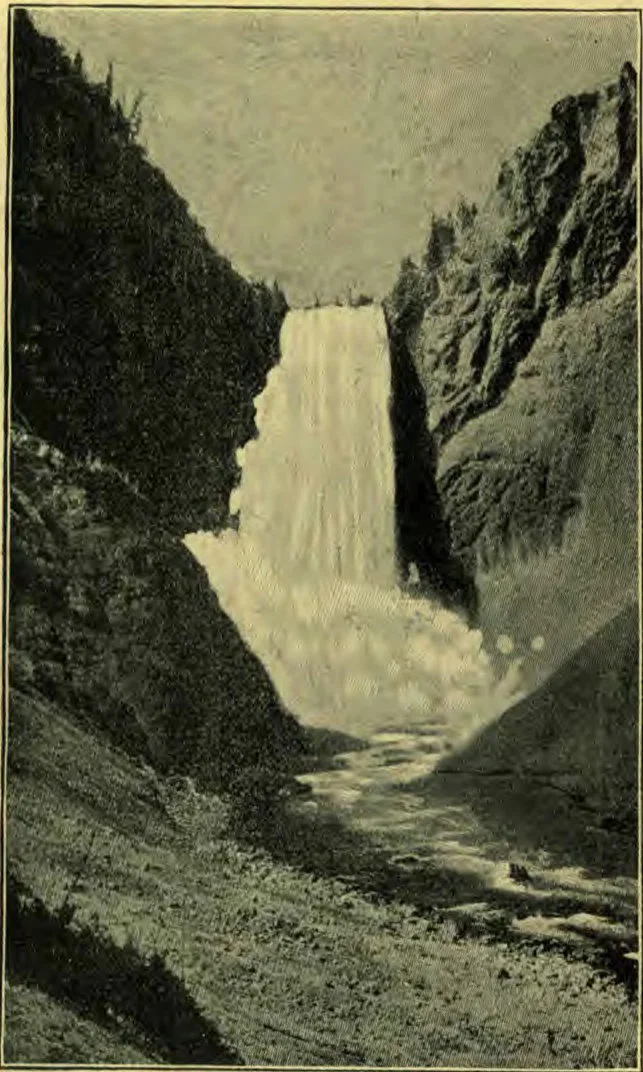
No pen can tell of the wonder and beauty of this most interesting place. I can not express my feelings as I looked on the lofty mountains lifting up their hoary heads into the regions of eternal snow; the dark, silent forests of evergreens; the charming valleys, with sparkling fountains and laughing brooks; the beautiful rivers, with dashing cascades and lovely waterfalls; the wonderful hot springs and gushing geysers, throwing boiling water from thirty to one hundred and fifty feet into the sunlight, and then falling back to earth like a shower of diamonds; and the deep and awful canons, whose rock-riven sides speak of Him who can plow a passage through the solid mountains for his streams to flow on their clear, winding way to the sea. As2I looked, for the first time, on the lower falls of the Yellowstone, I was so overcome by their magnificence and overpowering grandeur that I turned away, sat down upon the rocks, and wept. When I turned my head again, and watched the river make its awful leap of three hundred feet, and the beautiful blue water turn to white foam and sparkling crystal as it fell on the rugged rocks below, and then, recovering itself, wind away like a green ribbon at the bottom of the Grand Cañon, I shouted, “Glory!”
The Grand Cañon of the Yellowstone, twenty-four miles long, with a depth of from six hundred to twelve hundred feet, is the most brilliantly colored landscape in the world. Words can not give an idea of the surpassing loveliness of this romantic place. It looked as if a dozen of the most beautiful sunsets had been thrown together into that deep, awful abyss, and had caught on rock, and crag, and peak, and cranny, until the sides of the cañon were one mass of glory. Clinging to the rocks, I crept to the edge, and looked down. Where shall I begin, or how, in anywise to describe this tremendous sight,—its overpowering grandeur, and at the same time its inexpressible beauty? I thought of the sea of glass mingled with fire, and exclaimed, “Great and marvelous are thy works, Lord God Almighty.”
We are surrounded every day by the great and marvelous; but we do not seem to be so aroused and impressed as when we stand in the presence of the uncommon, and, like Moses at the burning bush, say, “I will now turn aside, and see this great sight.” A visit to the National Park affords a rare opportunity to see the strange and wonderful side of nature.
During the ten days we were there, and in our circuit of over a hundred miles, we had abundant opportunity to see nearly all the great sights of the park. There is nothing more startling or impressive than the hot springs and geysers. There are three thousand hot springs, there being over four hundred in one basin alone. These vary in size and shape from those the size of a common water-pail, to giants that measure from thirty to forty feet in diameter. Morning Glory spring, as its name suggests, is a glory indeed. It is a silent pool about twenty feet across, its funnel-shaped and delicately-colored walls giving it the appearance of a morning glory.
GREAT FALLS OF THE YELLOWSTONE
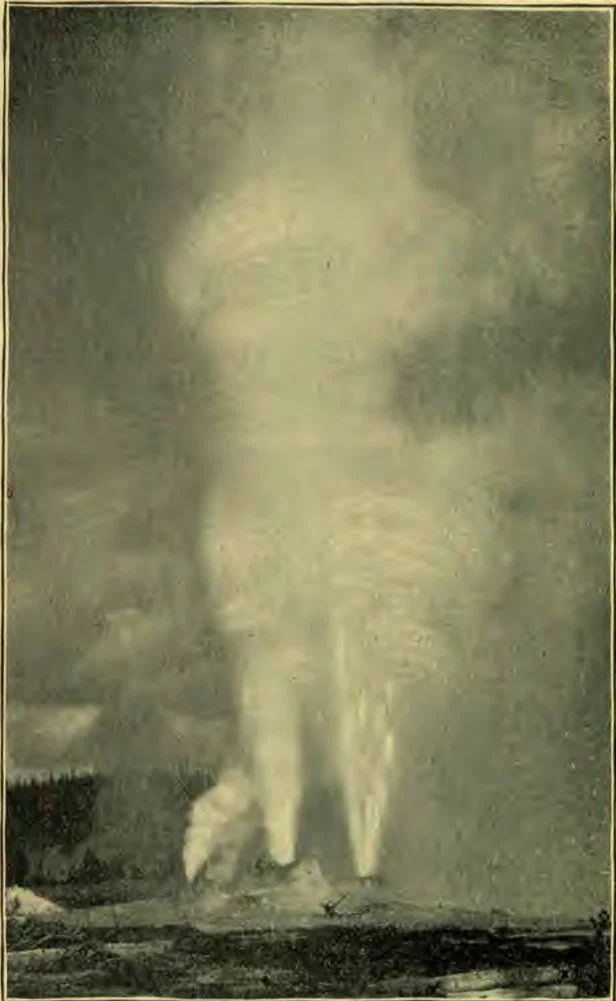
The geysers of this region rival anything of the kind in the known world. There are over fifty that throw a column of hot water from thirty to two hundred feet into the air, at intervals of six minutes to fourteen days. There are several geyser basins. These are large tracts of land, some containing three or four square miles, which can be fitly described as a “desert land,—a waste, howling wilderness.”
If you would picture to yourself a geyser, imagine yourself standing on the brink of a hot-water pool, which is constantly bubbling and boiling. All at once, with a rushing, seething, hissing sound, the water leaps into the air, thirty, fifty, seventy-five, one hundred or two hundred and fifty feet, and continues this for several minutes, and sometimes for over two hours; then suddenly it resumes its ordinary bubbling and boiling. These geysers really seem to go mad. Approach their crater, and look down into their deep, blue, hot waters; and if it is their time to play, they will leap forth with a rush and roar like a wild beast from his den. Each one seems to have an individuality of its own; and, like men, each must be studied to be appreciated. They have all been named, their names being suggested by their habits and surroundings. Here are a few: Bee Hive, Saw Mill, Surprise, Spasmodic, Grand, Giant, Riverside, Splendid, Comet, and Old Faithful. A new one has lately appeared, and must of necessity be named “Dewey.”
Away up on the eastern slope of Terrace mountain, in a rough, ragged place, occupying one hundred and seventy acres, sparkling and glittering in the morning sunlight with a pearly whiteness that almost blinds the eye, are the Mammoth Hot Springs — a world of wonder in themselves. They are fifty in number, with craters varying from six to thirty feet in diameter. The water is blue, green, deep. As it boils up, and flows over the side of the mountain, it forms terraces, which, for beauty of form and delicacy of coloring, are incomparable. As they stood out in the golden sunlight of that July morning, they appeared indeed like “angel terraces,” or pearly steps, which could be fitly used to ascend to the palace of the Lord of hosts. They differ from the others in holding carbonate of lime in solution.
O the mysteries that cluster around these boiling springs and gushing geysers! How far beneath our feet are the fires that make them boil and hiss? Whence the force that throws them hundreds of feet into the air? and where the supply of water that keeps them constantly flowing? For instance, there is “Old Faithful,” which for centuries, no doubt, has continued regularly, at intervals of about an hour, to throw his sparkling waters to a height of one hundred and fifty feet. Think of it—before you and I were born, before Columbus sighted this land, or Napoleon marched his conquering host through Europe; yes, before St. John saw his vision of the new earth and the jeweled city, Old Faithful, surrounded by the grand old mountains, was throwing up his pearls and diamonds as freely as when you and I stand in his presence, and are lost in admiration of his beauty.
LION, LIONESS, AND CUB
As I turned from these scenes in the National Park, I think I had a better idea of the experience through which our earth is yet to pass when “the sea shall boil like a pot,” the mountains be moved out of their places, and when the “Lord shall make the earth empty, and turn it upside down;” also of that time when the “wilderness and the solitary place shall be glad; . . . and the desert shall rejoice, and blossom as the rose.” Then as we go forth to view the glory of our Father’s house, we shall see that this earth, which seems so great to us in our earthly pilgrimage, is but a single room in the palace of our King.