If your home were in the twentieth story of a modern “sky scraper” in some of our large cities, you would be likely to use the elevator in going up and down. If you were compelled to climb the stairs, you would think it a terrible task; but when you reached the top, you would be only about one fourth the height of Mt. Hood. How insignificant appear the great buildings of men, when compared with some of the buildings of God!
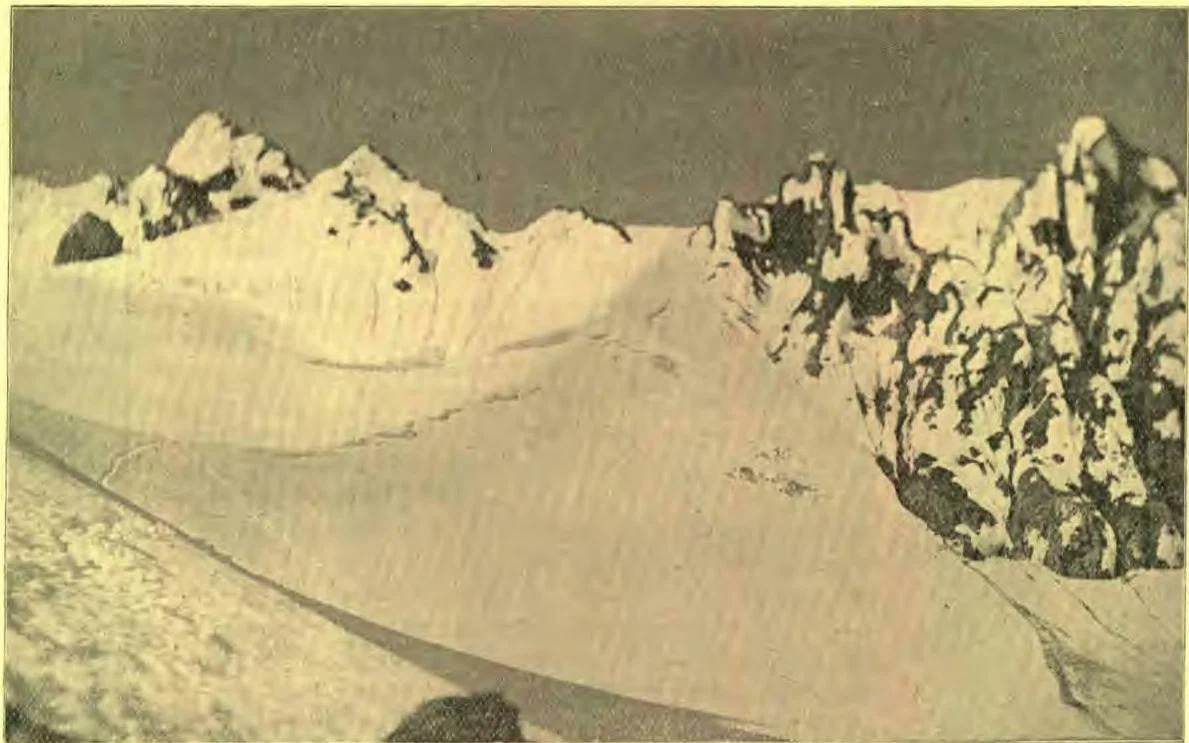
THE CREVASSE.
Mt. Hood owes its fame more to its situation, and its slender, graceful outline, than to its height. Standing almost on the banks of the mighty Columbia, about sixty miles east of Portland, Ore., it looks down on the vast plains of eastern Oregon on one side and the mighty Pacific Ocean on the other.
Geologists tell us that, ages ago, Mt. Hood was much higher than it is at the present time, the top and one side of the mountain having been blown off by a volcanic explosion. The explosion left the crater about two thousand feet below the summit, on the south side of the mountain, where it is now found. This theory is undoubtedly correct, but we know that geological ages do not cover as many years as so-called science often teaches. Before the flood there were no volcanoes, and God has told us quite definitely when the flood occurred. We may, therefore, safely conclude that the explosion that reduced the height of Mt. Hood was of comparatively recent date.
The ascent of Mt. Hood is not usually considered either difficult or dangerous; but one unaccustomed to mountain climbing may find it both. Scores of persons climb to its summit each year; and whenever an accident has occurred, it has been because of the reckless daring of some one whose courage was greater than either his caution or experience.
It was principally a desire to do something unusual that led the writer and another young man to climb Mt. Hood, and spend a night on the summit. Years before, a guide had been compelled to remain on the summit overnight, with the result that he came near losing his life; but we thought we were prepared for the ordeal, and had no fear for the outcome.
Early one July morning we left our camp at timber line on the south side of the mountain, and began to tramp up over the snow fields. We carried two pairs of blankets, a mackintosh, a camera, a large canteen of water, and a generous lunch. That made a rather heavy load for amateur mountaineers; but we took our time, and reached the crater without difficulty, a little before noon. Here we took a short rest, and ate a lunch before continuing the ascent to the summit. One crevasse, and only one, blocked our way. By making a long detour to the left, we were able to cross this on an ice bridge.
The photograph here reproduced shows this crevasse at the end of the long ridge of snow. It was taken from the crater, looking toward the summit.
Beyond the crevasse we struggled, step by step, up the steep banks of ice and snow, until about three o’clock, when we reached the very top. The last part of the ascent was hard work. We were sheltered from the wind, but not from the sun, so the climb was almost like taking a Turkish bath. On the summit we were greeted by a strong wind, so bitterly cold that it chilled us in a moment, and effectually took away our appetite for scenery. We accordingly lost no time in searching out a sheltered spot, and at once began to dig a cave in the snow.
The spot selected for our Eskimo house was on the north side of the peak, where an almost perpendicular wall of snow reached from a narrow shelf of rock to the very top of the mountain. The entrance to our cave was perhaps ten or twelve feet from the actual summit. We dug through about a foot of snow, and then struck solid ice. In this the round, blunt points of our alpenstocks made little impression, and it was nearly sundown before we finished the cave, which was long enough to sleep in, high enough to stretch in, and wide enough for two to lie side by side. Of course we expected to sleep. Eskimos sleep in snow houses. Why shouldn’t we?
We spread the mackintosh on the floor, and on top of this laid one pair of blankets, reserving the other for covering. Then we partly blocked the entrance of our snug little cave, and went out to see the sunset.
A few clouds were drifting about in the mountains below; but in the distant west the sky was clear. For a moment we caught the reflection of the sun’s parting rays on the restless waters of the distant Pacific; then twilight fell. Twilight lingers a long time on the mountain tops; so for more than an hour we stood in a sheltered nook out toward the western extremity of the summit, and gazed on the scene spread out before us. We saw the lights of Portland and the gleam of an occasional campfire, but the clouds grew thicker and blacker until we could see nothing but a dark, rolling mass of vapor. The wind had redoubled its fury, until it was no longer possible to stand against it. We crawled back to the cave, blockaded the entrance so as to leave only a small airhole, and prepared to—shiver.
We slept very little that night. Long before morning we had doubled up the second pair of blankets to put under us, in a vain endeavor to keep down the terrible cold. We mutually agreed that Eskimos have more than a mackintosh42and two pairs of blankets to sleep on when they make their bed on a floor of ice.
All things have their end; and when morning came, there ended one of the most miserable nights the writer ever spent. But despite our night of suffering, we were able to appreciate the beauty of the glorious sunrise. No pen can describe the rich and varied tints of crimson and gold scattered lavishly upon the dark clouds hiding the earth from view.
We were so numb and stiff from the cold that we dared not attempt the descent until after eleven o’clock, when the sun had softened the crust of the snow sufficiently for us to pierce it with our alpenstocks. Even then we proceeded with great caution, until we had safely crossed the crevasse. Then all caution was thrown to the winds, and we went down with long strides, sometimes venturing a short glissade.
Below the crater we found a homemade toboggan, which some one had left on the rocks. It was a rough affair, but we thought it would be a time-saver in the descent, and this it certainly proved. It carried us from the crater to within a few rods of our camp,—a distance of three miles,—in so short a time that it is scarcely worth mentioning.
When we looked back at the peak, it was covered with clouds. We had descended just in time, and were heartily glad that our novel, and not altogether unenjoyable, adventure was over. J. EDGAR ROSS.