Ten thousand cattle from Olancho were on their way to the coast when we left Jutigalpa, and yet there seemed to be plenty left.
Everywhere the guava bushes, almost trees, were hanging heavy with fruit. Outwardly the guava resembles the apple, but the greenish skin is separated from the seeds by only a thin layer of pulp. The inner part, a pink mass of soft seeds and pulp, is delicately flavored, and makes a delicious jelly, much loved by the Spanish palate, though we saw none made in Honduras, the delicacy being imported from Cuba. The guava shrubs spread out their branches, giving shade for the cattle, which eat all the fruit they can reach.
The valleys—veritable parks, these valleys!—are covered with a short grass, which has the appearance of being neatly shaven by a lawn-mower. There is just enough roll in the prairie to suggest spots in Central Park, New York, or Washington Park, Chicago; but one looks in vain for graveled walks, stone pavements, or the haze of a city's smoke overhead. These are God's parks. No human hand has planted the shrubs, builded the mountains that rise on either hand, or directed the streams that dash, in ribbons of foam, down their rocky sides.
Sometimes travelers are met, always mounted on mules or horses, and always greeting us with a hearty, Buenos dias. Usually a moso, or footman, leads the caravan, the pack-mule following, with two cowhide trunks balanced high, one on either side of the pack-saddle. Then comes the señora, mounted on a saddle with a back-rest—the palace-car of Honduras. She is dressed in a long riding habit, and carries a large parasol, the well-trained mule following the trail without much attention from the rider. In fact, there is a perfect division of labor between the mule and its rider,—the mule keeping the trail and its footing, while the rider gives her attention to keeping her seat and avoiding overhanging branches.
The men in the party are provided with machetes slung in sheaths at the belt, and balanced with heavy revolvers. These strong native knives are useful in cutting away overhanging branches and vines, which might otherwise brush one from the saddle.
One hot day we met a woman carrying a monkey on her lap: both chatted pleasantly, and then passed on. At another time a mail-carrier with a week's accumulated correspondence of the third city in the republic, done up in a packet about as large as a music roll, overtook us, and kept us company for several hours. His blue hatband (blue and white are the colors of the republic) bore the words, in letters of white, “Correos de Honduras.” His cotton trousers were rolled above the calves of his dark-skinned legs. Leather sandals were fastened with thongs to his feet. He had a springing step, which he kept up all day. In the afternoon he quickened his pace, and left us, with our mules, two leagues behind.
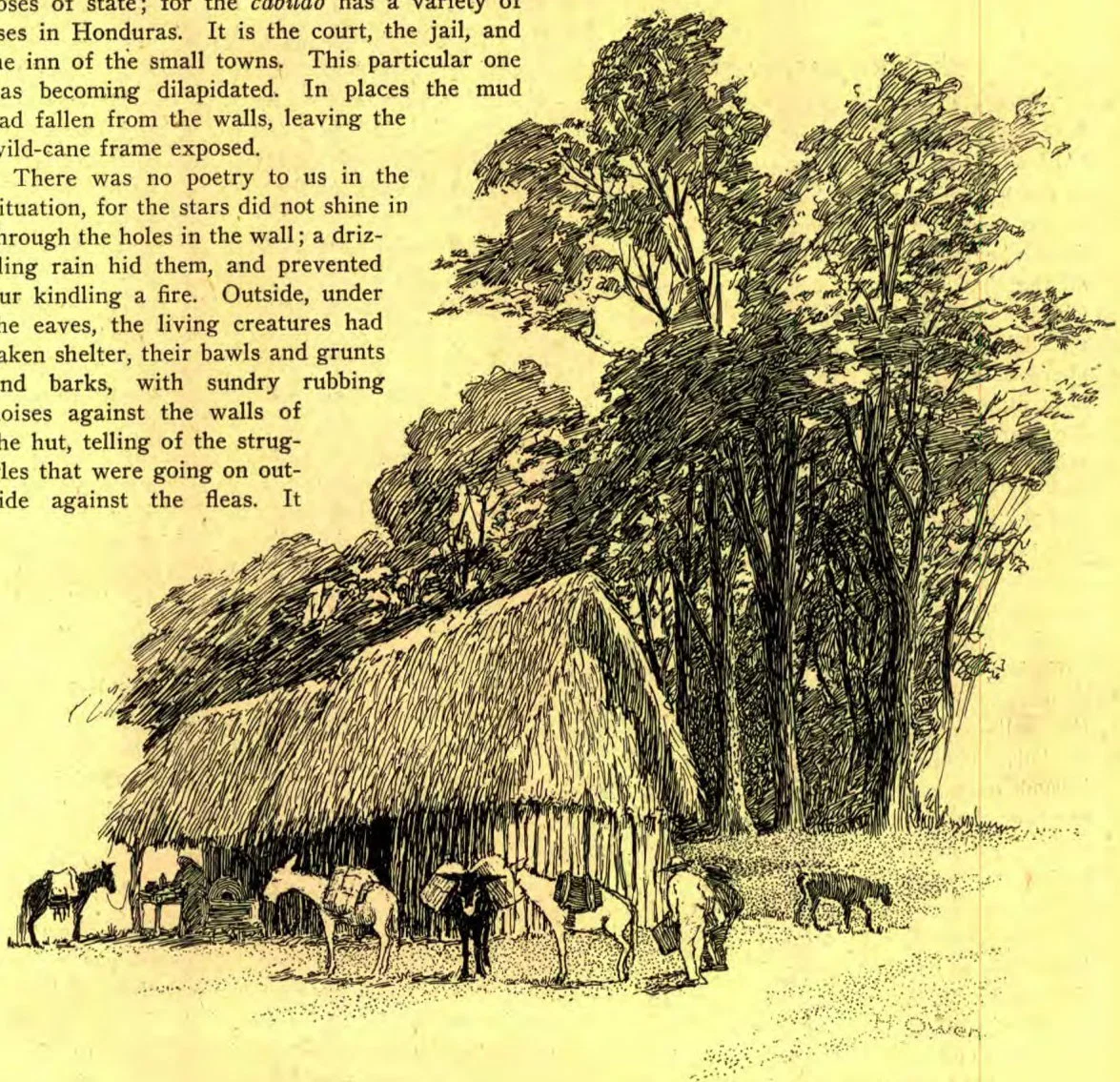
A THATCHED HUT. THE PACK-MULES ARE A PART OF OUR CARAVAN
At night we came to a village of mud huts, with thatched roofs, and were shown to the cabildo by the villagers. Several calves, which had settled for the night, reluctantly gave up their places for us; and we made our beds on the large cedar tables that had served the purposes of state; for the cabildo has a variety of uses in Honduras. It is the court, the jail, and the inn of the small towns. This particular one was becoming dilapidated. In places the mud had fallen from the walls, leaving the wild-cane frame exposed.
There was no poetry to us in the situation, for the stars did not shine in through the holes in the wall; a drizzling rain hid them, and prevented our kindling a fire. Outside, under the eaves, the living creatures had taken shelter, their bawls and grunts and barks, with sundry rubbing noises against the walls of the hut, telling of the struggles that were going on outside against the fleas. It was nearly morning before the trouble ceased, and we could distinguish the sound of the rain upon the roof—a noise that is not a patter, as the thatch deadens the sound of the falling drops.
Morning is always welcome to travelers in Central America; and the change from night to day comes more quickly than it does farther north. For breakfast the village afforded a few eggs and some sel-sel—a vegetable preparation, done up in leaves, which will defy the most ravenous appetite. We tried roasting it, but the change was not for the better.
Breakfast over, we took to our saddles. Occasionally Indians would pass, loaded with pelts, and carrying long blow-pipes. The women had the burden of their babies added to that of their packs; but Honduras is not a populous country, and many a league of uninterrupted wilderness was passed, where the sign of human habitation, no matter how humble, would have been welcome indeed.
We often forget that all nations of the earth are “of one blood;” but let one travel through the wilds of a strange country till night falls; let him watch the unfamiliar stars come out in the unfamiliar heavens, and see the light of the moon streaming down through trees of strange form; let him hear the sound of the coyote calling to his mate, and the half-human voice of the baboon filling the air with a babel of sound—and he will be prepared to welcome as streaming from the windows of those near of kin the uncertain gleams of light coming through the pole walls of a native hut. The sound of hands shaping tortillas, and of voices bidding us welcome in Hondurasian Spanish, are like music in our ears; and the dark-skinned faces of our host and hostess appear little darker than our own by the light of the fogong. Truly, we are all brethren.