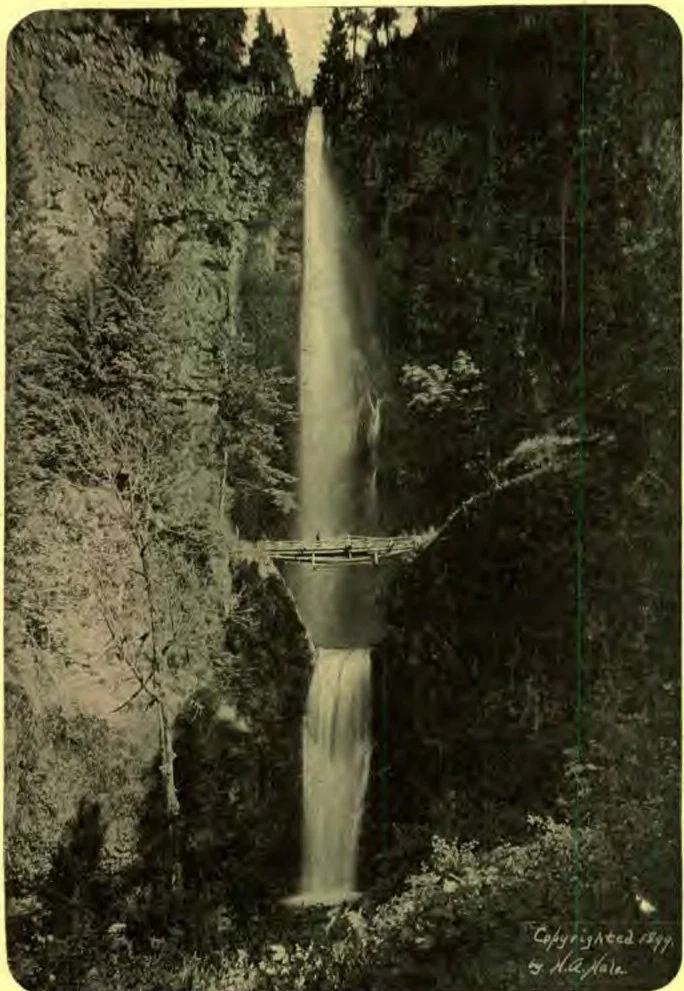
Copyright, 1899, by H. A. Hale, Portland, Ore.
MULTNOMAH FALLS
ISLANDS are formed in several ways, and if large, are generally looked upon as fairly permanent features of the earth’s surface; but occasionally they disappear, and we are surprised at the history their destruction reveals. One such island, upon which I played when a boy, had no appearance of being otherwise than a part of the mainland around which the water had worked its way; but the truth was revealed when the soil was removed, and the core of the island proved to be a stranded tree. It was clear that a very long time ago some great freshet had uprooted and carried down-stream a large tree, and that it had lodged at some shallow spot. No sooner was it an obstruction to the free flowing of the water, than it began catching drifting material; and this, securely lodged, was an additional check to the progress of anything floating. Such a barrier soon begins to collect sand about it, and the growth of an island is then begun. In the sand lodge seeds of water-plants, and these rank growths, if submerged species, check the current, and cause floating particles to sink; and later, taller plants, like wild rice, spatterdock, and arrow-head, take root and flourish. Thus, in various ways, the soil is accumulated, or, as I have said, the island grows. Then the seed of some tree lodges, and a maple, a willow, or a water-birch takes root. Dry land is made at last; grass starts, and the birds frequent the58spot. It may be the work of a few years, or of many, for this is the history of some of the islands in our rivers and creeks. Perhaps we never think of this when walking about, and that is where we make a grave mistake. No matter what the character of the locality, it is always well to keep our eyes open, that we may the better understand its present condition. The island of which I have told gave no clue as to why it was an island and not a bit of the surrounding meadow; but this is no reason for wondering why it was here at all.
That my play-day island, now no more, was very old, as we count years, was shown by the fact that close to the level of the water were found pretty flint arrow-heads and pieces of Indian pottery. Here was a pretty chapter of the island’s history. When but a sand-bar, bare perhaps at low tide only, Indians came here, perhaps to fish, or to lie in wait for passing water-fowl; but here they came, and what they left behind clearly proves that the old tree was the foundation of the new land long before the white man came to this country.
Wherever there is a little brook, the story of the making and unmaking of islands is told. It is never necessary to travel to the ends of the earth to learn about a great many interesting things that are going on outdoors. The familiar incidents about our doorsteps are never to be despised. A cat in the grass can tell as much as a tiger in the jungle.—Charles C. Abbott, M. D., in St. Nicholas.